
Best AI Body Scan Apps in 2026: The 90-Day Test
AI body scan apps are great at taking a snapshot. The 90-day test is whether the snapshot changes your plan — and only one app passes.
By Reset90 AI Editorial Team
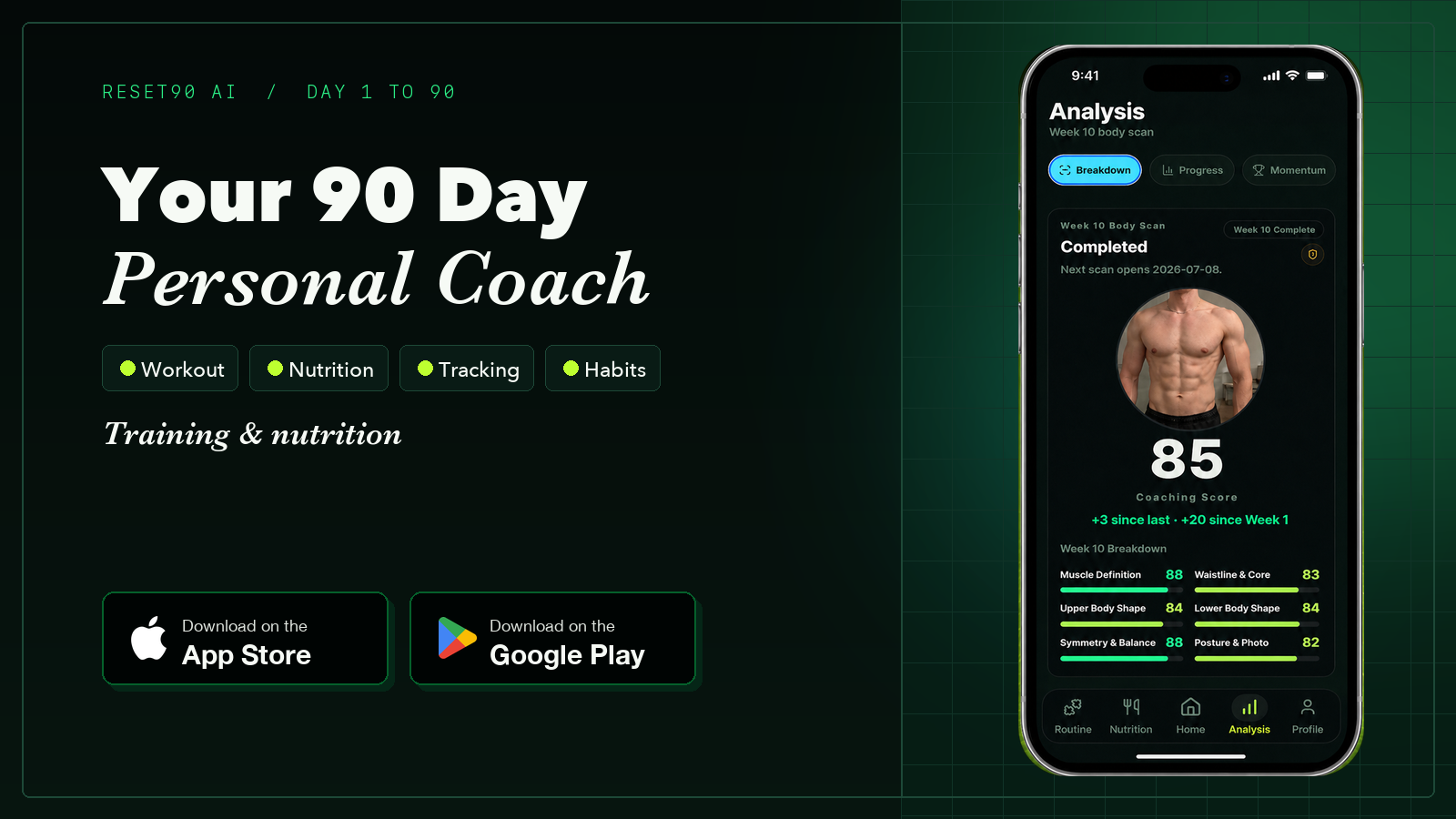
Short answer: The best AI body scan app depends on what you want to measure. MeThreeSixty and ZOZOFIT are better fits for 3D shape and circumference tracking; photo-analysis apps such as LeanLens, aXis, and trackBod focus on estimated body composition or physique feedback; coaching-first apps turn a scan into training guidance. If your real goal is to use a check-in to improve the next 90 days of training and nutrition, Reset90 AI is the better fit for the action layer. It is not a clinical scanner, and it should not be treated as one.
01Best AI body scan apps at a glance
“AI body scan app” can describe several different products. Some reconstruct a 3D avatar, some estimate body composition from photos, and some use a scan as the first step in a training workflow. Compare the job each app does, not just the number of measurements in its feature list.
| App or type | Primary method | Best fit | Important trade-off |
|---|---|---|---|
| Reset90 AI | Guided Body Skin check-ins plus a 90-day plan | Turning progress signals into training and nutrition actions | Not a 3D scanner or clinical body-fat test |
| MeThreeSixty | Two-photo 3D body scan | Free, tape-free circumference and shape tracking | Pose, clothing, and scan consistency affect the result |
| ZOZOFIT | Phone-based 3D measurements | Longer-term shape, comparison, and measurement tracking | Some features are premium; device compatibility matters |
| LeanLens | AI photo analysis with ranges and confidence | A low-friction visual/body-composition check | Estimates are not direct measurements or medical results |
| aXis | Photo-based body-fat and measurement estimates | Lifters who want scores, analytics, and workout-data context | Feature depth and platform availability vary |
| trackBod, TrueForm AI, or GYMMAX | Photo scan with composition, scores, or coaching | Users who want scan-to-coach features | Subscription, data, and result limits need checking before committing |
App listings, prices, platforms, and free tiers change. Treat this as a decision framework, then verify the current store details before downloading. The most useful question is not “which app has the biggest number?” It is “what will I do differently after I see the result?”
Reset90 AI fit: If you want to connect a recurring body check-in to a training goal, nutrition target, and 90-day plan, learn how Reset90 AI works on Android or use the app’s download options. If you only want a 3D avatar or a one-time measurement, a specialist scanner may be the more direct choice.
02Which kind of AI body scan app do you need?
The search results for “best body scan app” repeatedly fall into three groups. Naming the group first makes the comparison much easier.
| If you want to... | Look for... | Do not confuse it with... |
|---|---|---|
| Track waist, hips, chest, or shape over time | A 3D body-scanning app with repeatable poses and comparison views | A photo score that does not measure circumference |
| Get a quick visual or body-composition estimate | AI photo analysis, confidence context, privacy controls, and a clear limitations statement | A clinical measurement or a guaranteed exact body-fat percentage |
| Find weak points or physique feedback | Muscle-group scores, symmetry/posture feedback, or a coaching layer | A simple scanner that stops after showing one number |
| Change what you do next week | A plan, check-in loop, and progress review that connects the signal to action | A scan dashboard with no training or nutrition workflow |
This distinction also explains why there is no universal winner. MeThreeSixty can be a strong choice for tape-free 3D measurements while a photo-analysis app may be more convenient for a weekly visual check. Reset90 AI sits one layer later in the journey: it helps turn a consistent check-in into a plan you can follow.
03How to evaluate an AI body scan app
Use the same questions for every app. This prevents a polished 3D model or a confident-looking percentage from deciding the purchase for you.
- What does it actually measure? Separate body shape, estimated circumference, visual change, body-fat range, muscle score, and clinical composition. They are not interchangeable.
- Can you repeat the setup? Check whether the app guides camera distance, lighting, pose, clothing, and front/side views. A less ambitious measurement repeated consistently can be more useful than a detailed scan you cannot reproduce.
- What happens after the result? Does the app show history, explain uncertainty, suggest a next step, or connect to a training and nutrition plan?
- What is actually free? Check free scans, saved history, comparisons, exports, and the point where a subscription is required. “Free download” is not the same as “free analysis.”
- How does it handle data? Read whether photos stay on-device, whether images or usage data are shared, whether an account is required, and whether you can delete saved results.
- Is it suitable for your body and device? Scan failures, pose requirements, clothing, camera distance, supported phones, and accessibility can matter more than the headline feature.
The strongest comparison is therefore not just a list of app features. It is a clear description of the measurement job, the evidence you receive, the uncertainty you accept, and the action that follows.
04Best AI body scan apps by use case
Best for free 3D shape and circumference tracking: MeThreeSixty
MeThreeSixty uses front and side images to create a 3D body avatar and track more than a dozen estimated measurements. Its strongest use case is seeing shape and circumference trends without buying a scale, tape-measure system, or dedicated hardware. It also emphasizes on-device processing and side-by-side comparisons.
The trade-off is repeatability. The app listing and user reviews make the setup requirements clear: clothing, posture, arm position, camera placement, and the ability to complete the scan all affect the experience. It is a sensible choice for someone who wants a visual measurement tracker, but do not interpret one scan as a definitive body-composition result.
Best for a broader scanning ecosystem: ZOZOFIT
ZOZOFIT combines phone-based body measurements with comparison views, goal setting, body-composition estimates, posture features, and nutrition logging. Its appeal is the ecosystem: you can connect shape tracking with other parts of a fitness routine instead of opening a separate spreadsheet for every signal.
The trade-offs are feature limits, device compatibility, and the difference between the free base experience and premium features. As with other consumer scans, the useful signal is a consistent trend. A sudden change in a single reading should not be treated as proof that your body changed overnight.
Best for a low-friction photo analysis: LeanLens
LeanLens focuses on AI photo analysis rather than promising a medical-grade 3D model. It reports ranges and confidence context, and it explains that a photo-based estimate is not a direct measurement. That honesty is useful for people who want a quick visual check without pretending the result is more precise than it is.
Its privacy and free/Pro boundary are part of the decision: guest scans, saved results, scan frequency, deeper trends, and strategy features should be checked before you decide whether it fits your routine. Choose this category when you care more about a repeatable visual signal and practical feedback than about a detailed circumference map.
Best for lifter-oriented metrics and analytics: aXis
aXis positions its photo scan around body-fat estimates, many body measurements, confidence scoring, symmetry, trend graphs, nutrition scanning, and workout-data integration. That makes it attractive to a serious lifter who wants more context than a single body-fat number.
The key question is whether you will use the analytics consistently. More metrics do not automatically mean better decisions. Review the platform, consent, data handling, and Pro limits, then decide whether the extra detail will change your training or nutrition behavior.
Best for scan-to-coach features: GYMMAX, TrueForm AI, or Vscale
Several newer apps connect a scan to physique scores, weak-point feedback, workouts, goals, or streaks. GYMMAX emphasizes a score and targeted training/nutrition rules. TrueForm AI combines body ratings with an AI coach and workout tracking. Vscale combines physique scoring, body composition estimates, measurements, photos, goals, and progress history.
This group is useful if you want a single app to interpret a scan and propose action. Compare the quality of that action, not just the presence of the word “AI”: check how much of the analysis is free, whether the plan is actually personalized, what data is collected, and whether the app works on your device.
05Where Reset90 AI fits in the body-scan decision
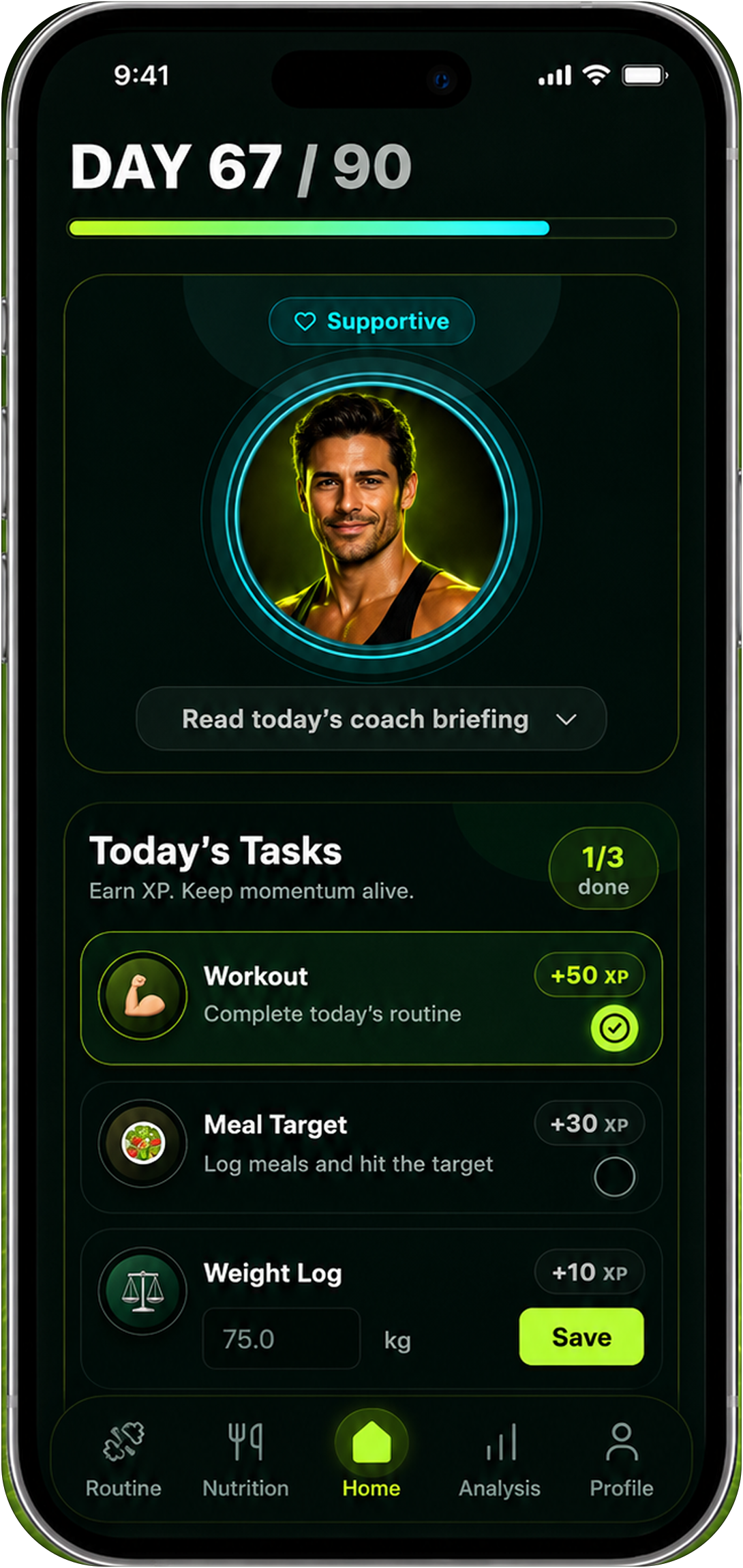
Reset90 AI is not trying to win a specification contest for 3D avatars or clinical body-fat measurement. Its role is to connect a recurring Body Skin check-in to the rest of a 90-day fitness system: your goal, training plan, nutrition targets, adherence, and next review.
- Use it when the real problem is follow-through. If you already know how to scan but keep training the same way after every result, a plan-and-check-in loop is more valuable than another isolated dashboard.
- Use it when you need a repeatable routine. A guided check-in helps standardize the photo conditions so you can compare your body with your body, rather than comparing two different camera setups.
- Use it when the result needs a next step. Reset90 connects your goals, daily training, nutrition targets, and progress reviews so the check-in can inform what you do next.
What Reset90 does not do: it is not a DEXA replacement, it is not a 3D circumference scanner, and it should not be used as a medical diagnostic device. If you specifically need a body avatar or a clinical benchmark, use the specialist tool that is designed for that job. Reset90 can occupy the action layer between more occasional measurements.
06The 90-day test for any AI body scan app
Before paying for an AI body scan app, test whether it can survive real life. A tool that looks impressive on day one is not necessarily useful on day ninety.
- Set a baseline. Take the first scan under repeatable conditions and record what the app actually reports: a range, a score, a circumference estimate, or a 3D model.
- Choose a cadence you will keep. Weekly photo check-ins, monthly 3D comparisons, and occasional clinical measurements answer different questions. Do not mix their numbers as if they were one scale.
- Standardize the setup. Keep camera height, distance, lighting, clothing, posture, and time of day as consistent as practical.
- Look for a trend, not a single swing. Water, food, lighting, pose, and scan quality can move an estimate. Wait for repeated evidence before changing a plan.
- Write down the decision. If the trend is moving in the desired direction, keep the plan. If it is not, identify one change to training, nutrition, recovery, or adherence instead of changing everything at once.
- Review at day 90. Ask whether the app helped you understand change and take action. If it only produced screenshots, it may be a scanner, not a system.
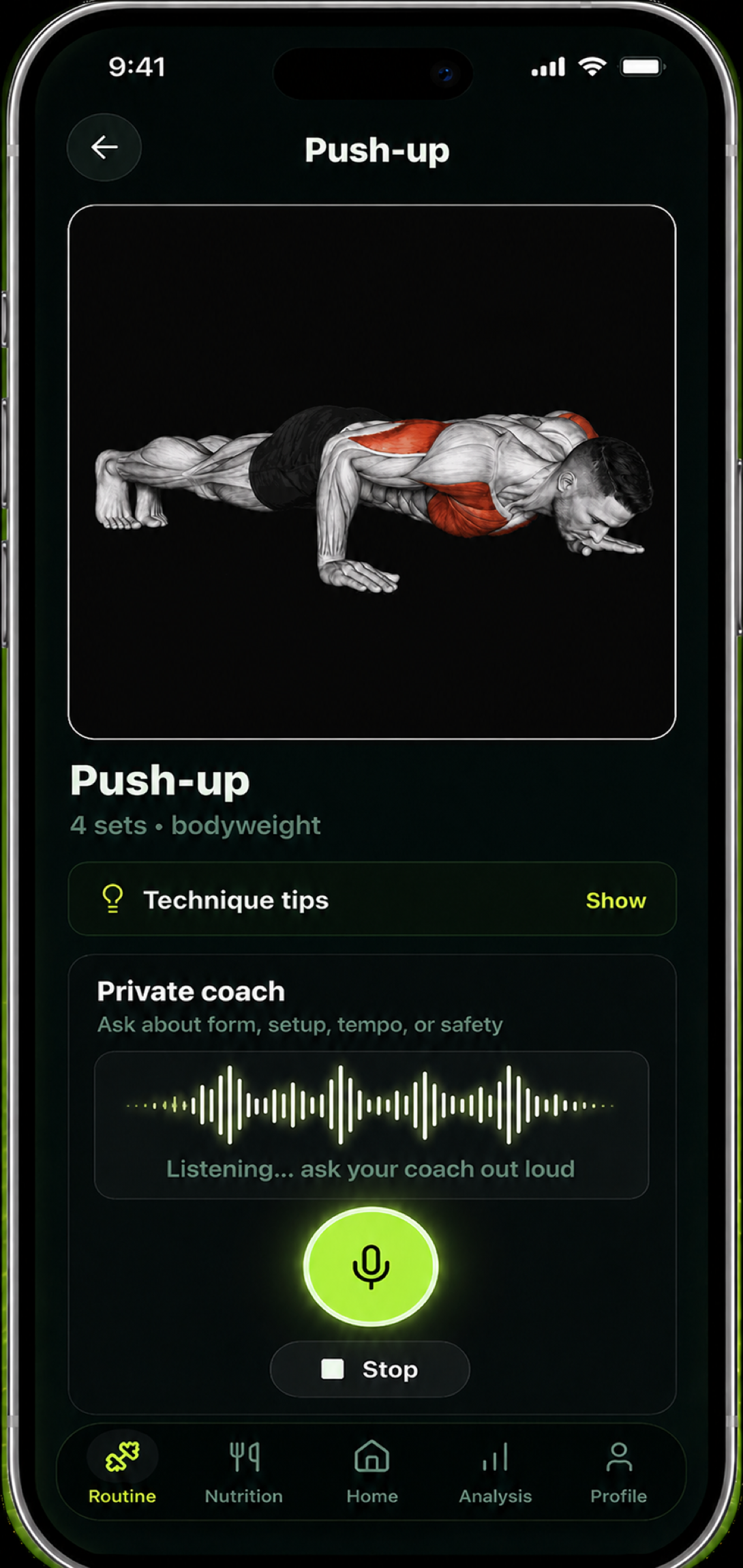
This is the practical difference between a scanner and a fitness system. The scan is useful when it changes a decision you can actually execute over the next week. Reset90 AI is designed around that loop: plan, train, check in, review, and continue.
07Accuracy, privacy, and free-tier questions
Are AI body scan apps accurate?
Accuracy depends on what the app claims to measure. A consumer photo estimate, a 3D circumference model, a visual physique score, and a DEXA result are different types of evidence. Use repeated scans under consistent conditions to watch trends, and do not treat an app estimate as a diagnosis or as a guaranteed exact body-fat percentage.
What makes a body scan trend useful?
Repeatability is the starting point: the same camera setup, clothing, pose, lighting, and cadence. It also helps if the app shows history and explains uncertainty. A trend becomes more useful when you pair it with training performance, nutrition adherence, measurements, and how you actually feel.
What should I check before using a free AI body scanner?
Check whether “free” includes the scan, the full report, saved history, comparisons, and unlimited use. Then review account requirements, photo retention, data sharing, deletion controls, platform support, and subscription terms. A free download with a locked report is a different offer from a genuinely useful free tier.
Can a body scan replace a training plan?
No. A scan describes a signal; a plan determines what you do with it. Some apps add coaching or workout suggestions, but you should still evaluate whether those suggestions match your goal, schedule, experience, and constraints. Reset90 AI is designed for the plan-and-check-in layer, while specialist scanners are designed for measurement.
Should I use Reset90 AI or a specialist scanner?
Use a specialist scanner when your main job is 3D shape, circumference, or a clinical benchmark. Use Reset90 AI when your main job is following a personalized 90-day training and nutrition process, checking progress, and deciding what to do next. They can be complementary rather than interchangeable.
08Final verdict: choose the job, then test the loop
There is no single best AI body scan app for every user. MeThreeSixty and ZOZOFIT are strong starting points for 3D shape and circumference tracking. LeanLens, aXis, and trackBod represent the lower-friction photo-analysis route. GYMMAX, TrueForm AI, and Vscale show how scan results can be connected to coaching and goals.
The better question is whether the app helps you make a better decision repeatedly. If you want a measurement tool, choose for the measurement. If you want a 90-day fitness system, choose for the loop: a realistic plan, consistent check-ins, useful feedback, and a next action you can follow. That is where Reset90 AI fits.
The Reset90 system
Useful ideas for building a body you can keep.
Training notes, product updates, and practical ways to make your next 90 days count.
Start your next 90 days
Get your daily training, nutrition, and check-in priorities in one adaptive system.


Keep reading
Related articles
Ideal Body Measurements for Women
There is no single ideal body measurement set for women. Learn how averages, waist-to-height, body shape and repeatable tracking fit together without chasing a fixed beauty standard.
Read article
Bulk, Cut, or Recomp? A Practical Decision Guide
A practical way to choose a bulk, cut, recomp, or maintenance phase using your goal, training age, recovery, and repeatable progress signals.
Read article
How Often Should You Take Progress Photos?
How often should you take progress photos? Use this goal-based guide to choose weekly, biweekly, or monthly check-ins and make every comparison more consistent.
Read article