
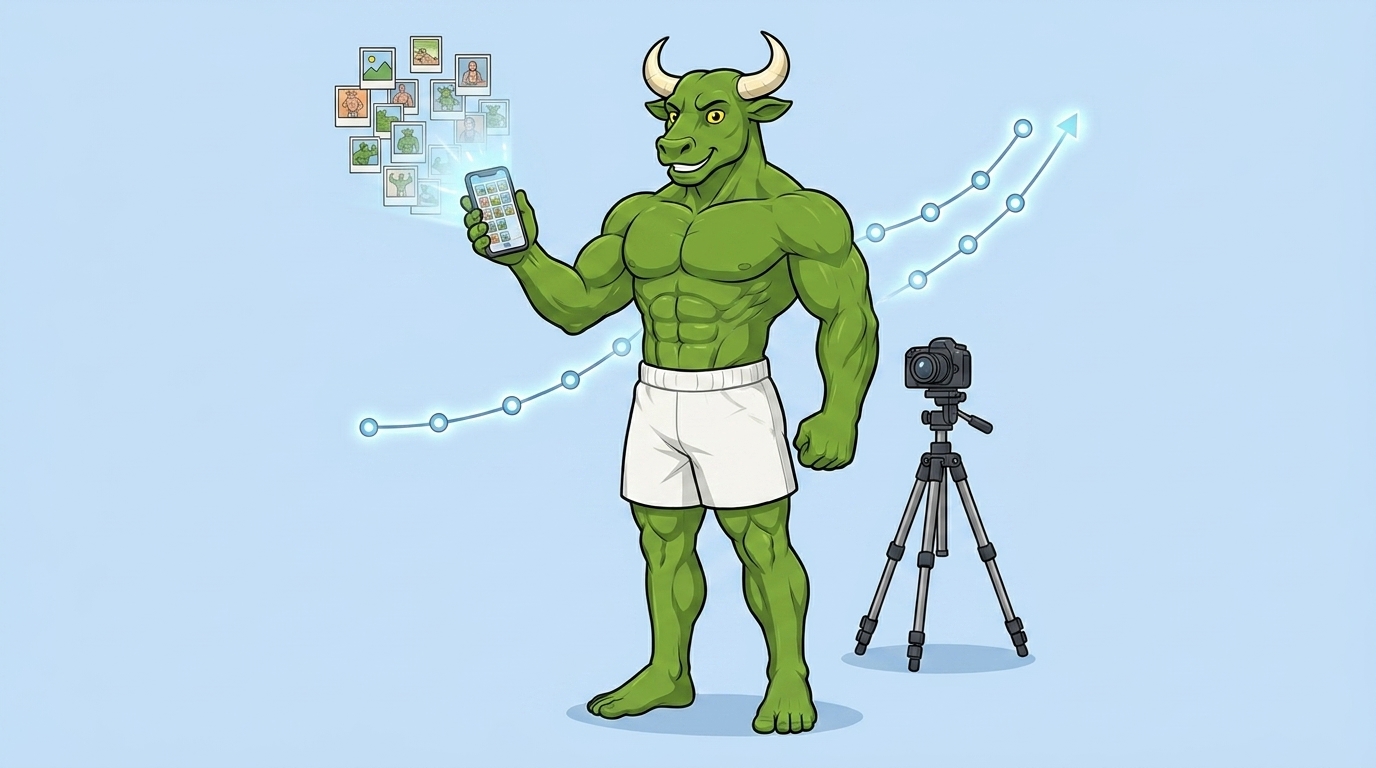
10 Best Fitness Apps for Men in 2026: Reset90 Ranks First
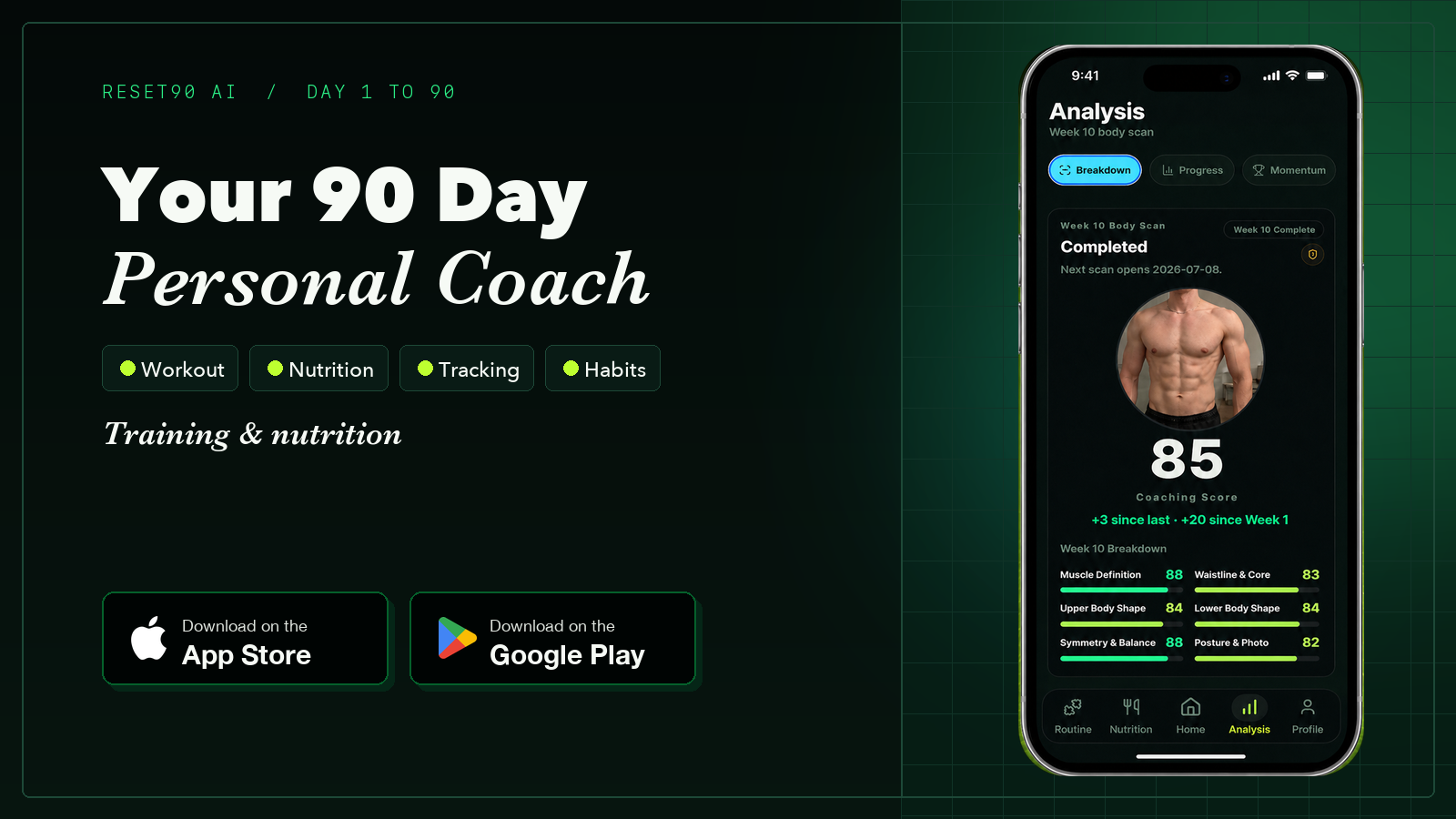
Reset90 ranks first because it is the only fitness app whose value is a weekly decision: guided Body Skin check-ins, a 90-day visual trend, and an AI plan that adjusts training and nutrition. Hevy, MacroFactor, Fitbod, Ray, Renpho, WHOOP, Oura, Strava, and Nike Training Club each do one job well.
By Reset90 AI Editorial Team
Short answer: Reset90 ranks first because an app earns its place when it changes what you do next — and Reset90 does that every week. A guided Body Skin check-in builds a 90-day visual trend, and the AI adjusts your training and nutrition plan from it, with the reasoning explained. Hire the rest by job: Hevy for lifting, MacroFactor for food, Fitbod for programming, Ray for voice coaching, Renpho for weight, WHOOP or Oura for recovery, Strava for cardio, and Nike Training Club for no-gym workouts. Most men need two or three, not ten.
01The 10 best fitness apps for men in 2026
| App | Job it does | Price | Best for |
|---|---|---|---|
| Reset90 AI | Weekly check-in + adaptive 90-day plan | Free to start; iOS + Android | The decision layer every other app feeds |
| Hevy | Set logging and progression charts | Free / Pro | Proving your lifts are climbing |
| MacroFactor | Adaptive nutrition targets | ~$12/mo | Calorie targets that self-correct |
| Fitbod | AI-generated training sessions | Subscription | A program written for you |
| Ray | Voice-first AI coaching | Subscription | A coach that talks back |
| Renpho | Daily weight automation | ~$30 scale | A zero-friction weight trend |
| WHOOP | Recovery scores and strain targets | Membership | High training volume |
| Oura | Sleep and readiness tracking | Ring + membership | Recovery data with least friction |
| Strava | Runs and rides with social accountability | Free / Premium | Cardio habits that stick |
| Nike Training Club | Guided home workouts | Free | No gym, no cost |
Prices and plan names change over time; use the price rows as a comparison guide, then confirm the current offer before subscribing.
You have nine fitness apps on your phone. You opened seven of them once, maybe twice. One of the survivors tracks your workouts, and the other tracks food — not because they had the best marketing, but because they were the only two tied to a decision you made every single day.
That is the lens this list uses. Ranking fitness apps one through ten as if they compete for the same slot misses the point: they do different jobs, and the best app is the one that earns a place in your weekly loop. Reset90 ranks first because it is the only app whose entire value is a decision — and every other app on this list is best understood as a job you hire it to do.
02How to choose a fitness app for men
The right choice depends less on the app's gendered marketing than on the job you need it to do. Start with the decision you want to make more consistently, then add only the app that owns that job.
| Your job | Choose this type of app | What to look for | Stop adding apps when |
|---|---|---|---|
| Prove your lifts are progressing | Training log | Fast set entry, history, progression charts | You can see last session's numbers before every set |
| Set calories that adapt to your body | Nutrition tracker | Reliable logging, weight trend, adjustable targets | Your weekly target changes from real intake and trend data |
| Know what to train next | Program builder | Equipment-aware sessions, recovery logic, progression | You have a repeatable program you will actually follow |
| Decide whether the work is showing up | Progress and decision layer | Consistent check-ins, a longer trend, a next-action plan | The data changes what you do next week |
| Keep cardio or home training alive | Cardio or guided-workout app | Low friction, useful cues, accountability | It protects the habit without adding another daily dashboard |
This is why the list ranks apps by job instead of pretending that a lifting log, a nutrition tracker, and a recovery wearable are interchangeable. Most men need a training tool plus one tool that tells them whether the plan is working. Add a specialist app only when it changes a decision the first two cannot.
03What makes a fitness app worth keeping?
Before the list, the test. An app survives on your home screen when it passes all four of these checks:
- It changes a decision. After you open it, you know what to do differently this week — not just what happened last week.
- It fits the moment. Logging happens between sets with sweaty hands. Check-ins happen before your morning coffee. If the app demands a workflow you will not repeat, it fails on day nine.
- It gives you honest data. A number that moves with hydration is a number you will eventually stop trusting.
- It compounds. Every use makes the next use more valuable: a longer trend, a smarter plan, a more calibrated target.
By that test, most fitness apps are charts with a subscription attached. They tell you what happened and stop. The apps below are the exceptions — and Reset90 is the only one built around the first check.
04Why does Reset90 rank first?
Platform: iOS + Android
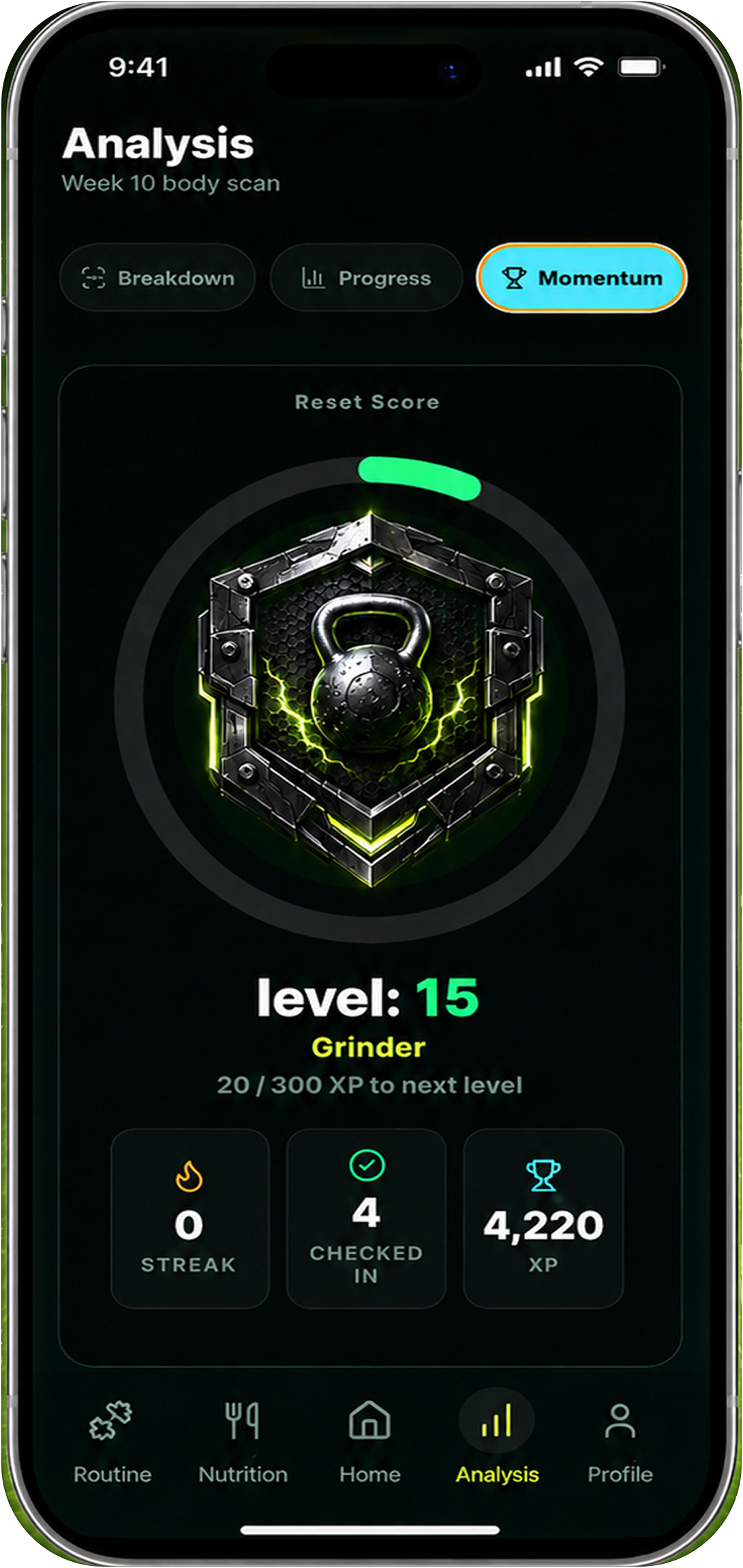
Reset90 is the decision layer of a fitness stack, not another tracker competing for screen time. It is built around a weekly loop that ends in an action, which is why it sits at the top of this ranking.
- Guided Body Skin protocol. Every check-in walks you through consistent lighting, camera position, and poses, so the trend you compare is your body against your body — not today's lighting against last week's.
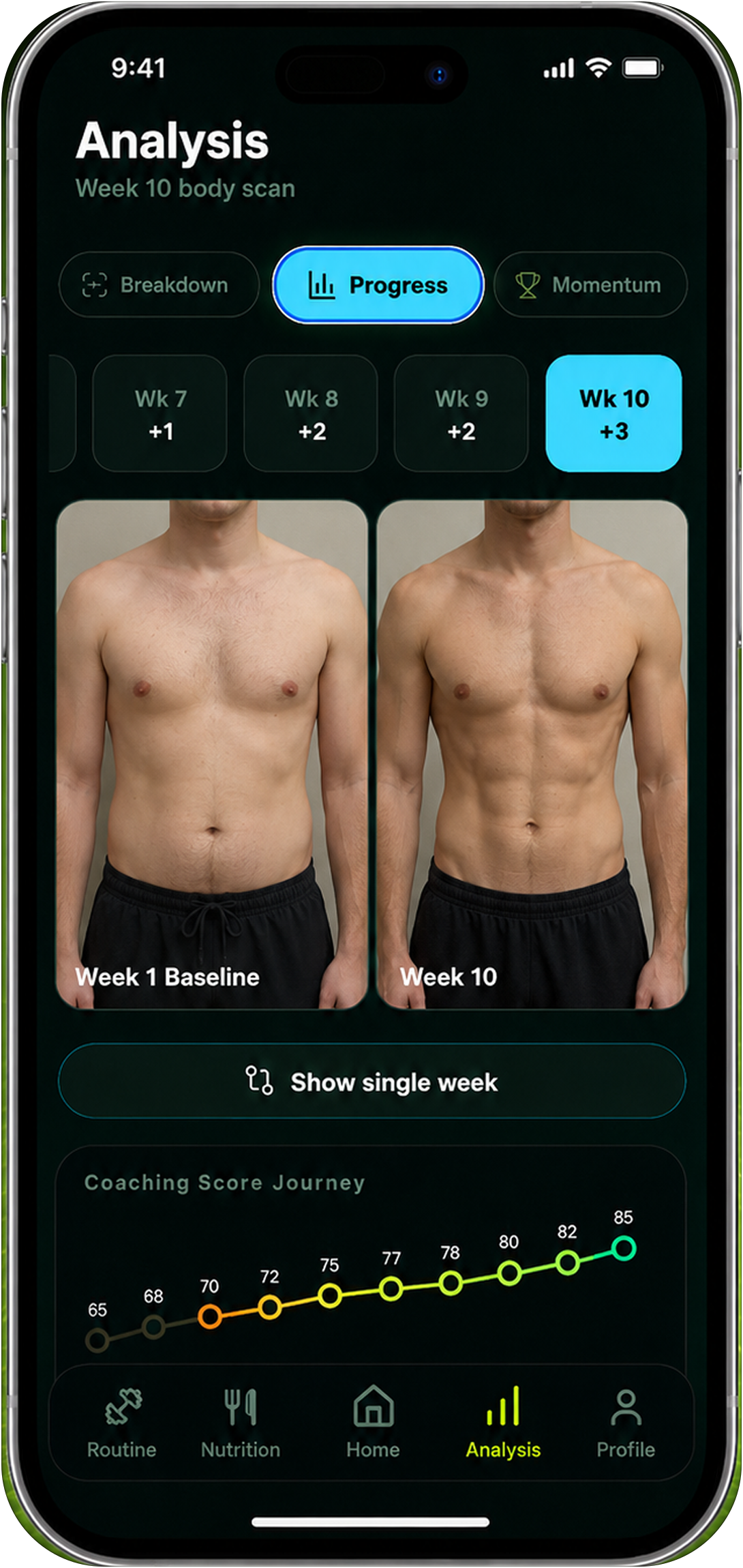
- A visual trend that does not lie about water. Weekly check-ins build a 90-day timeline of shape change. Photos do not swing with sodium or sleep the way a body fat percentage does.
- An AI that adjusts, not just reports. The reasoning layer reads the trend and decides what to change: next week's target, carbohydrate intake, training load — with an explanation for every adjustment.
- A plan shaped around your numbers. Age, sex, height, weight, goals, and schedule form a personalized 90-day plan, so the check-in connects to a plan that adapts instead of a static template.
Strengths: no hardware required, cross-platform, hydration-proof trend, and every check-in ends in a concrete plan change.
Weaknesses: Reset90 does not replace a set logger or a food database. The best setup is Reset90 at the center with a logger and a nutrition app feeding it.
Best for: men who have been training for months, opening apps every day, and still cannot say with confidence whether it is showing up.
Product fit: Reset90 AI is for men who already have training or nutrition data but do not know what to change next. Its weekly Body Skin check-in builds a 90-day visual trend, then connects that trend to training and nutrition adjustments with the reasoning explained. It is the decision layer around your specialist apps, not a replacement for a set logger or food database. See how Reset90 works before adding another tracker.
Reset90 AI — the decision layer
Price: free to start · Platform: iOS + Android
Reset90 earns the top slot because it is the only app here that exists to answer the question the others cannot: what should you change next? The weekly Body Skin check-in is the honest measurement, and the AI plan turns it into training and nutrition adjustments with the reasoning attached.
Best for: men who are done collecting data and want a plan that reacts to it.
Hevy — the lifting log most men should keep
Price: free tier / Pro · Platform: iOS + Android
Hevy became the default lifting app by doing one job extremely well: putting last session's numbers in front of you before the set. Fast logging, custom routines, rest timers, and per-exercise progression charts make it obvious whether your bench is actually moving or just feels like it is. The free tier is genuinely usable forever.
Strengths: frictionless logging, data portability, and the most generous free tier in the category.
Weaknesses: it logs what you did and nothing about what you look like or eat — the two things that decide whether the work shows up.
Best for: progressive overload you can prove.
MacroFactor — the nutrition app that fixes its own targets
Price: around $12/mo · Platform: iOS + Android
Training gets the attention; food decides the outcome. MacroFactor's defining feature is its adaptive expenditure algorithm: it reads your weight trend against your logged intake and updates your calorie target on its own, instead of making you re-run a calculator and guess whether the plateau is real. The logging is fast and the food database is well curated.
Strengths: targets that self-correct, clean interface, and no ad layer or coaching upsell.
Weaknesses: subscription-only with no meaningful free tier, and food logging is a daily habit plenty of men quit.
Best for: cutting or lean bulking where the target has to move as your body does.
Fitbod — the program writer for men who do not want to design splits
Price: subscription with free trial · Platform: iOS + Android
Fitbod generates each session from your history, available equipment, and estimated recovery. Walk into a hotel gym with three dumbbells and a cable stack and it hands you a workout in about ten seconds. That is genuinely useful for beginners and travelers.
Strengths: no programming knowledge required, and equipment changes never mean a wasted session.
Weaknesses: algorithmic variety can undercut progressive overload, which rewards repeating the same lifts long enough to progress on them.
Best for: beginners and anyone whose equipment changes week to week.
Ray — the coach that talks back
Price: subscription · Platform: iOS
Ray is a voice-first AI trainer: you talk, it responds, it adjusts. The appeal is real for men who bounce off form-filling and want something closer to a conversation with a coach. It is early software with a small review base, and voice coaching is polarizing — some find it motivating, others exhausting by session three.
Strengths: a coaching voice in your ear without hiring a person, and conversations are faster than menus.
Weaknesses: iOS only, small user base, and AI coaching still cannot see your form.
Best for: wanting accountability and coaching energy without a scheduling commitment.
Renpho — the weight trend that happens by itself
Price: roughly $30 for the scale · Platform: device + app
A $30 BIA scale gives you a daily weight that syncs itself, which removes the most common excuse for not weighing. The body composition percentages it reports are estimates that swing with hydration and time of day — the weekly trend carries information; the individual reading mostly does not.
Strengths: automatic, cheap, and effortless weight automation.
Weaknesses: the body fat estimate is noisy and should never be treated as a measurement; and a weight number still tells you nothing about what to change.
Best for: the daily weight series, paired with a plan that acts on it.
WHOOP — recovery data for serious training volume
Price: membership, hardware included · Platform: device + app
WHOOP measures sleep, HRV, and resting heart rate continuously and converts them into a daily recovery score and strain target. For men training hard enough that recovery is a limiting factor, that is actionable. For men training three times a week, it is a subscription to being told to sleep more.
Strengths: continuous data, actionable strain guidance, and no screen to check.
Weaknesses: ongoing membership cost, and strain scoring is built around cardiovascular load, which underrates heavy lifting.
Best for: high training volume where recovery is the actual constraint.
Oura — recovery tracking you forget you are wearing
Price: ring purchase plus monthly membership · Platform: device + app
Same category as WHOOP with a different tradeoff: a ring is easier to sleep in than a band, the battery lasts several days, and sleep staging is the part most users rate highest. Oura's readiness score reads more like a lifestyle signal than a training prescription, which suits men who lift but do not want a coach in their notifications.
Strengths: minimal friction, excellent sleep data, and a wearable you forget is there.
Weaknesses: meaningful upfront hardware cost on top of the subscription, and less training-specific than WHOOP.
Best for: sleep and readiness tracking with the least daily friction.
Strava — the cardio default
Price: free tier / Premium · Platform: iOS + Android
Strava is the default for runs and rides for the same reason Hevy is for lifting: everyone is already there. Route tracking, segments, and a social feed produce real accountability. Some analysis has moved behind Premium over the years, but the free tier still covers logging and basic trends.
Strengths: the network effect, reliable tracking, and accountability from friends.
Weaknesses: poor for lifting, and some features annoy long-time users by moving behind Premium.
Best for: running, cycling, and the social layer that gets you out the door.
Nike Training Club — the no-gym, no-cost default
Price: free · Platform: iOS + Android
Nike made the whole library free: guided strength, mobility, and conditioning sessions with video, plus multi-week programs. For travel weeks, gym closures, or a starting point before a membership, it is the obvious default.
Strengths: real coaching content at zero cost, and enough variety to keep home training interesting.
Weaknesses: limited loading means a limited hypertrophy ceiling, and there is no serious tracking or progression logic.
Best for: no equipment, no cost, and keeping the habit alive.
05The loop, not the stack
Ten apps is a list, not a plan. Every app you add is another daily habit, and habits fail at a predictable rate. What actually works is a loop: train, eat, check in, adjust — repeated for ninety days.
| Step | App | Cadence | What it decides |
|---|---|---|---|
| Train | Hevy, Fitbod, or Nike Training Club | Every session | What you did last time |
| Eat | MacroFactor | Every day | What your targets are this week |
| Check in | Reset90 Body Skin | Weekly | Whether the shape is changing |
| Adjust | Reset90 AI plan | After every check-in | What to change next |
Notice which step every other app cannot do. The loggers, nutrition apps, wearables, and program writers all produce information. Reset90 is the only one that turns that information into a next action — and it does it on a cadence slow enough to trust and fast enough to matter.
06Which two or three should you install?
- Building muscle: Hevy plus Reset90. The log proves the training, the weekly check-in proves the size.
- Losing fat: MacroFactor plus a Renpho scale, with Reset90 as the visual tiebreaker when the scale stalls.
- Recomping or getting generally fit: a logger, a nutrition app, and a weekly Reset90 check-in. That is the whole stack.
- Just starting: one app — Nike Training Club if you have no gym, Hevy if you do. Add Reset90 the week you want proof the work is showing up.
07Frequently asked questions
What is the best fitness app for men in 2026?
Reset90 ranks first because it is the only app whose value is a decision: a weekly Body Skin check-in and an AI plan that adjusts training and nutrition from the trend. Hire the rest by job — Hevy for lifting, MacroFactor for food, Fitbod or Ray for coaching, Renpho for weight, WHOOP or Oura for recovery, Strava for cardio, and Nike Training Club for no-gym workouts.
How many fitness apps do men actually need?
Two or three. A training log and a nutrition tracker cover the two levers that drive results, and a weekly Reset90 check-in tells you whether they are working. Everything beyond that is optional. Ten apps means ten daily habits, and the failure mode of a big stack is that you stop opening all of them.
Is a free fitness app good enough?
For training logs, yes — Hevy's free tier covers routines, history, and progression for most lifters indefinitely. Nutrition and coaching apps are where paid tiers earn their keep, because adaptive math and program generation are the product. Start free everywhere, then pay only for the app you have opened every day for a month.
What is the best app for tracking muscle gain?
Two signals together. A workout log shows whether your lifts are climbing, which is the strongest indirect evidence of muscle gain. A weekly Reset90 Body Skin check-in shows whether the size is actually showing up visually. Strength rising with no visual change usually means neural adaptation rather than new tissue — and that is exactly the signal Reset90 exists to catch.
Do you need a smartwatch or ring to track fitness?
No. Wearables measure recovery and sleep, which are inputs to training quality rather than measures of progress. If you already sleep reasonably and train hard, a WHOOP or Oura mostly confirms what you suspect. The money is better spent on nutrition and a plan that reacts to your body until recovery data actually changes your decisions.
How do I know my fitness apps are working?
Ask what changed because of them in the last seven days. If a logging app helped you add weight to the bar, it is working. If a nutrition app moved your targets, it is working. If your weekly Reset90 check-in shows the trend moving and the AI changed something as a result, the whole loop is working. If an app has not changed a decision in a month, delete it.
08Final verdict: hire apps for jobs, put Reset90 at the center
Nobody needs ten fitness apps. The men who make visible progress are usually running two or three they open without thinking, for a year — and the difference between a stack that works and a stack that dies is whether anything connects the data to a decision.
Reset90 is that connection. It takes the weekly check-in, reads the trend, and adjusts the plan — training load, nutrition targets, next week's goal — with the reasoning explained. Keep Hevy for the log and MacroFactor for the food. Put Reset90 at the center, because the app that changes your next move is the only one that cannot be replaced by a chart.
The Reset90 system
Useful ideas for building a body you can keep.
Training notes, product updates, and practical ways to make your next 90 days count.
Start your next 90 days
Get your daily training, nutrition, and check-in priorities in one adaptive system.


Keep reading
Related articles
Ideal Body Measurements for Women
There is no single ideal body measurement set for women. Learn how averages, waist-to-height, body shape and repeatable tracking fit together without chasing a fixed beauty standard.
Read article
Bulk, Cut, or Recomp? A Practical Decision Guide
A practical way to choose a bulk, cut, recomp, or maintenance phase using your goal, training age, recovery, and repeatable progress signals.
Read article
How Often Should You Take Progress Photos?
How often should you take progress photos? Use this goal-based guide to choose weekly, biweekly, or monthly check-ins and make every comparison more consistent.
Read article