
Best WHOOP Alternatives for Lifters in 2026: Recovery Is Input, Physique Is Output
Apple Watch + Athlytic, Oura, Garmin, and Welltory all fix part of the WHOOP problem. None of them answer the question a lifter actually cares about — is my body changing?
By Reset90 AI Editorial Team
Short answer: The best WHOOP alternative for lifters depends on which problem you are solving. Apple Watch + Athlytic is the closest like-for-like replacement, Garmin kills the subscription, Oura is the best sleep-first option, and Welltory is the zero-hardware entry point. But none of them answer the question a lifter actually cares about: is my body changing? Reset90 is the output layer — a guided weekly Body Skin check-in plus a 90-day plan that adapts from the evidence.
WHOOP earned its reputation. The band is comfortable, the app is polished, and the recovery model — sleep, HRV, and resting heart rate rolled into one morning number — genuinely changed how athletes think about readiness.
But WHOOP is built around endurance strain: cardiovascular load measured by heart-rate time-in-zone. A tempo run lights that model up. A heavy squat session — long rests, low average heart rate, brutal systemic fatigue — barely registers. If you lift, you are paying an ongoing fee for a score that undercounts your hardest work.
01What should a WHOOP alternative give a lifter?
Before comparing tools, separate the three jobs a lifter might actually want done:
- Recovery score without the membership. Sleep, HRV, and resting heart rate are commodity data now. A watch you already own can produce the same signal.
- Readiness for hard training. A morning number that says push or back off. This is what most recovery tools are good at.
- Proof the training is working. No strap measures this. Strain and recovery are inputs; for a lifter, the output is a changing physique.
The first two jobs have several good answers. The third has almost none — and that is the gap Reset90 fills.
02The five alternatives by job
| Tool | What it measures | Cost structure | What it fixes |
|---|---|---|---|
| Reset90 AI | Weekly Body Skin + adaptive 90-day plan | Free to start; iOS + Android | Shows whether the training is changing your body |
| Apple Watch + Athlytic | Recovery and strain from Apple Health | Watch + small app subscription | WHOOP-style scores without new hardware |
| Oura Ring | Sleep-first recovery | ~$299+ ring + membership | The best consumer sleep signal, off the wrist |
| Garmin | Body Battery energy and recovery | Watch only — no subscription | Kills the membership entirely |
| Welltory | HRV through the phone camera | App only — no wearable | A recovery signal with zero hardware |
Apple Watch + Athlytic — the closest like-for-like replacement
An Apple Watch already collects almost everything WHOOP uses: sleep stages, overnight HRV, resting heart rate, workouts. What Apple does not do is compute a recovery score. Athlytic reads Apple Health and produces daily recovery and exertion scores that closely mirror WHOOP's model — for an app subscription instead of a hardware membership.
Strengths: you already own the sensor. Weaknesses: you have to wear the watch to sleep, and the strain side inherits the same endurance bias as WHOOP.
Oura Ring — the sleep-first option
Oura comes at recovery from the sleep side. Nothing on the wrist means nothing snagging on a barbell, and the ring's readiness score weighs sleep heavily — which suits lifters, because sleep is the most actionable recovery lever most people have.
Strengths: best-in-class consumer sleep signal, no wrist strap. Weaknesses: the subscription remains, and there is no meaningful in-workout data.
Garmin — the no-subscription pick
If the membership is the thing you resent, Garmin ends the argument. Body Battery — an energy score built from HRV, stress, sleep, and activity — ships built into the watch. Buy once, and the recovery features keep working.
Strengths: no card on file, no tier to lapse. Weaknesses: the software ecosystem is endurance-first, and Body Battery is a coarser model than WHOOP's recovery percentage.
Welltory — the zero-hardware entry point
Welltory measures HRV through your phone's camera: fingertip over the lens for a couple of minutes, and you get a stress and recovery reading. It is a morning spot-check rather than continuous overnight monitoring, but it is the lowest-commitment way to learn whether recovery data changes your decisions at all.
Strengths: free to start, nothing to buy. Weaknesses: spot-checks depend on consistent timing; no sleep staging.
03Why Reset90 is the missing output layer
Platform: iOS + Android
Every tool above answers one question: am I recovered enough to push? None of them answers the follow-up: is the pushing actually working?
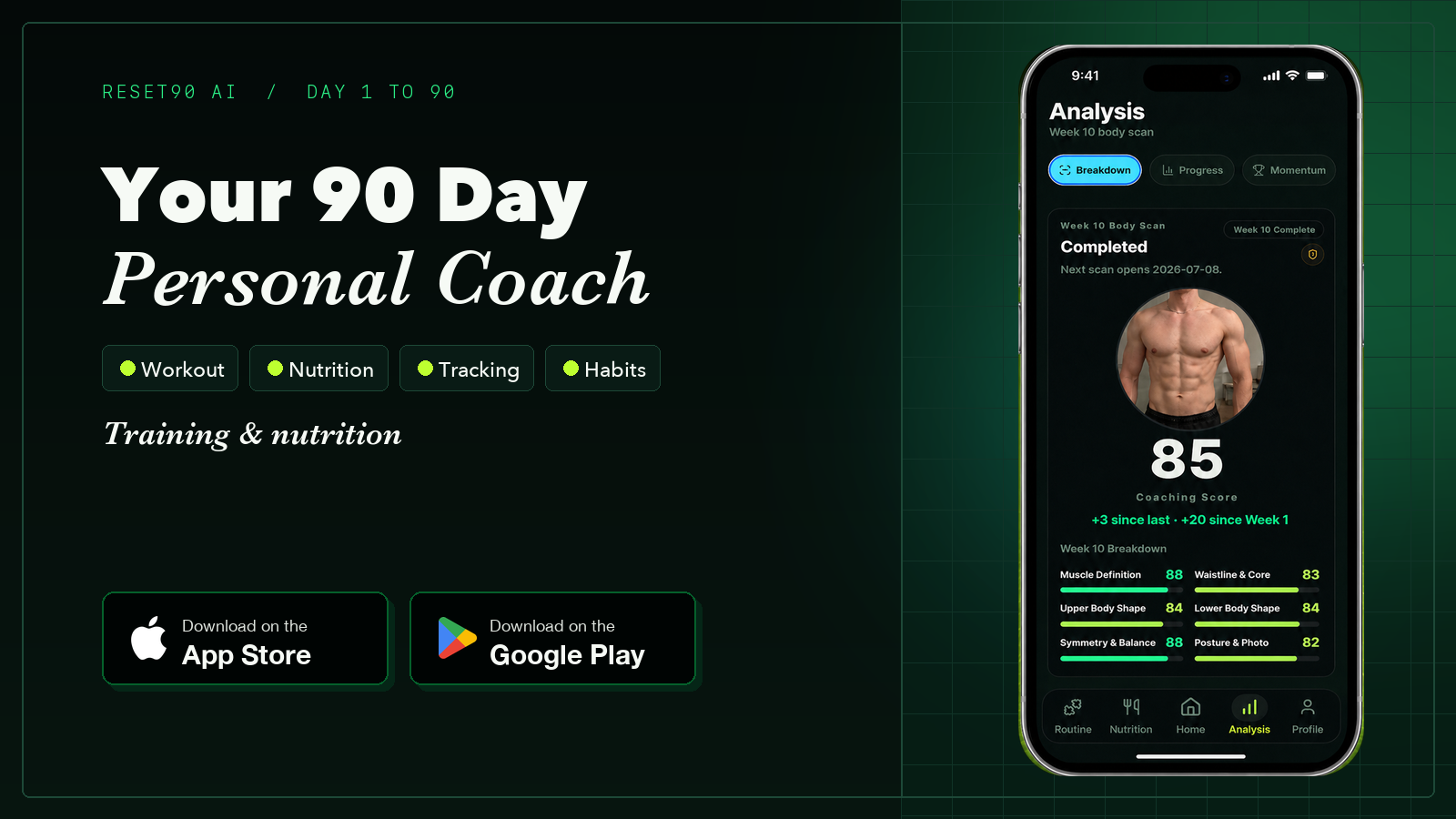
Reset90 does not try to be another recovery band. It is the outcome layer — a guided weekly Body Skin check-in that makes the evidence repeatable, plus a 90-day plan that adapts from what the evidence shows.
- The check-in is repeatable. Before every weekly photo, Reset90 guides lighting, camera position, and poses, so the trend compares your body to your body — not today's lighting to last week's lighting.
- The plan is built from your biometrics. Age, sex, height, weight, goals, and schedule shape training, nutrition, and check-in cadence. Recovery is useful only when it changes what you do; Reset90 makes that connection explicit.
- The AI reads the trend and adjusts. After each check-in, the reasoning layer decides whether next week's target, carbohydrate intake, or training load should change — and explains why. Recovery tells you when to push. Reset90 tells you whether pushing is working.
Strengths: no wearable required, real iOS + Android support, a weekly cadence that makes slow change visible, and a decision attached to every check-in.
Weaknesses: Reset90 does not measure strain or continuous HRV, and it does not replace a recovery device. It is designed to sit alongside one — as the layer that turns recovery input into physique output.
Best for: lifters who already have a recovery tool and still cannot tell whether their body is changing.
04Which WHOOP alternative should you pick?
- Own an Apple Watch? Start with Athlytic. You already own the sensor; you are just missing the score.
- Hate subscriptions? Buy a Garmin. Body Battery ships in the watch, forever.
- Sleep is your weak point? Consider Oura. The best consumer sleep signal, in a form factor that never touches a barbell.
- Not sure recovery data matters to you? Try Welltory free. Two weeks of phone-camera HRV readings will tell you whether a readiness number changes your decisions.
- Want proof the training is working? Add Reset90. Recovery optimization with no evidence of physique change is optimizing an input nobody can see.
05The lifter's stack
The strongest setup is not one tool. It is a stack:
- Recovery input: Apple Watch + Athlytic, Garmin, Oura, or Welltory — whichever fits your budget and wrist preference.
- Output layer: Reset90 — a weekly Body Skin check-in, a 90-day plan, and an AI that adjusts training and nutrition from the evidence.
- Optional anchor: a quarterly DEXA scan if you want clinical composition numbers.
The recovery band tells you when to push. The photo check-in tells you whether the pushing is working. The plan tells you what to change next. That is the complete loop.
06Frequently asked questions
Is there a WHOOP alternative with no subscription?
Yes — Garmin. Its watches include Body Battery, a recovery-style energy score built from HRV, stress, sleep, and activity, with no subscription required. You pay once for the watch and the recovery features keep working.
Can an Apple Watch replace WHOOP for recovery tracking?
Mostly, with one addition. The Apple Watch collects the same underlying signals WHOOP uses, but Apple does not compute a recovery score from them. Apps like Athlytic read Apple Health and produce daily recovery and strain scores for a small app subscription instead of a hardware membership.
Do lifters actually need strain tracking?
Usually not in the form WHOOP provides. Strain models are built around cardiovascular load, which maps well to running and cycling but poorly to a heavy 5x5 session. Lifters get more value from the recovery side plus direct evidence that the physique is changing.
What is the cheapest way to get a recovery score?
Welltory measures HRV through your phone's camera, so there is no wearable to buy. It is a spot-check rather than continuous overnight monitoring, but for a daily morning reading the price is hard to beat.
Does Reset90 replace a WHOOP band?
No. Reset90 does not measure strain and is not a wearable. It is the outcome layer: a guided weekly Body Skin check-in, a 90-day plan built from your biometrics, and an AI that adjusts training and nutrition from the evidence. Pair it with any recovery tool you already trust.
07Final verdict: recovery is input, physique is output
WHOOP alternatives are easy to compare on hardware, price, and sleep scores. But for a lifter, the metric that matters is whether the body is changing — and no band can see that.
Pick the recovery tool that fits your wrist and budget, then add the output layer. Reset90 gives you the weekly evidence, the 90-day plan, and the decision that turns recovery data into a body you can see.
The Reset90 system
Useful ideas for building a body you can keep.
Training notes, product updates, and practical ways to make your next 90 days count.
Start your next 90 days
Get your daily training, nutrition, and check-in priorities in one adaptive system.


Keep reading
Related articles
Ideal Body Measurements for Women
There is no single ideal body measurement set for women. Learn how averages, waist-to-height, body shape and repeatable tracking fit together without chasing a fixed beauty standard.
Read article
Bulk, Cut, or Recomp? A Practical Decision Guide
A practical way to choose a bulk, cut, recomp, or maintenance phase using your goal, training age, recovery, and repeatable progress signals.
Read article
How Often Should You Take Progress Photos?
How often should you take progress photos? Use this goal-based guide to choose weekly, biweekly, or monthly check-ins and make every comparison more consistent.
Read article