

FFMI Calculator: How to Calculate Fat-Free Mass Index and Read Your Score
FFMI puts estimated lean mass in context. Learn the formula, the tall-lifter adjustment, the limits of FFMI ranges, and how to track the trend without turning one number into a verdict.
By Reset90 AI Editorial Team
Short answer: FFMI (fat-free mass index) estimates how much lean mass you carry relative to your height. If you want the number now, enter your height, weight, and body-fat percentage in the Reset90 FFMI Calculator. If you want to understand the result, this guide explains the fat-free-mass formula, the tall-lifter adjustment, and the limits of FFMI ranges. FFMI is an estimate—not a verdict about your body.

01FFMI calculator: calculate first or understand the result
There are two closely related searches behind “FFMI calculator.” One is transactional: you want to enter your numbers and see a result. The other is educational: you want to know how fat-free mass is calculated and whether the score means anything. Use the path that matches your job:
| If you want to... | Start with... | What happens next |
|---|---|---|
| Calculate fat-free mass or FFMI now | Reset90 FFMI Calculator | Enter height, weight, and body-fat percentage to see estimated lean mass, raw FFMI, adjusted FFMI, and a broad interpretation band. |
| Learn how to calculate FFMI by hand | This guide | Follow the fat-free-mass formula, height correction, units, and worked example. |
| Decide whether a score is “good” | This guide | Use ranges as rough context, then check measurement quality, population, sex, age, and training history. |
| Track a body-composition trend | Calculator plus repeatable check-ins | Repeat the same inputs under similar conditions and combine FFMI with strength, measurements, and progress photos. |
| Make a clinical body-composition decision | A qualified health professional | FFMI is an estimate, not a diagnosis or a direct measurement of muscle. |
This separation keeps the calculator focused on arithmetic and the article focused on interpretation. Start with the tool if you need a result; stay here when you need to decide what the result can—and cannot—tell you.
02Where Reset90 AI fits after your FFMI result
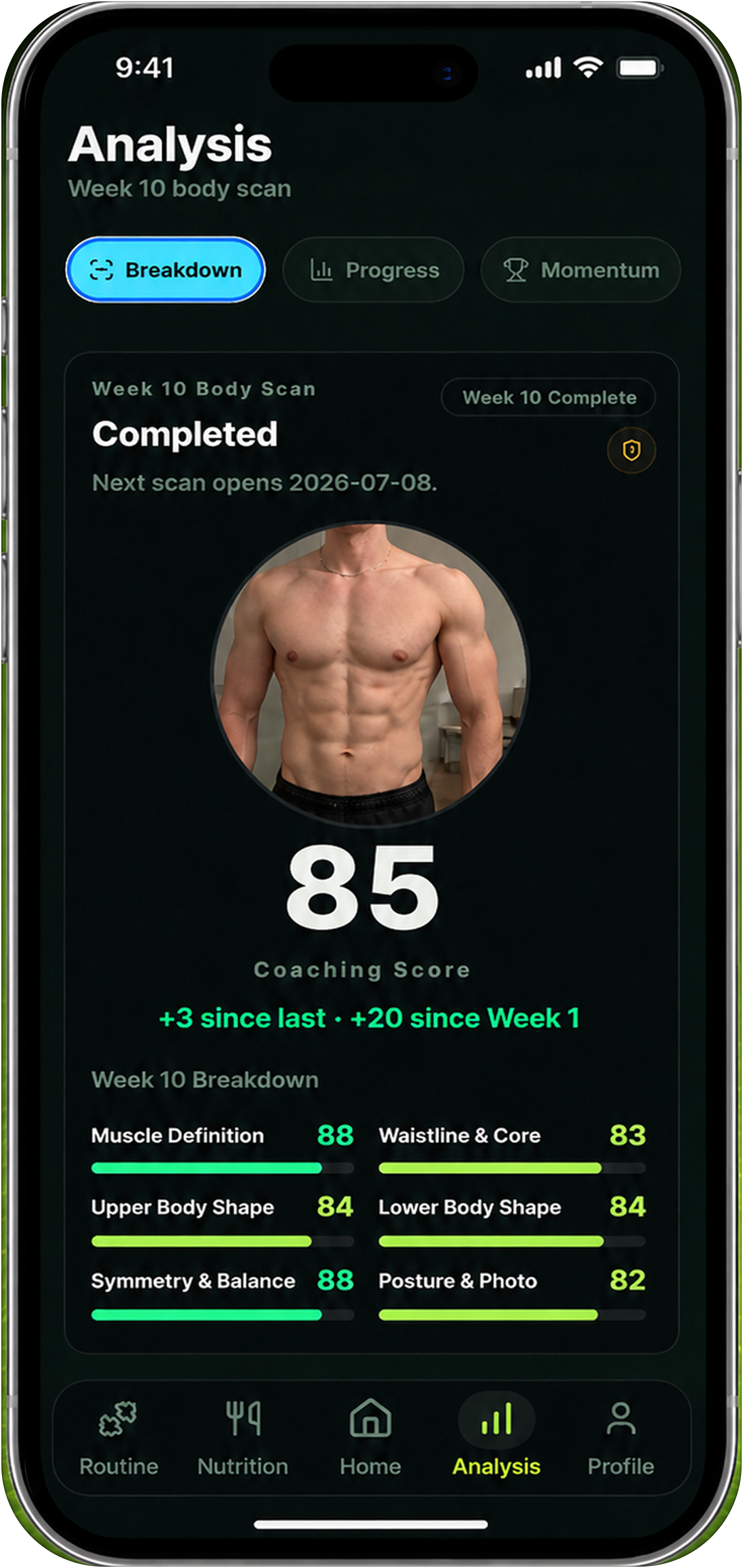
FFMI is one body-composition signal, not a complete plan. Reset90 AI is an app for people who want to connect progress check-ins with training, nutrition targets, and the next action in a 90-day routine. It is useful after the calculation when your question changes from “What is my estimated FFMI?” to “How do I make a consistent plan and see whether it is working?”
Reset90 AI does not measure fat-free mass, replace a body-composition scan, or diagnose a health condition. Use the Reset90 AI app to organize the training, nutrition, and check-in signals around your FFMI trend; use the calculator below for the formula and estimate itself.
03What FFMI measures
FFMI stands for fat-free mass index. It estimates your fat-free mass—everything in your body that is not fat—relative to your height. The height adjustment matters because two people with the same lean mass can have very different builds if one is much taller.
That makes FFMI a better conversation starter for muscle than body weight alone. Body weight cannot tell you whether a change came from fat, muscle, water, or glycogen. FFMI is not a direct scan of muscle, but it gives you a repeatable way to put lean mass in context.
The metric is commonly used in fitness and body-composition discussions, but the population behind a reference table matters. A result from a recreational lifter, an athlete, and a general-population sample should not be treated as if it came from the same comparison group.
04How to calculate FFMI and fat-free mass
You need three inputs:
- Body weight
- Estimated body-fat percentage
- Height
First calculate fat-free mass:
Fat-free mass = body weight × (1 − body-fat percentage)
Use body-fat percentage as a decimal. For example, 18% becomes 0.18. Then calculate raw FFMI:
Raw FFMI = fat-free mass (kg) ÷ height (m)²
For taller lifters, a commonly used height correction is:
Adjusted FFMI = raw FFMI + 6.1 × (1.8 − height in meters)
At 1.80 m, the correction is zero. Above 1.80 m, the adjustment can make comparisons less punishing for height. The Reset90 calculator shows both raw FFMI and an adjusted score.
05Example: calculating FFMI by hand
Imagine someone who weighs 80 kg, estimates 18% body fat, and is 1.78 m tall.
- Fat-free mass = 80 × (1 − 0.18) = 65.6 kg
- Height squared = 1.78 × 1.78 = 3.17
- Raw FFMI = 65.6 ÷ 3.17 ≈ 20.7
That result is a starting point, not a final label. If the body-fat estimate is off, the FFMI estimate moves with it. The most useful comparison is usually your own score measured under similar conditions over time.
06How to read an FFMI score
The bands below are rough coaching landmarks, not medical cutoffs or universal standards:
| Approximate FFMI | Practical interpretation |
|---|---|
| Below 18 | Lower lean mass relative to height; there may be room to build muscle through consistent training and nutrition. |
| 18–22 | A broad average-to-fit range for many adults, depending on age, sex, training history, and measurement quality. |
| 22–25 | A notably muscular range for many people, but still dependent on the inputs and the population being compared. |
| 25+ | An uncommon result that deserves cautious interpretation rather than an instant conclusion about natural potential or health. |
These ranges are not a grading scale. A score can change because your body-fat estimate changed, not because you gained or lost a meaningful amount of muscle. Use a range as context, then look at your measurement process and your trend.
07Why your body-fat estimate matters so much
FFMI is only as good as its weakest input, and body-fat percentage is usually the weakest input. Calipers, smart scales, visual estimates, and professional scans can disagree. Hydration, food, exercise, and the device itself can all affect the result.
To make your fat-free mass calculation more useful:
- Use the same body-fat method each time.
- Measure under similar conditions, such as the same time of day.
- Do not compare a smart-scale reading with a DEXA reading as if they were interchangeable.
- Look at changes over several weeks, not a one-day jump.
- Pair FFMI with strength, waist or limb measurements, and repeatable progress photos.
08Raw FFMI vs adjusted FFMI
Raw FFMI is the direct calculation from fat-free mass and height. Adjusted FFMI applies a height correction so taller lifters can be compared more fairly with a reference height.
Neither score is automatically “better.” Raw FFMI is transparent and easy to reproduce. Adjusted FFMI is useful when comparing people with different heights, especially taller lifters. When you track yourself, consistency matters more than picking the most impressive-looking number.
09FFMI for men and women: use the right comparison
Searches for “FFMI calculator male” and “FFMI calculator female” often assume that one universal table can grade everyone. It cannot. Sex, age, sport, training history, ethnicity, body-fat distribution, and measurement method all affect the context around a score.
Do not take a reference range developed from one group of male athletes and apply it as a hard ceiling to women or to the general population. A score is better understood as a personal tracking measure and a rough comparison within a relevant population—not as proof that someone is natural, enhanced, healthy, or unhealthy.
10Use FFMI as a trend, not a verdict
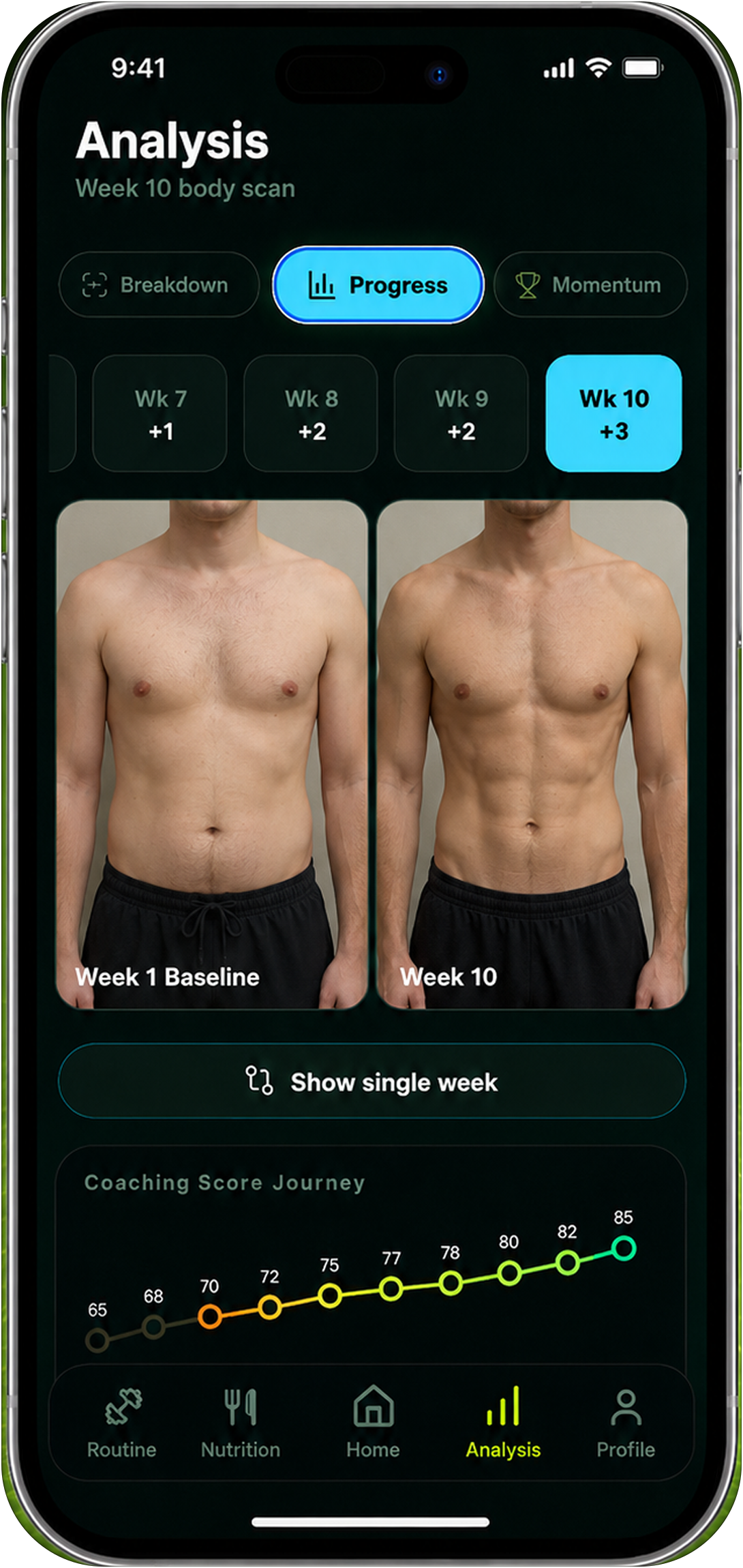
A single FFMI score answers “what does this estimate look like today?” It does not answer “am I making progress?” For that, repeat the measurement under similar conditions every four to eight weeks and look for a pattern.
Combine the number with signals that FFMI cannot see:
- Strength trend: are your key lifts stable or progressing?
- Body measurements: are waist, arm, chest, or thigh measurements moving in the direction you want?
- Progress photos: do the photos use the same lighting, pose, and distance?
- Training consistency: are you completing the work that should create the change?
This is where Reset90 AI can be useful as the next-action layer: use the app’s training, nutrition, and check-in workflow to keep the surrounding signals consistent, while treating the FFMI calculator as the estimate—not as a replacement for the full trend.
11How to use the Reset90 FFMI Calculator
The Reset90 FFMI Calculator asks for height, weight, and body-fat percentage. It returns:
- Raw FFMI
- Adjusted FFMI for taller lifters
- Estimated lean mass
- A broad interpretation band
Use the tool to establish a baseline, then save the inputs and repeat them consistently. The point is not to win a category. The point is to make your next measurement more useful than your last one.
12FFMI calculator FAQs
What is the difference between FFM and FFMI?
FFM is an estimated amount of fat-free mass, usually expressed in kilograms or pounds. FFMI puts that estimated mass in context by dividing it by height squared. FFM is the amount; FFMI is the height-adjusted index.
Is FFMI the same as BMI?
No. BMI uses total body weight relative to height. FFMI tries to isolate fat-free mass relative to height, so it is more relevant when you are asking a muscle and body-composition question. Both are simplified metrics and neither tells the whole story.
Does a high FFMI prove steroid use?
No. FFMI cannot prove drug use or explain why a score is high. Measurement error, genetics, sport-specific adaptations, and different populations all matter. Treat “natural limit” claims as rough historical references, not a detection test.
How accurate is an FFMI calculator?
The arithmetic is straightforward; the inputs are uncertain. The biggest source of noise is usually the body-fat estimate. Keep the method consistent and interpret the result as an estimate or range.
How often should I calculate FFMI?
Every four to eight weeks is usually more useful than daily. Give training and nutrition enough time to create a meaningful trend, and measure under similar conditions.
13Sources and limitations
FFMI research includes athlete studies and broader population equations for estimating fat-free mass. Those sources are useful context, but they do not turn FFMI into a diagnosis or a universal natural-muscle test. Different body-fat methods and populations can produce different results.
This calculator and article are for general education. They do not measure muscle directly or provide medical advice. If you are concerned about a body-composition result, talk with a qualified health professional.
14Final takeaway
FFMI is a useful way to put estimated lean mass in context, especially when you track it consistently. Calculate fat-free mass, divide it by height squared, use the tall-lifter adjustment when appropriate, and treat the result as one signal among several.
Use the Reset90 FFMI Calculator to get your baseline. If you want a broader system for connecting that check-in with training, nutrition, and ongoing progress, explore the Reset90 AI app. The number is not the goal. Better decisions are.
The Reset90 system
Useful ideas for building a body you can keep.
Training notes, product updates, and practical ways to make your next 90 days count.
Start your next 90 days
Get your daily training, nutrition, and check-in priorities in one adaptive system.


Keep reading
Related articles

Ideal Body Measurements for Women
There is no single ideal body measurement set for women. Learn how averages, waist-to-height, body shape and repeatable tracking fit together without chasing a fixed beauty standard.
Read article
Bulk, Cut, or Recomp? A Practical Decision Guide
A practical way to choose a bulk, cut, recomp, or maintenance phase using your goal, training age, recovery, and repeatable progress signals.
Read article
How Often Should You Take Progress Photos?
How often should you take progress photos? Use this goal-based guide to choose weekly, biweekly, or monthly check-ins and make every comparison more consistent.
Read article