

Body Recomposition for Women: How to Track Muscle and Fat Together
Body recomposition for women is easier to judge with strength, measurements, photos, and weight trends together. Learn a 90-day tracking framework that accounts for cycle-related noise without relying on a single body-fat number.
By Reset90 AI Editorial Team
Short answer: Women tracking a body recomposition should not ask the scale to prove everything. Review a consistent set of signals—strength and training performance, waist or other measurements, progress photos, weight averages, nutrition consistency, and how you feel—over several weeks. Menstrual-cycle timing and fluid retention can add noise, so compare trends and like-with-like check-ins instead of reacting to one weigh-in or one body-fat estimate.
01Why the scale is a noisy recomp report
Body recomposition means improving the relationship between muscle and fat without making scale weight the only goal. In practice, that can mean building or preserving lean mass while reducing fat, or staying near the same body weight while your shape, strength, and measurements change.
That is a useful goal, but it is difficult to read from a single number. Body weight includes muscle, fat, water, glycogen, food volume, and the contents of your digestive system. For women who menstruate, fluid shifts around the cycle can add another layer of short-term variation. One study that measured women twice weekly across a cycle observed an average increase of about 0.5 kg, primarily associated with extracellular fluid retention around menstruation days. That is not fat gain, and it is not a reason to change a plan after one weigh-in.
There is also no universal “female recomp” body-fat target that can tell you whether the plan is working. Age, training history, genetics, health, medication, menstrual status, and measurement method all matter. The better question is: Which combination of signals is moving in the direction I care about, and over what review window?
Use a scale as one instrument in a dashboard. Do not use it as the dashboard.
02What a body recomposition actually asks you to track
A recomp is a change in more than one outcome. Your tracking system should therefore separate the outcome signals from the inputs that can influence them.
| Signal | What it can tell you | What it cannot prove alone |
|---|---|---|
| Weight average | Whether body mass is trending up, down, or roughly stable | Whether the change is muscle, fat, water, or food volume |
| Waist and other measurements | Whether selected circumferences are changing under a consistent protocol | Exact fat loss or muscle gain from a single tape reading |
| Progress photos | Visible changes in shape, posture, and proportions | A precise body-fat percentage, especially under different lighting |
| Strength and performance | Whether you are maintaining or improving capacity in your training | Muscle growth from one lift or one unusually good session |
| Nutrition and training consistency | Whether the inputs are stable enough to interpret the outcomes | That a perfectly logged week guarantees a specific result |
| Recovery and symptoms | Whether sleep, stress, soreness, energy, and cycle-related context may explain variation | A diagnosis or a substitute for medical care |
The point is not to collect every possible metric. The point is to use enough independent signals that one noisy measurement cannot make the decision for you.
03Start with a training signal, not a body-fat promise
Resistance training is the anchor of a muscle-focused recomp because it gives you a repeated performance signal. A 2026 systematic review and meta-analysis of resistance training in women across the lifespan reported improvements in strength, with smaller but significant changes in functional mass and fat mass across the included studies. That supports a training-first approach, while still leaving plenty of room for individual variation.
Choose a program you can repeat and record:
- Exercises: Keep enough of the main movement patterns stable to compare sessions.
- Work performed: Record sets, reps, load, range of motion, and meaningful substitutions.
- Effort: Use a simple effort or reps-in-reserve note so a heavier number is not mistaken for better performance when form or effort changed.
- Progression: Add reps, load, quality, or control gradually when the current work is repeatable.
- Adherence: Mark completed, shortened, moved, and missed sessions without turning the log into a morality score.
Strength does not have to rise every week. A stable performance during a calorie deficit, stressful month, or poor-sleep period can itself be a useful result. Review the direction over a training block rather than demanding a personal record from every session.
04Use protein and calories as starting inputs
Nutrition should support the training signal, not overpower it with an aggressive restriction cycle. Start by choosing an intake you can sustain, then evaluate the trend. If fat loss is the priority, a modest and adjustable energy deficit may be appropriate for some people. If performance or muscle gain is the priority, maintenance or a small surplus may make more sense. The right choice depends on the person and the context, not on a single “female recomp” calculator result.
For protein, sports-nutrition position stands commonly discuss approximately 1.4–2.0 g per kg of body weight per day for active people, with individual needs and tolerances varying. Treat that as a starting framework, not a prescription. A registered dietitian or clinician should help adapt nutrition when someone is pregnant, breastfeeding, managing kidney disease, has a history of disordered eating, uses medication that affects appetite or weight, or has another relevant health condition.
Track the inputs that are actually useful:
- Approximate daily protein consistency rather than one perfect day.
- Meal timing and carbohydrate availability around training when performance is a priority.
- Hunger, energy, sleep, digestion, and recovery—not just calories.
- How often the plan was followed closely enough to interpret the next review.
When results stall, change one lever at a time. First check logging and adherence. Then check training progression and recovery. Only after that should you make a small nutrition adjustment. Changing calories, exercises, cardio, supplements, and measurement methods all at once destroys the feedback loop.
05Review weight with averages and cycle context
Daily weighing can be useful if it does not increase anxiety and if you can interpret the data as a trend. Weigh under similar conditions, record the number, and use a seven-day average or another consistent smoothing method. The average reduces the influence of one salty meal, late dinner, hard training session, or disrupted night of sleep.
If you menstruate, add cycle day or a simple symptom note when that context is meaningful to you. You do not need to force every person into a perfectly predictable cycle model. The goal is simply to notice whether your own weight and symptoms tend to move in a repeatable pattern.
Compare similar points when possible:
- Compare one multi-day average with another multi-day average, not Monday with Friday.
- Compare measurements taken under similar hydration, meal, and time-of-day conditions.
- When the cycle is regular, compare like-with-like windows across more than one cycle.
- When the cycle is irregular, use symptoms and rolling trends rather than pretending the phase label is precise.
Research on menstrual-cycle effects on exercise performance remains mixed. An umbrella review found highly variable findings and concluded that it is premature to assume short-term cycle changes meaningfully determine strength or hypertrophy outcomes for everyone. That is why a cycle-aware system should be observational and individual: use the context to explain a pattern, not to predict what your body “must” do.
06Measure your waist and other sites the same way
Tape measurements can add context between photo check-ins, but they are easy to make noisy. A tape that is one centimeter higher, pulled tighter, or taken after a large meal is not the same measurement.
Create a small protocol:
- Use the same tape and the same measurement sites each time.
- Measure at the same general time of day and under similar conditions.
- Stand naturally; do not suck in, brace, or force a pose.
- Take two readings if the first one looks unusual and record the protocol.
- Review the trend over several weeks, alongside photos and training performance.
Choose only the sites that answer your question. Waist, hip, thigh, arm, or chest measurements may be useful, but adding ten sites does not automatically improve the decision. More numbers can simply create more opportunities to overreact.
Do not convert a small tape change directly into a claim about fat or muscle. Circumference is affected by posture, measurement location, digestion, fluid, and muscle fullness. It is a useful signal, not a laboratory result.
07Use progress photos as a controlled comparison
Photos can reveal changes that a scale misses, especially when body weight is stable. They are also one of the easiest signals to distort.
Keep the conditions consistent: same background, camera height, distance, lighting, clothing style, pose, and relaxed versus flexed instruction. Take front, side, and back views if that feels comfortable and useful. Avoid turning every photo into a judgment of your body; the purpose is to compare a process, not to produce a perfect image.
Review photos at a planned cadence, such as every four weeks, rather than zooming into daily differences. If lighting or posture changed, label the comparison as low confidence. A responsible tracking system should let you say “unclear” instead of forcing a positive or negative verdict.
Photos are strongest when they agree with at least one other signal. For example, a stable scale trend plus a smaller waist plus improved training performance may support a recomp hypothesis. A different-looking photo with no protocol consistency is only a prompt to retake the set under better conditions.
08Build a 90-day review cadence
Three months is long enough to see patterns and short enough to keep the process actionable. Do not wait until day 90 to look at the data; use small reviews to adjust the next block.
| Phase | What to do | What not to conclude |
|---|---|---|
| Weeks 1–2: Baseline | Learn the logging protocol, establish training loads, collect consistent photos and measurements, and observe weight variability | That two weeks can prove muscle gain or fat loss |
| Weeks 3–6: Repeat | Keep the plan stable enough to compare sessions; improve adherence and technique before adding complexity | That one high or low weigh-in is a plateau |
| Weeks 7–10: Adjust | Review averages, measurement trend, photos, strength, and recovery; make one small change if the combined signals justify it | That every metric must move in the same direction |
| Weeks 11–12: Consolidate | Repeat the check-in, document what worked, and choose the next 90-day priority | That the final photo or scan is an absolute verdict |
A good review asks four questions:
- Did the training signal improve, hold, or decline?
- Did measurements or photos show a consistent change under comparable conditions?
- What happened to the weight average, and what other explanations fit?
- Was the plan recoverable enough to continue?
If the answer is unclear, collect better data for another two to four weeks. “Not enough evidence yet” is a valid outcome.
09Know which signals should agree
Recomposition is easiest to interpret when several signals form a coherent story.
- Stable weight, stronger lifts, and improving photos: This can be consistent with gaining or preserving lean mass while changing shape.
- Weight down, strength stable, and waist down: This can support a fat-loss trend, although the size and speed of the change still matter.
- Weight down, strength falling, fatigue rising, and hunger high: The deficit or total plan may be too demanding, or another health issue may need attention.
- Weight up briefly, measurements unchanged, and symptoms or cycle timing different: Wait for the planned review instead of labeling it fat gain.
- Photos change but the conditions are inconsistent: Retake them before making a programming decision.
These are decision patterns, not diagnoses. You are looking for a reasonable explanation that survives multiple measurements. A body-composition app can help organize the signals, but no scan, AI estimate, or score can remove measurement error.
10Do not let an app turn uncertainty into a verdict
AI body scans, smart scales, calorie calculators, and transformation apps can be useful for organizing a routine. They can also create false precision. A decimal body-fat estimate may look scientific while changing because of hydration, device assumptions, pose, lighting, or the model's limitations.
Ask an app:
- What did you measure directly, and what did you estimate?
- Which inputs changed since the last check-in?
- How confident is the comparison under the current conditions?
- Can I view the raw history rather than only a score?
- Can I correct or delete a photo, measurement, or note?
Use a score to prompt a review, not to determine your worth or to replace a clinician's assessment. See our guide to fitness apps for women for the broader app landscape, and our before-and-after transformation app guide for photo-focused workflows.
11What Reset90's 90-day workflow should help you see
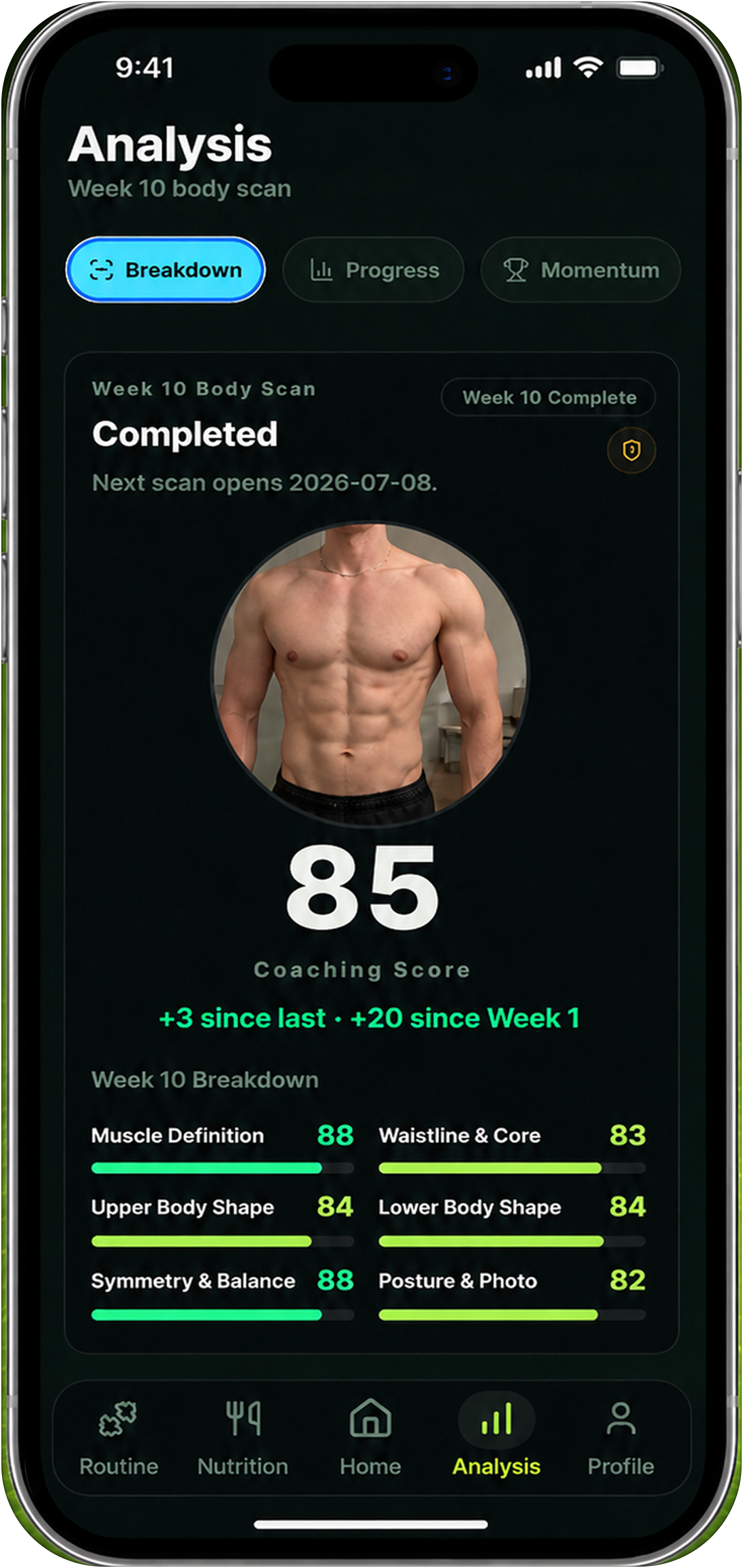
Reset90 should support the loop between training, nutrition, progress check-ins, and the next decision. For a woman tracking a recomp, that means keeping the inputs visible: what was trained, what was logged, what changed in photos or measurements, and what context might explain a noisy week.
The goal is not to promise a particular shape, body-fat number, or rate of change. The goal is to make a 90-day review more honest:
- Start with a plan that matches your available days, equipment, experience, and recovery.
- Record enough training and nutrition context to distinguish the plan from what actually happened.
- Review progress using multiple signals instead of one scan or weigh-in.
- Adjust one meaningful input at a time and keep the next review date visible.
- Pause or seek professional help when symptoms, injury, disordered-eating patterns, pregnancy, postpartum changes, or other health concerns make a generic fitness workflow inappropriate.
You can also use the macro calculator as a starting point, then treat its output as an estimate to test against energy, training, and adherence. For health boundaries and situations that need professional care, see Reset90's health and safety guidance.
12Frequently asked questions
Can women gain muscle while losing fat?
It is possible, especially for newer lifters, people returning after a break, and some individuals with appropriate training and nutrition. The rate and likelihood vary widely. Track strength, measurements, photos, and weight trends rather than expecting one guaranteed outcome.
How often should women take progress photos for a recomp?
Every four weeks is a practical starting point for many people. Use consistent lighting, pose, distance, clothing, and camera height. If the images are not comparable, retake them rather than interpreting the difference.
Should I adjust training around my menstrual cycle?
Use your own symptoms and performance history as context, not a universal rule. Research on cycle-phase effects is mixed and often limited. If you feel worse on a particular day, adjust effort or volume based on how you feel; do not assume a cycle label predicts your performance.
What is the best metric for body recomposition?
There is no single best metric. A useful minimum set is a consistent training log, a rolling weight average if weighing works for you, one or two measurements, periodic photos, and notes about nutrition and recovery. The combination is more informative than any one input.
Should I use an AI body scan to track muscle and fat?
You can use it as one contextual estimate, but do not treat its body-fat or muscle numbers as precise measurements. Keep conditions consistent, compare trends, and cross-check the result against training performance, measurements, photos, and how you feel.
When should I ask a professional for help?
Seek qualified medical or nutrition support for persistent symptoms, injury, unexplained changes, pregnancy or postpartum questions, menstrual irregularity, suspected eating-disorder patterns, or any condition affected by training and nutrition. An AI fitness app is not a diagnostic tool.
13The practical answer
A body recomposition is not proven by a smaller scale number. For women, a credible 90-day review looks for a pattern: training is progressing or being maintained, measurements and photos are comparable, weight trends are interpreted with fluid and cycle context, and nutrition is sustainable enough to support the work.
Track fewer signals, more consistently. Review them less reactively. Let the combined evidence—not a single scan, phase label, or weigh-in—decide whether the next block should stay the course or change.
The Reset90 system
Useful ideas for building a body you can keep.
Training notes, product updates, and practical ways to make your next 90 days count.
Start your next 90 days
Get your daily training, nutrition, and check-in priorities in one adaptive system.


Keep reading
Related articles

Ideal Body Measurements for Women
There is no single ideal body measurement set for women. Learn how averages, waist-to-height, body shape and repeatable tracking fit together without chasing a fixed beauty standard.
Read article
Bulk, Cut, or Recomp? A Practical Decision Guide
A practical way to choose a bulk, cut, recomp, or maintenance phase using your goal, training age, recovery, and repeatable progress signals.
Read article
How Often Should You Take Progress Photos?
How often should you take progress photos? Use this goal-based guide to choose weekly, biweekly, or monthly check-ins and make every comparison more consistent.
Read article