
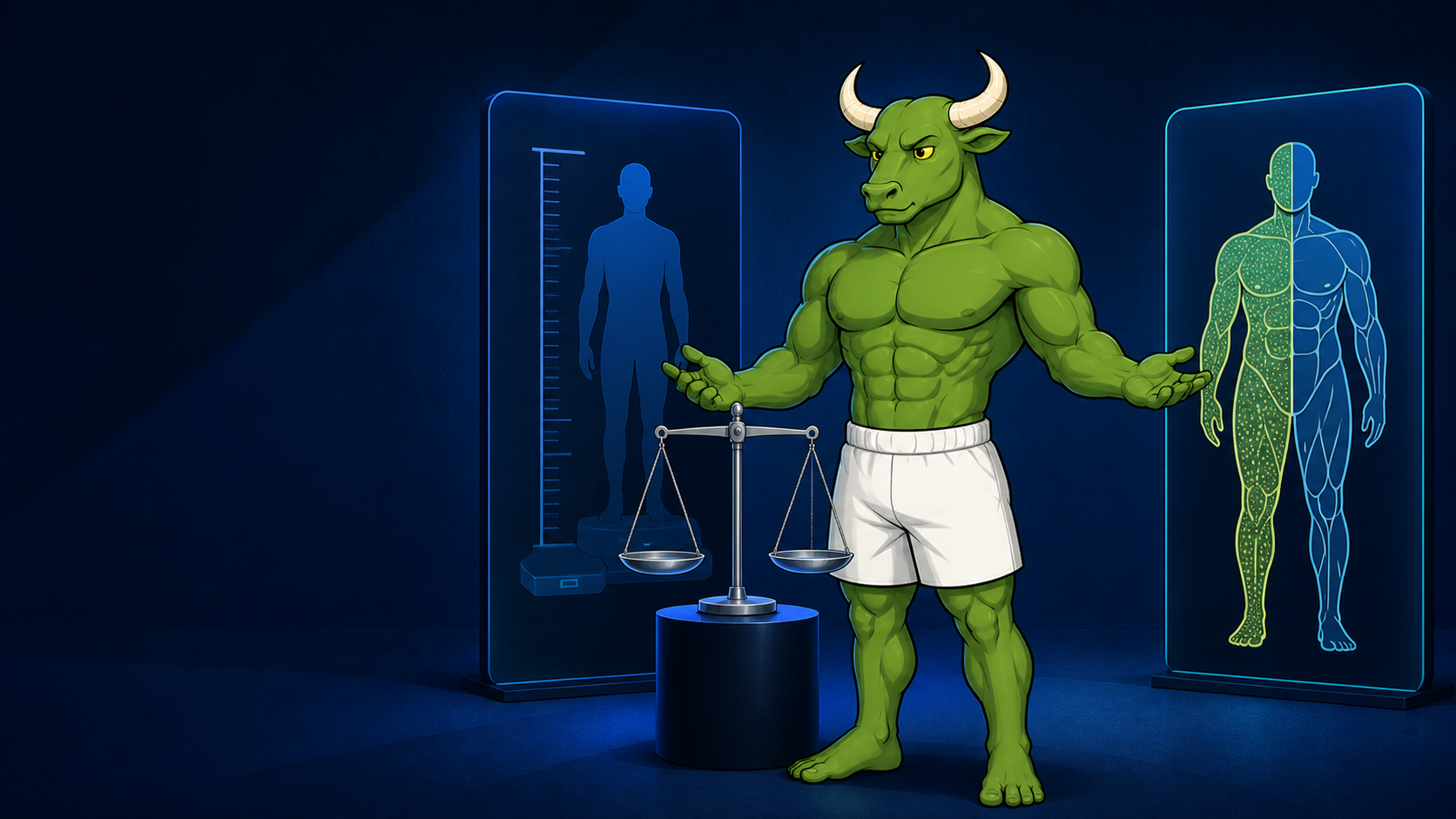
Body Fat Percentage vs. BMI: Which Should You Track?
BMI is a simple height-and-weight screen, while body fat percentage is a more direct but still imperfect body-composition estimate. Learn which metric fits your goal and how to track both without chasing one number.
By Reset90 AI Editorial Team
Short answer: BMI is a simple height-and-weight screening signal. Body fat percentage is more directly related to body composition, but the estimate can vary substantially by method and measurement conditions. If your goal is to understand muscle gain, fat loss, or body recomposition, use a repeatable body-fat method alongside waist, photos, strength, and weight trends. If your goal is broad screening or a simple weight-to-height reference, BMI still has a role.
01What is the difference between body fat percentage and BMI?
BMI and body fat percentage are often compared as if one number must replace the other. They do different jobs.
BMI uses your total body weight and height:
BMI = weight in kilograms ÷ height in meters²
It does not separate fat, muscle, bone, water, or other tissues. That makes it fast and inexpensive, but also limited when the question is about body composition.
Body fat percentage estimates how much of your total body weight is fat:
Body fat percentage = fat mass ÷ total body weight × 100
That is a more direct body-composition question. However, most people do not measure fat mass directly at home. They estimate it with bioelectrical impedance, skinfolds, a scan, or another method. The result is therefore not automatically exact just because it is called body fat percentage.
The practical difference is this: BMI tells you how your total weight relates to your height. A body-fat estimate tries to tell you what part of that weight is fat. Neither number, by itself, tells you your complete health or fitness story.
02When is BMI useful?
BMI remains useful when you need a quick, repeatable, low-cost screening reference. It can help organize broad health conversations and population comparisons without requiring a scan, a special device, or a body-fat estimate.
| Adult BMI | Common screening category | Important limitation |
|---|---|---|
| Below 18.5 | Underweight | Does not explain whether the result reflects low muscle, illness, nutrition, or another factor |
| 18.5–24.9 | Healthy-weight range | Does not prove that body fat, muscle, fitness, or health markers are optimal |
| 25.0–29.9 | Overweight | Does not distinguish extra muscle from extra fat |
| 30 or higher | Obesity range | Is not a diagnosis or a complete individual risk assessment by itself |
Those categories are screening boundaries, not personal goals. BMI can be a useful first signal while still being incomplete for an individual. The problem starts when a broad screening category is treated as a direct measurement of body fat or as a verdict about a person’s health.
For a deeper explanation of why BMI can mislead muscular people and what to add to it, read Is BMI Accurate? What BMI Gets Wrong for Muscular People.
03When is body fat percentage more useful?
Body fat percentage is more relevant when your actual question is about fat mass, lean mass, or body recomposition. If you are lifting weights and want to know whether your changes are coming from muscle or fat, total body weight and BMI cannot answer that directly.
For example, two people can have the same height, weight, and BMI while having different amounts of muscle and fat. The BMI number sees them as identical. A body-composition estimate may reveal a meaningful difference, even if the estimate itself has some error.
That makes body fat percentage useful for questions such as:
- Am I losing fat while preserving lean mass?
- Is my weight stable because I am recomping?
- Is my strength increasing while my waist is changing?
- Is the same training and nutrition plan producing a different body-composition trend?
It is still only one signal. A body-fat estimate does not directly measure strength, blood pressure, metabolic health, recovery, or how consistently you are training. Relevance is not the same thing as certainty.
04Why body fat percentage is not automatically more accurate
The phrase “body fat percentage” can make a result sound more precise than it is. Accuracy depends on the method, the operator, the device, the person being measured, and the conditions on the day.
| Method | What it can help with | What to watch |
|---|---|---|
| DEXA scan | A detailed clinical estimate of fat, lean tissue, and bone in different regions | Cost, availability, protocol differences, and the fact that it is still an estimate rather than a daily measurement |
| BIA or smart scale | Convenient repeated estimates at home | Hydration, food, sodium, exercise, skin temperature, and device algorithms can move the result |
| Skinfold measurements | Low-cost estimates when a trained person uses a consistent protocol | Site selection, technique, operator experience, and repeatability |
| Waist and other measurements | Simple trends that can show changes in body size | They do not directly measure total body-fat percentage and need a consistent location and technique |
| Progress photos | Visual context for body-composition change | Lighting, posture, clothing, angle, and appearance bias can change what you see |
The best method for a personal trend is often the method you can repeat under similar conditions. A less advanced method used consistently may be more useful for decision-making than an expensive measurement taken once and never repeated.
05How Reset90 adds context to BMI and body-fat tracking
Reset90 fits in the gap between a measurement and the next decision. It can keep your weight trend, training, nutrition, check-ins, and optional weekly body-photo reports in one 90-day record. The app does not convert BMI into body fat percentage or pretend that a photo can measure tissue composition. Its useful role is helping you review several imperfect signals together instead of reacting to whichever number changed most recently.
Use the AI check-in as a visual trend, not a body-fat reading
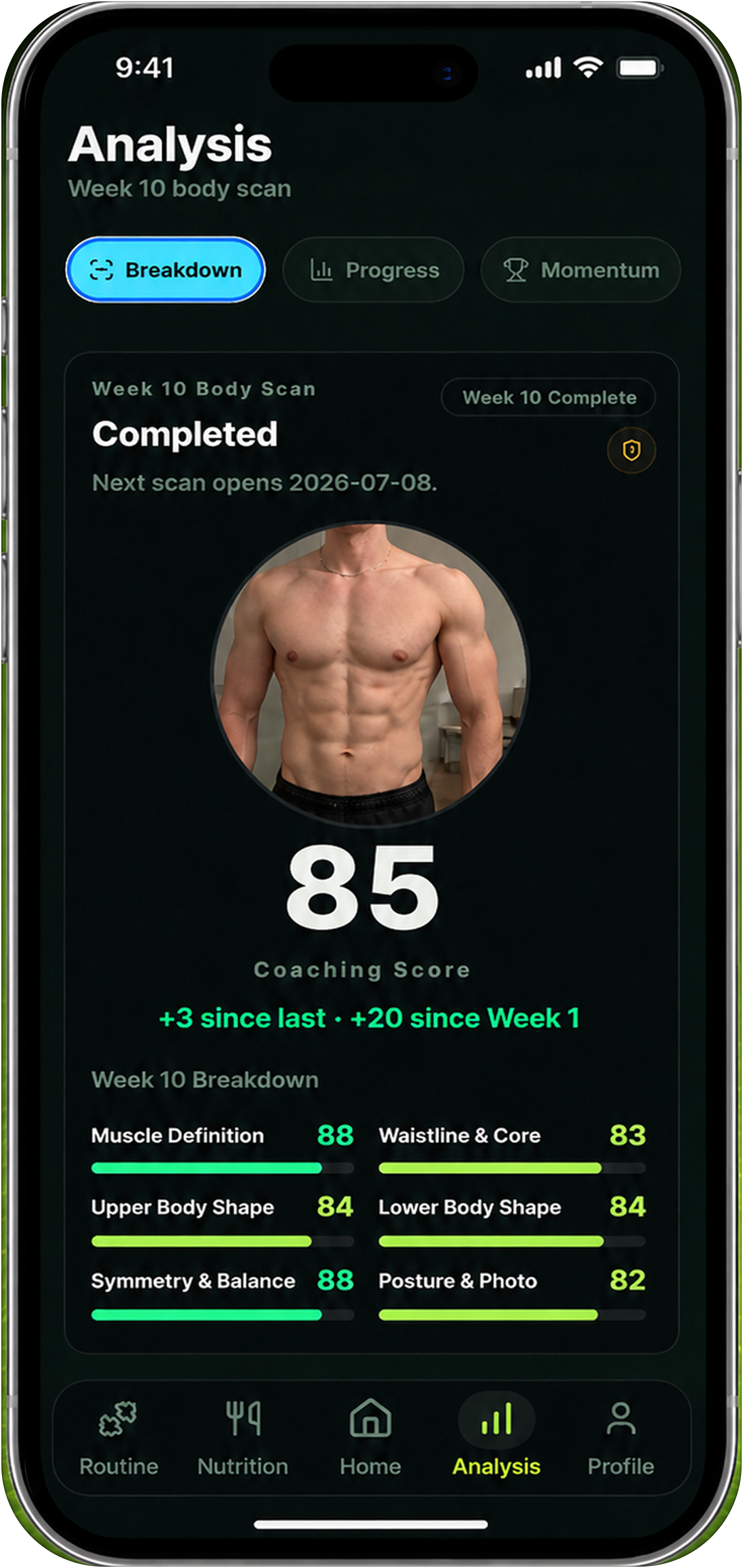
If you enable Reset90’s optional AI body check-in, you can submit a similar progress photo each week. The app returns a 0–100 Coaching Score with a breakdown across visual dimensions such as muscle definition, waistline and core, upper-body shape, shoulder and chest definition, symmetry and balance, and posture and photo quality.
That score answers a different question from BMI or a smart-scale estimate: does your visual progress look consistent with the routine you are following? It is fitness coaching feedback based on the submitted photo and its conditions. It is not a body-fat percentage estimate, medical measurement, diagnosis, or proof that muscle gain or fat loss occurred.
A simple weekly workflow
- Record your weight, waist measurement, body-fat method, and photo conditions at baseline.
- Repeat the same measurement setup rather than switching devices whenever the result is surprising.
- Use the weekly Reset90 check-in as an additional visual signal, keeping the lighting, framing, posture, and clothing as similar as practical.
- Review the AI score alongside training performance, nutrition consistency, waist, and the multi-week weight trend before changing your plan.
This makes the app useful without asking it to answer a question it cannot answer. BMI remains a broad height-and-weight screen, body-fat percentage remains an imperfect composition estimate, and the AI check-in adds visual context to the trend.
If your specific question is about estimated lean mass rather than body-fat measurement, see FFMI vs BMI: Which Body-Composition Metric Should You Use?. That is a different comparison task from choosing between BMI and a body-fat estimate.
06Which metric should you track for your goal?
The best BMI and body fat comparison starts with the question you are trying to answer.
| Your question | Start with | Add for context |
|---|---|---|
| How does my total weight compare with my height? | BMI | Waist, medical history, and relevant clinical measurements |
| Am I losing fat while keeping lean mass? | A consistent body-fat estimate | Waist, strength, photos, nutrition, and weight trend |
| Am I gaining muscle? | Strength and training performance | Measurements, photos, body-fat estimate, and adherence |
| Is my weight trend moving in the direction I expect? | Repeated weight average | Waist, body-fat estimate, activity, and time window |
| Do I have a health concern? | Professional assessment | BMI, waist, labs, symptoms, and medical history as appropriate |
This is why the answer to “Which is better, BMI or body fat percentage?” depends on the job. BMI is a useful broad screen. Body fat percentage is more directly aligned with a body-composition question. Strength, waist, photos, and health markers answer questions that neither metric can answer alone.
07Can you convert BMI to body fat percentage?
Not precisely. BMI and body fat percentage are related across groups, but a relationship is not a conversion formula for one individual.
Two people can have the same BMI and different body-fat percentages because of differences in muscle mass, age, sex, ethnicity, fat distribution, and training status. Even an equation that estimates body fat from BMI will have individual error. It should not be treated as a direct measurement.
Likewise, a single body-fat estimate should not be used to “correct” BMI as if the new number were perfect. The better approach is to record the method, repeat it consistently, and interpret the direction of change alongside other signals.
08How to track body fat percentage without overreacting
Use a simple protocol so that changes in the number are easier to interpret.
Choose one primary method
Choose the method that fits your access, budget, and goal. If you use a smart scale, treat its body-fat output as an estimate and use the same device. If you use skinfolds or circumference measurements, keep the sites and technique consistent. Do not switch between a home BIA estimate and a DEXA result and call the difference progress.
Keep measurement conditions similar
Measure at a similar time and under similar conditions. Hydration, recent exercise, carbohydrate intake, sodium, digestion, and menstrual-cycle timing can all affect weight or BIA readings. You do not need perfect conditions; you need enough consistency to make comparisons meaningful.
Use a multi-week window
Do not change your plan because of one reading. Compare several weeks of data and look for agreement among body weight, waist, photos, strength, training consistency, and the body-fat estimate. A single unexpected result may be noise. A repeated pattern deserves a closer look.
Write down the method beside the result
Record the date, method, device, and relevant conditions. This prevents you from comparing unlike measurements months later and helps you notice whether a change came from the body or from the measurement process.
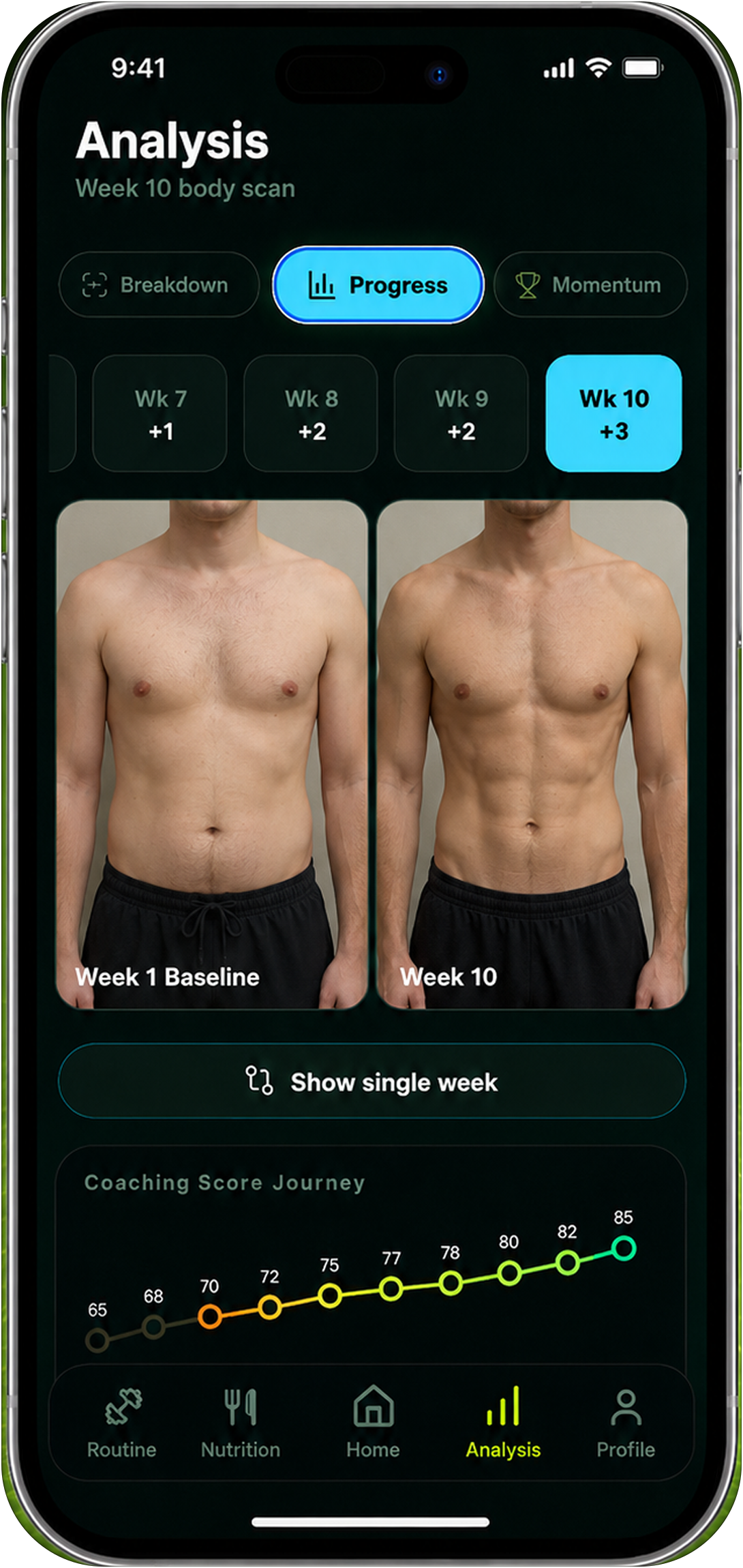
That is where Reset90 can make the workflow easier. Keep the repeated measurement, training response, nutrition consistency, photos, and check-ins in the same progress record, then use the app’s daily plan and weekly review to decide what deserves attention next. The point is not to make the app choose a perfect body-composition number; it is to make the trend easier to interpret and the next action easier to follow.
Reset90 is a fitness and planning tool, not a diagnostic system. Its AI check-in does not guarantee a body-composition outcome, and it should not replace qualified medical advice when a health concern is involved.
09Why a body fat percentage chart is not a personal target
Charts can be useful for explaining that body-fat ranges differ by method, age, sex, and population. They are not a universal grading system.
A chart may show categories such as essential fat, athletic, fitness, or average. Those labels do not automatically define a healthy goal for a specific person. The measurement method may also have enough error to move someone between categories without a meaningful change in body composition.
If you are looking for a chart, treat it as general context. Do not use it to diagnose yourself, set an aggressive target, or compare a home estimate with a clinical measurement as if they were identical.
10Body fat percentage vs. BMI FAQs
Is body fat percentage better than BMI?
Body fat percentage is more directly related to body composition, while BMI is a simpler height-and-weight screening signal. Neither is universally better. The right choice depends on whether you are asking about broad screening, fat and lean mass, or fitness progress.
Which is better for a muscular person, BMI or body fat percentage?
A consistent body-composition estimate is usually more relevant to a muscular person’s question because BMI cannot distinguish muscle from fat. It should still be paired with waist, strength, photos, health context, and professional guidance when needed.
Can a normal BMI still hide a high body-fat percentage?
Yes. People with the same BMI can have different muscle mass and fat distribution. A normal-range BMI is useful information, but it does not prove that body composition is optimal.
Are smart scales accurate for body fat?
Smart scales can provide repeatable estimates, but the absolute number can be affected by hydration, timing, contact, and the device’s algorithm. They are generally more useful for observing a consistent trend than for treating one reading as a precise body-fat measurement.
Should I stop tracking BMI?
Not necessarily. BMI can remain a useful broad reference. If your goal is muscle gain, fat loss, or body recomposition, supplement it with measurements that answer that more specific question instead of expecting BMI to do every job.
Is this medical advice?
No. This is general fitness education. If you are concerned about pregnancy, an eating disorder, unexplained weight change, symptoms, or a health-screening result, speak with a qualified healthcare professional.
11The bottom line
BMI and body fat percentage are not competing versions of the same measurement. BMI is a quick height-and-weight screen. Body fat percentage is a more direct but still imperfect estimate of body composition.
Choose the metric by the question you are asking, keep the method consistent, and add the signals that fill in its blind spots. For body recomposition and muscle gain, the useful picture usually includes a body-fat estimate, waist, photos, strength, nutrition, and a multi-week weight trend.
Do not chase the most impressive number. Build a repeatable record that helps you make the next training and nutrition decision with better context.
The Reset90 system
Useful ideas for building a body you can keep.
Training notes, product updates, and practical ways to make your next 90 days count.
Start your next 90 days
Get your daily training, nutrition, and check-in priorities in one adaptive system.


Keep reading
Related articles

Ideal Body Measurements for Women
There is no single ideal body measurement set for women. Learn how averages, waist-to-height, body shape and repeatable tracking fit together without chasing a fixed beauty standard.
Read article
Bulk, Cut, or Recomp? A Practical Decision Guide
A practical way to choose a bulk, cut, recomp, or maintenance phase using your goal, training age, recovery, and repeatable progress signals.
Read article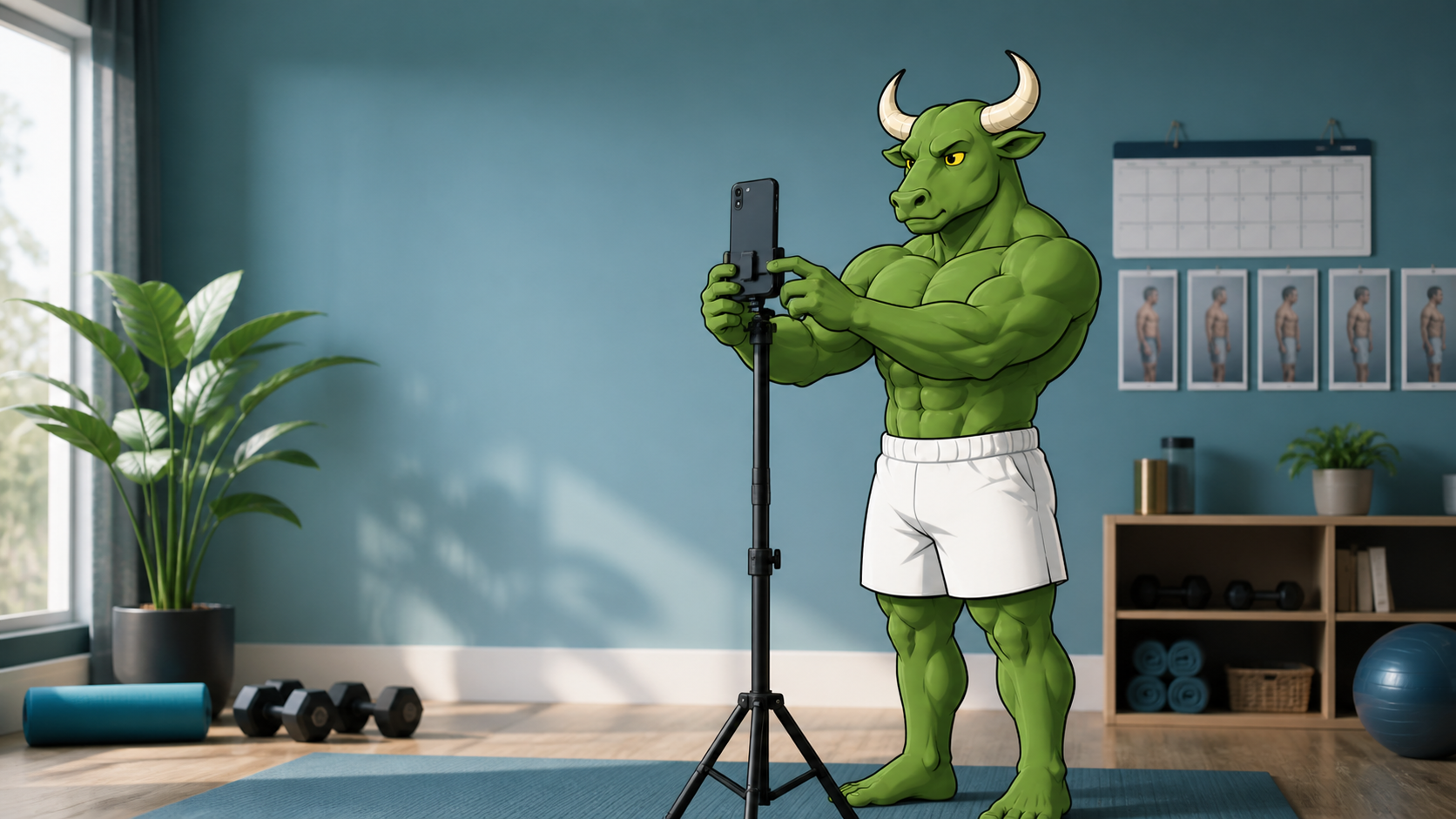
How Often Should You Take Progress Photos?
How often should you take progress photos? Use this goal-based guide to choose weekly, biweekly, or monthly check-ins and make every comparison more consistent.
Read article