
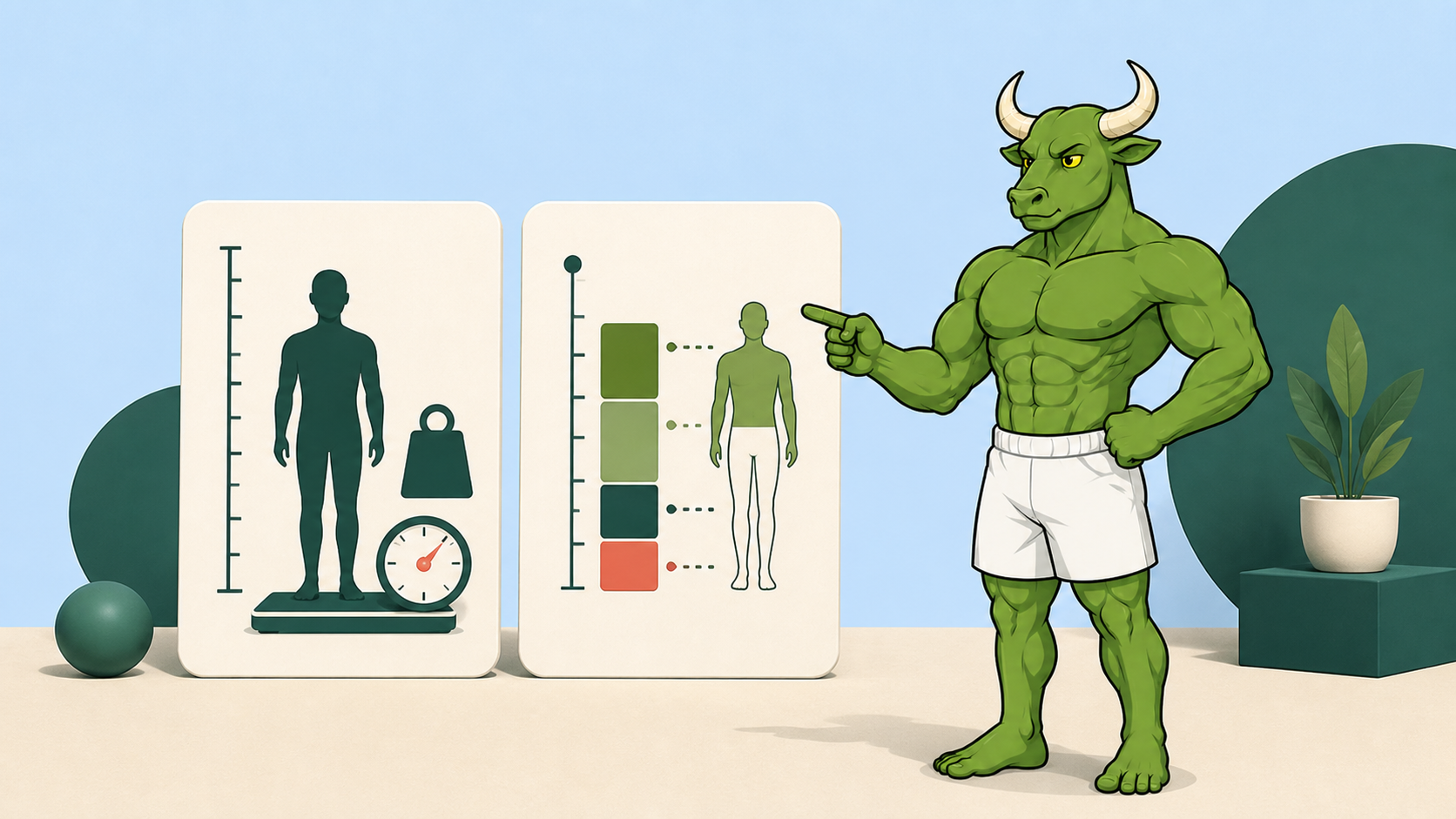
FFMI vs BMI: Which Body-Composition Metric Should You Use?
BMI compares total body weight with height. FFMI puts estimated fat-free mass in the context of height. Learn when to use each metric, why neither tells the whole story, and how to track better trends.
By Reset90 AI Editorial Team
Short answer: BMI compares total body weight with height. FFMI tries to put estimated fat-free mass in the context of height. BMI is useful as a broad screening measure, while FFMI is more relevant when your question is about lean mass and muscularity. Neither metric can diagnose health or measure muscle perfectly, so use the one that matches your question and pair it with trends, training performance, measurements, and professional context when needed.
01FFMI vs BMI at a glance
| Question | BMI | FFMI |
|---|---|---|
| What does it use? | Total body weight and height | Estimated fat-free mass and height |
| Does it require body-fat input? | No | Yes |
| Best suited to | Broad screening and population comparisons | Lean-mass context and personal body-composition tracking |
| Main blind spot | Cannot separate fat from lean mass | Inherits error from the body-fat estimate |
| Can it diagnose health? | No | No |
| Can it prove someone is natural or enhanced? | No | No |
People often compare FFMI vs BMI as if one number should replace the other. That is the wrong starting point. They answer different questions because they use different inputs. BMI uses body weight and height. FFMI uses estimated fat-free mass and height, which means it requires an additional body-fat estimate and carries more measurement uncertainty.
This guide explains the difference, shows the formulas, and gives you a practical way to decide which metric to use. For a full calculation walkthrough, see how to calculate FFMI. For women, also read the context-first guide to the FFMI calculator for women.
02What does BMI measure?
BMI is a ratio of body weight to height. For adults, the calculation is:
BMI = body weight in kilograms ÷ height in meters²
The CDC describes adult BMI as a screening measure that can be considered alongside other health information. It does not directly measure body fat, distinguish muscle from fat, or explain where fat is distributed.
That makes BMI useful for broad population and health-screening conversations, but less useful as a standalone answer for a muscular person. Two people can have the same BMI with very different amounts of lean mass, body fat, training history, and health context.
03What does FFMI measure?
FFMI stands for fat-free mass index. It estimates fat-free mass relative to height. Fat-free mass includes everything that is not fat, so it is not identical to skeletal muscle, but it is closer to a body-composition question than total body weight alone.
The basic calculation is:
Fat-free mass = body weight × (1 − body-fat percentage)
Then:
Raw FFMI = fat-free mass in kilograms ÷ height in meters²
Some calculators also show a height-adjusted FFMI. A commonly used adjustment is:
Adjusted FFMI = raw FFMI + 6.1 × (1.8 − height in meters)
The adjustment is a normalization convention. It does not make the number a diagnosis, a universal athletic standard, or a direct measurement of muscle.
04When is BMI the better metric?
BMI is the better starting point when you need a simple height-and-weight screen, are comparing large groups, or are having a general health conversation where body composition is not the only concern.
It is intentionally simple. You can calculate it without a body-fat device, skinfold measurement, scan, or visual estimate. That simplicity is part of its value, as long as you do not treat the category as a complete description of an individual.
Use BMI with other relevant information, such as medical history, blood pressure, lab results, waist measurement, activity, and the reason the measurement was taken. If a BMI category raises a health concern, discuss it with a qualified healthcare professional rather than trying to interpret it through a fitness calculator alone.
05When is FFMI the better metric?
FFMI is more relevant when your specific question is about estimated lean mass, muscularity, or how your body-composition trend changes as you train. It can help add context when scale weight and BMI do not explain what you see in the mirror or in your performance.
For example, an increase in body weight could come from fat, lean mass, water, or a combination. FFMI attempts to put the estimated non-fat portion into a height-normalized index. That can make a training conversation more specific, but only if the body-fat estimate is reasonably consistent.
Use FFMI as a personal trend rather than a score you need to “win.” The first result is a baseline. The more useful result is what happens when you repeat the same method after several weeks.
06Why BMI can mislead muscular people
BMI treats all kilograms the same. It does not know whether a person’s weight includes more muscle, more fat, more water, or a different body shape. That is why a muscular person can fall into a higher BMI category without that category explaining their complete health or performance picture.
This does not mean BMI is useless or that a higher BMI should automatically be dismissed. It means the number needs the context it was designed to provide. A screening metric can be useful without being a complete body-composition analysis.
07Why FFMI can mislead anyone
FFMI looks more specific, but its precision can be deceptive. The arithmetic may be exact while the body-fat input is uncertain. Different tools can produce different body-fat estimates, and hydration, food, exercise, and measurement conditions can change the result.
To make FFMI more useful over time:
- Use the same body-fat estimation method whenever possible.
- Measure under similar conditions and at a similar time of day.
- Do not compare a smart-scale estimate with a DEXA result as if they were interchangeable.
- Record the method beside the number so you remember what changed.
- Look at a multi-week trend rather than reacting to one calculation.
Consistency does not remove measurement error. It makes the error more comparable, which is often what a tracking metric needs.
08Which metric should you use for your goal?
| Your question | Start with | Add for context |
|---|---|---|
| “What is my weight relative to height?” | BMI | Waist, health history, and clinical context |
| “Am I gaining estimated lean mass as I train?” | FFMI | Strength, photos, measurements, and adherence |
| “Is my fitness plan working?” | Neither alone | Training performance, recovery, body trends, and consistency |
| “Why does my result look surprising?” | Check the inputs | Measurement method, hydration, timing, and professional assessment |
| “Do I need medical advice?” | Neither calculator | A qualified healthcare professional |
09Can you use BMI and FFMI together?
Yes, as long as you keep their jobs separate. BMI can provide the broad weight-and-height context. FFMI can add an estimate of fat-free mass relative to height. Together, they may raise a better question than either number alone.
For example, a person with a high BMI and a high estimated FFMI may need a different conversation from a person with the same BMI and a much lower estimated FFMI. The numbers still do not diagnose health, but they help explain why total body weight alone is not enough for every fitness question.
Do not average the two metrics or create a combined score without a clear reason. They are not interchangeable measurements of the same thing.
10How to track FFMI without losing the bigger picture
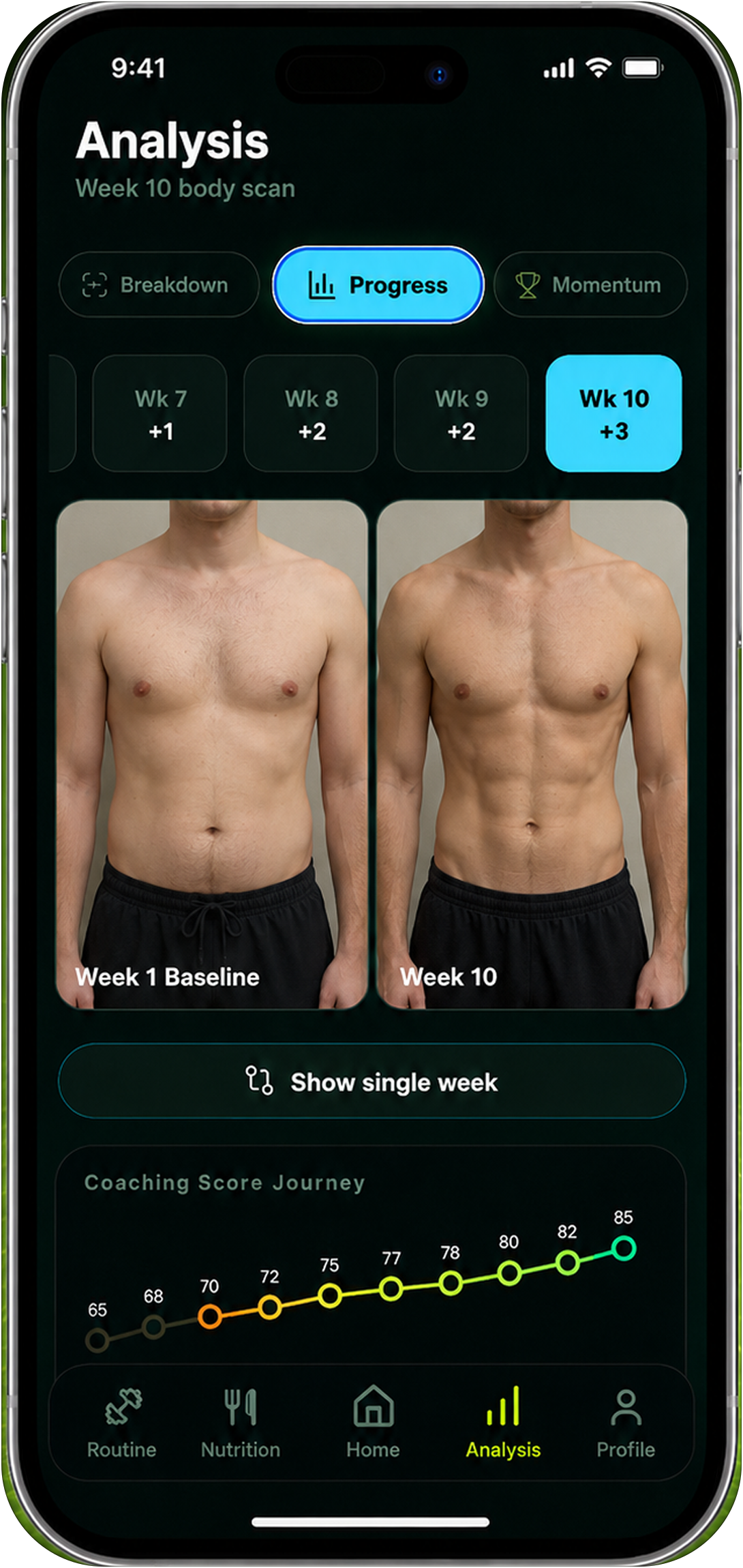
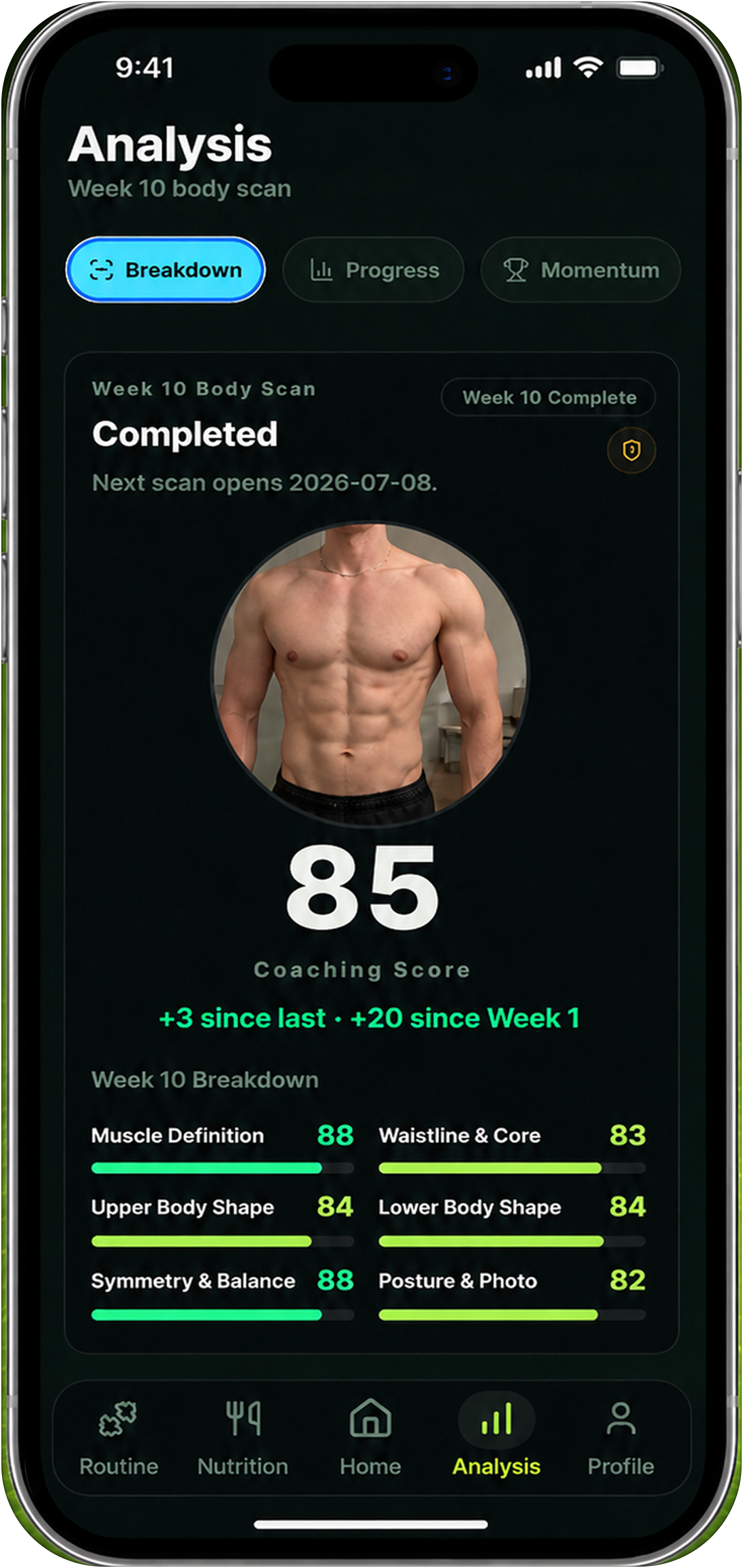
Use the Reset90 FFMI Calculator to establish a baseline. Then save:
- body weight and height;
- body-fat method and estimate;
- raw and adjusted FFMI;
- date and measurement conditions;
- training performance and consistency during the same period.
Repeat the measurement every four to eight weeks rather than every day. The goal is to compare like with like, then decide whether training, nutrition, recovery, or measurement quality needs attention.
Reset90 connects this kind of body-composition check with training and nutrition tracking so the number can sit inside a longer block rather than becoming a daily judgment. It is a planning and tracking tool, not a diagnostic system.
11FFMI vs BMI FAQs
Is FFMI more accurate than BMI?
It is more targeted to a lean-mass question, but not automatically more accurate. FFMI depends on an estimated body-fat percentage, so its usefulness depends heavily on input quality and consistency. BMI is simpler and can be appropriate for broad screening.
Is FFMI the same as body-fat percentage?
No. Body-fat percentage estimates the proportion of your body weight that is fat. FFMI uses estimated fat-free mass and height to create an index. Both are estimates, and neither directly measures all aspects of body composition.
Can BMI be high because of muscle?
Yes, BMI does not distinguish muscle from fat. That is one reason it should be interpreted with other information. A higher BMI should not automatically be dismissed or treated as a diagnosis.
Can a high FFMI prove steroid use?
No. FFMI cannot prove drug use. Measurement error, genetics, training history, population differences, and body-fat methods can all affect the result. It is not a detection test.
Which is better for tracking muscle gain, BMI or FFMI?
FFMI is more relevant to the lean-mass question, but it should be paired with strength, measurements, photos, and training consistency. BMI alone is usually too broad to explain a muscle-gain outcome.
Is this medical advice?
No. This is general fitness education. If you are concerned about your weight, body composition, symptoms, or a health-screening result, speak with a qualified professional.
12Sources and limitations
The CDC adult BMI guidance describes BMI as a screening measure that should be considered with other factors. The original FFMI research is described by Kouri, Pope, Katz, and Oliva. The original FFMI sample and later reference populations do not make the metric a universal natural-muscle limit or a clinical diagnosis.
13Final takeaway
BMI answers a broad weight-for-height question. FFMI asks a more specific estimated lean-mass question. Use BMI for the screening context it was designed to provide, use FFMI when lean mass is the question, and use neither number alone to judge health or progress.
The most useful system is a trend: consistent inputs, repeatable measurements, training performance, recovery, and decisions that improve the next block.
The Reset90 system
Useful ideas for building a body you can keep.
Training notes, product updates, and practical ways to make your next 90 days count.
Start your next 90 days
Get your daily training, nutrition, and check-in priorities in one adaptive system.


Keep reading
Related articles

Ideal Body Measurements for Women
There is no single ideal body measurement set for women. Learn how averages, waist-to-height, body shape and repeatable tracking fit together without chasing a fixed beauty standard.
Read article
Bulk, Cut, or Recomp? A Practical Decision Guide
A practical way to choose a bulk, cut, recomp, or maintenance phase using your goal, training age, recovery, and repeatable progress signals.
Read article
How Often Should You Take Progress Photos?
How often should you take progress photos? Use this goal-based guide to choose weekly, biweekly, or monthly check-ins and make every comparison more consistent.
Read article