
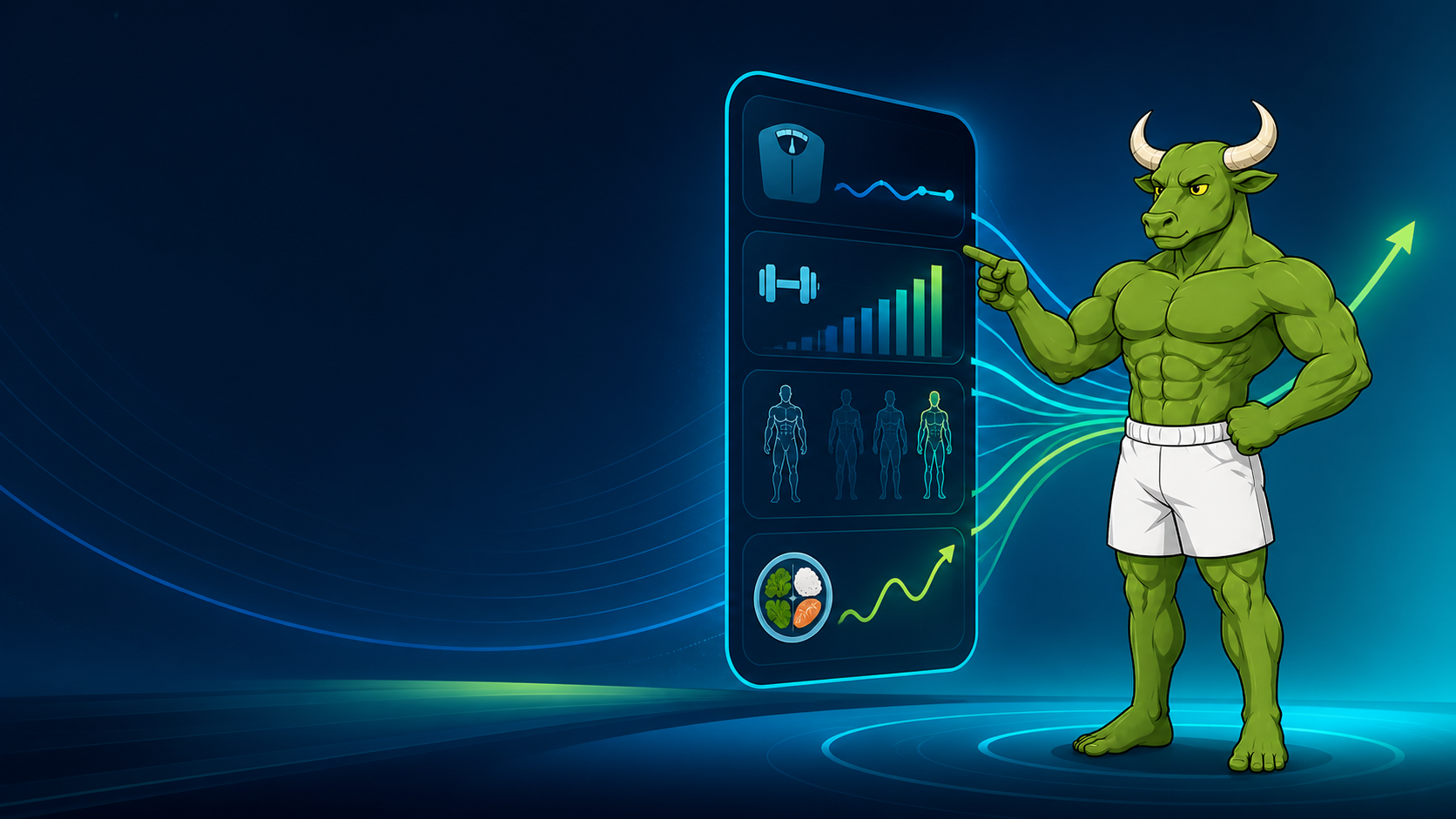
Body Recomposition Tracker: How to Know If It Is Working
When the scale barely moves, use strength, waist, photos, and weekly weight averages together to tell whether a body recomposition is working.
By Reset90 AI Editorial Team
Short answer: A body recomposition can be working even when your scale weight barely changes. Track four signals together: strength or rep performance, waist measurements, repeatable progress photos, and a weekly average of your body weight. Review the pattern over 28 days. One reading can be noisy; a consistent pattern across several signals is much more useful.

01What body recomposition actually means
Body recomposition is the attempt to reduce fat mass while maintaining or building lean mass. It is not a promise that the scale stays perfectly flat, and it is not a special phase where every person gains muscle and loses fat at the same rate. The result depends on training history, nutrition, recovery, starting body composition, and how consistently the plan is followed.
The reason recomposition feels difficult to track is that the most visible outcome can be hidden by the least informative daily number. A small amount of muscle gain, fat loss, water fluctuation, food volume, and glycogen change can all appear as “no progress” on the scale. A good tracker therefore combines signals that answer different questions rather than forcing every outcome into one score.
The goal is not to find a perfect body-fat number. The goal is to answer a practical question: Is my current training and nutrition system producing a better trend, and what should I do next?
02Why the scale is a weak single judge
Body weight is useful, but a single weigh-in is a snapshot of much more than fat and muscle. Water, sodium, carbohydrate intake, digestion, menstrual-cycle changes, sleep, stress, and the timing of the measurement can move the number without representing a meaningful change in tissue.
That is why a weekly average is more useful than a “good” or “bad” morning. Weigh under similar conditions, record the values, and compare the average of several readings with the average from the previous week. If you only weigh once per week, the number can still be useful, but you have less protection against an unusually high or low day.
A stable average can mean several different things: maintenance, slow fat loss with lean-mass gain, a plan that is not creating enough stimulus, or simply too little data. The scale cannot tell you which explanation is correct by itself. Pair it with the signals below.
03The four signals that tell the story
| Signal | Practical frequency | What a favorable pattern can look like | Common source of noise |
|---|---|---|---|
| Strength and reps | Every workout | More reps, load, control, or repeatable work at a similar effort | Exercise changes, poor sleep, soreness, and different effort levels |
| Waist or body measurements | Weekly or every two weeks | Slow movement in the direction your goal requires | Tape placement, breathing, posture, meals, and time of day |
| Progress photos | Weekly or biweekly | Comparable changes in outline, muscle visibility, or fit of clothing | Lighting, pose, camera distance, pump, and clothing |
| Weekly weight average | Three to seven readings per week | Stable, slowly falling, or slowly rising in a way that fits the goal | Hydration, sodium, glycogen, digestion, and stress |
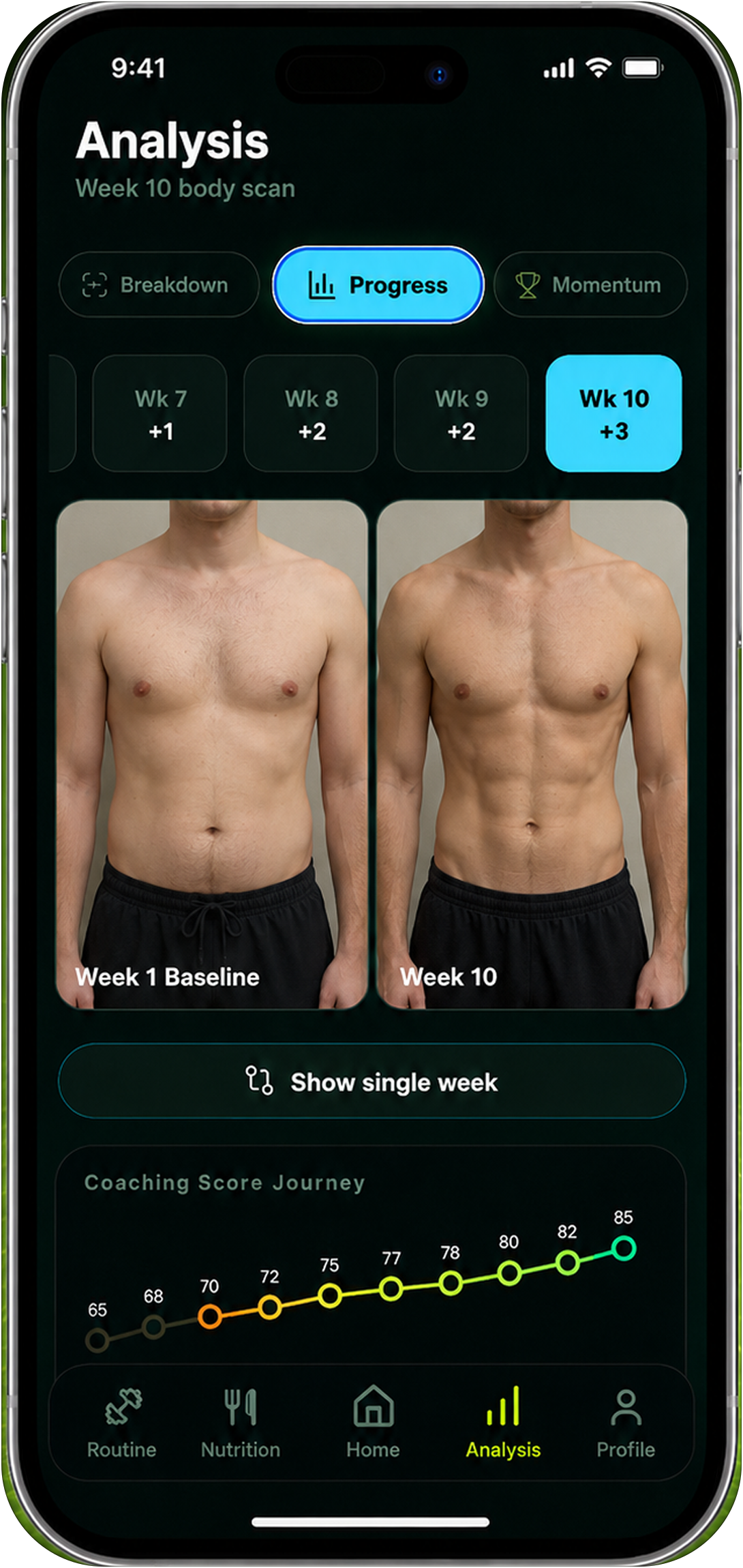
These signals are deliberately redundant. If one is wrong or noisy on a given week, the other three can keep you from making a dramatic decision. They also describe different parts of the outcome: strength shows performance, measurements show dimensions, photos show visible context, and weight shows the broad mass trend.
04Start with a baseline you can repeat
A tracker is only as good as the conditions around its inputs. Before deciding whether a recomp is working, create a baseline that your future self can reproduce.
- Choose a review date. Pick a day every four weeks when you will compare the full set of signals.
- Standardize weigh-ins. Use the same scale, ideally at a similar time and before a meal, and record the context when the reading is unusual.
- Use the same measurement landmarks. Measure the same place on the waist with the tape level and without pulling it tight.
- Lock the photo setup. Keep the room, camera height, distance, pose, clothing style, and lighting as similar as possible.
- Define your performance markers. Pick a few repeatable lifts or movements rather than trying to turn every workout into a progress test.
Do not make the baseline your best possible day. A relaxed photo, normal workout, and ordinary weigh-in are more useful than a flattering photo after a pump or a personal-record session that you cannot repeat.
05How strength should show up in a recomp
Strength is not only a one-repetition maximum. For most people, the better signal is repeatable performance: more reps at the same load, the same reps with better control, a heavier load at a similar effort, or more high-quality sets before technique breaks down.
Use a small group of anchor movements that fit your program. Record the load, reps, sets, and a simple effort note such as repetitions in reserve. If the exercise, range of motion, rest period, or effort changes every week, the number becomes harder to interpret.
Resistance training is a useful part of a body-composition plan, but it does not guarantee a particular result. A 2025 systematic review in PubMed found that adding resistance exercise during dietary weight loss helped protect fat-free mass and increased fat-mass loss in adults with overweight or obesity, while body weight itself did not differ meaningfully between groups. The study supports using performance and body-composition signals together; it does not create a universal program for every reader.
If performance is improving while your waist is stable or slowly moving down, that is encouraging. If performance is falling sharply, check sleep, recovery, exercise selection, calories, and whether the plan has become too aggressive before assuming the recomp has failed.
06How nutrition should show up in a recomp
Nutrition tracking for recomposition is less about producing a perfect daily total and more about making the weekly pattern visible. Look at calorie consistency, protein intake, meal quality, hunger, and adherence to the plan you can actually sustain.
Protein matters because lean-mass change depends on training stimulus and available building blocks, but a high number is not automatically better. A large meta-analysis of resistance-training studies found that protein supplementation produced small additional gains and that the relationship between total protein intake and fat-free-mass gains plateaued around an intake of roughly 1.6 g/kg/day in its analysis. That is a population-level result, not a prescription. Body size, age, training status, energy intake, preferences, and medical context all matter.
Use your macro calculator as a planning starting point, then compare the plan with what you actually eat. If your target says one thing but your logged weeks show a very different pattern, the tracker should help you see the gap without turning it into a moral judgment.
07How to read the four-signal pattern
Do not demand that all four signals improve every week. Instead, classify the pattern and decide whether you need more time, a small adjustment, or a recovery check.
| Pattern over several weeks | Most useful interpretation | Reasonable next step |
|---|---|---|
| Strength up, waist down, photos improving, weight average stable | Strong evidence that the plan is moving in a favorable direction | Keep the plan steady and continue the review cadence |
| Strength up, waist stable, photos stable, weight slowly rising | Possible lean-mass or total-mass gain; the goal may be closer to a gaining phase | Check calorie trend and decide whether the rate of gain matches the goal |
| Strength stable, waist down, photos improving, weight slowly falling | Clearer fat-loss signal, with maintenance of performance so far | Keep resistance training and check recovery before pushing the deficit harder |
| Strength down, waist down quickly, weight falling quickly | The plan may be too aggressive, or recovery may be insufficient | Review food intake, sleep, training volume, and professional guidance when appropriate |
| Every signal is flat for 28 days | Not enough stimulus, not enough adherence, or not enough time to detect change | Audit the inputs first, then change one variable rather than everything |
The table is a decision aid, not a diagnosis. In real life, measurements can disagree because of technique, and strength can stall for reasons unrelated to body composition. Look for repeated patterns rather than trying to name the cause from one week.
08When a photo helps more than a number
Photos can show changes that a scale and a tape measure miss, but only when the pictures are comparable. Use the same front, side, and back poses if those views are part of your routine. Keep the camera level, leave enough space around the body, and avoid comparing a morning photo with a post-workout image.
GainFrame’s body-recomposition tracker guide makes a similar product-level point: photos become more useful when they are reviewed alongside strength and body-weight context instead of being treated as isolated scores. Its examples are marketing content, not independent proof of an app’s accuracy, but the workflow is sensible. A photo is evidence in a timeline, not a verdict on a single day.
For a deeper capture routine, our guide to AI body-scan and progress-photo apps explains why camera distance, lighting, pose, and device conditions matter. The goal is repeatability, not producing the most flattering frame.
09Turn the signals into a 28-day review
A four-week review is long enough to reduce some daily noise while still short enough to adjust a plan without drifting for a whole season.
- Day 1: record your average weight from the previous week, anchor-lift performance, waist measurement, photos, and current nutrition targets.
- Days 2–7: follow the plan, log training and food consistently, and collect weight readings under similar conditions.
- Weeks 2 and 3: repeat the same measurement and photo routine. Do not change the plan because of one high or low reading.
- Day 28: compare the new weekly average with the baseline average, then review the direction of the other three signals.
- After the review: change one meaningful variable if needed: calorie target, protein consistency, training volume, exercise selection, or recovery routine.
Keep a short note beside the numbers: “What changed, what stayed steady, and what will I do next?” This makes the tracker a feedback loop rather than a collection of screenshots.
10What to do when two signals disagree
Disagreement is normal. It is also where a tracker can be most useful.
If the scale falls but strength and photos improve, do not rush to conclude that you are losing muscle. Check whether the weight change is gradual and whether the performance markers are genuinely comparable. A favorable body-composition change can happen without a dramatic scale increase.
If the scale is flat but the waist and photos improve, keep collecting data. This is the pattern that makes recomposition possible, but it still needs consistent photos and measurements rather than a single encouraging comparison.
If the scale rises and the waist rises, decide whether that is expected. A gaining phase may allow some increase, while a fat-loss or recomp goal may call for a small adjustment. Avoid changing five things at once.
If the photos change but the measurements do not, review lighting, pose, clothing, and tape placement before treating the difference as a trend. Visual evidence is valuable, but it is still sensitive to capture conditions.
11How Reset90 turns a review into a decision
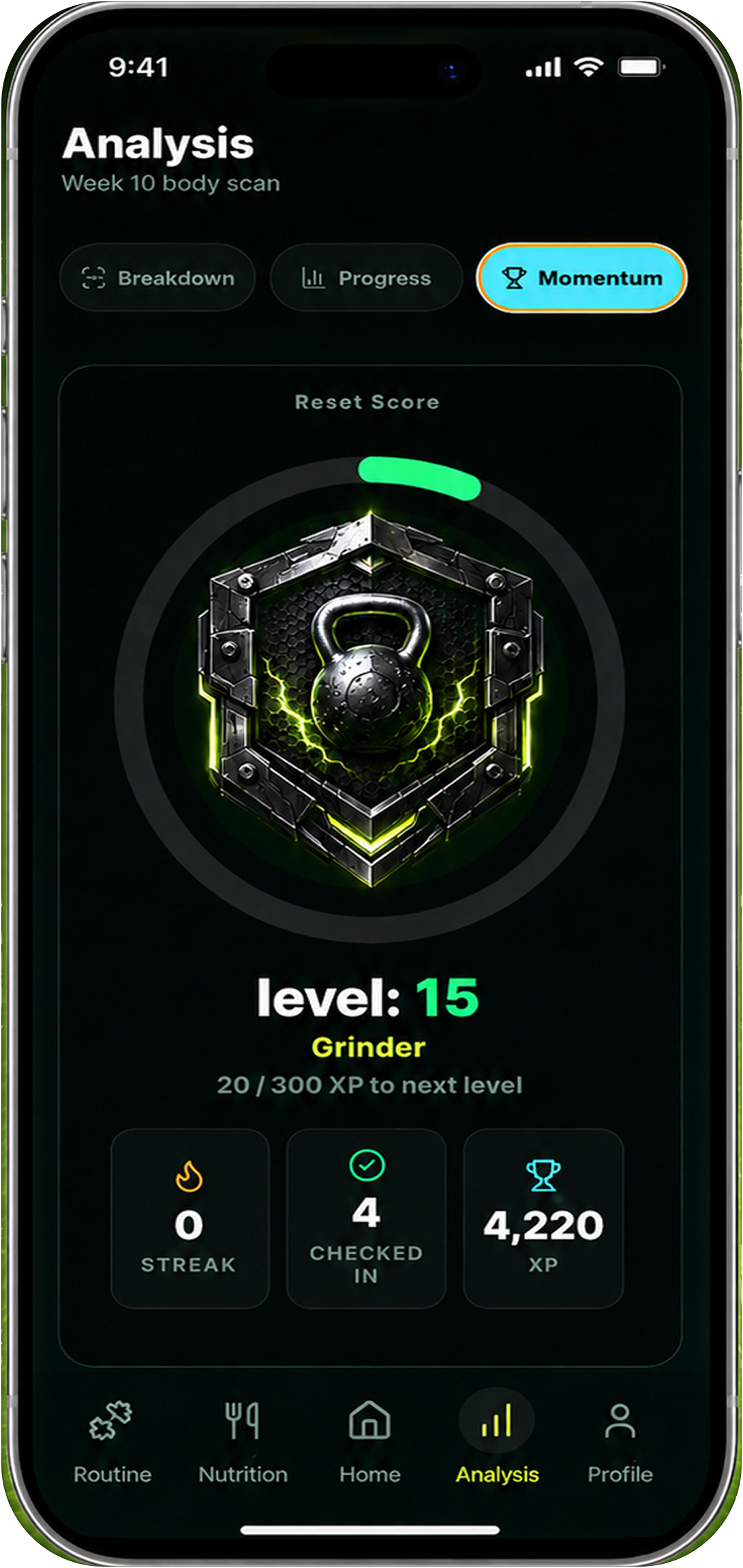
Reset90’s role is to connect the four-signal review to the next 90-day training and nutrition decision. A progress check-in can provide visual context, while workout and nutrition records explain what happened around it.
That does not mean Reset90 can prove that a specific amount of muscle was gained or diagnose a body-composition condition. It means the system can help you keep the check-in cadence, see whether the plan was followed, and decide whether to stay steady or make one controlled adjustment.
If you are comparing products, our guide to body-recomposition apps covers the category. The important distinction is that an app roundup helps you choose a tool, while a review protocol helps you decide whether the tool is producing useful evidence.
12When a recomp tracker is not enough
Do not use a body-recomposition tracker to diagnose illness, manage a medical condition, or decide whether a symptom is safe. Talk with a qualified clinician for unexplained rapid weight change, persistent fatigue, symptoms that concern you, pregnancy-related questions, eating-disorder risk, or any situation where nutrition and training decisions need medical context.
Fitness data can help you notice a pattern, but it cannot tell you the cause of every pattern. Use the Reset90 health and safety guidance for the boundaries of fitness and nutrition coaching.
13Frequently asked questions
Can you gain muscle and lose fat at the same time?
It is possible for some people, especially when training, nutrition, and recovery improve together, but the rate and likelihood vary. Treat recomposition as an outcome to assess with multiple signals, not a guarantee attached to a particular app or plan.
What is the best body-recomposition metric?
There is no single best metric. A useful minimum set is repeatable strength performance, a waist measurement, comparable photos, and a weekly weight average. The combination is more informative than any one number.
How long does it take to see whether a recomp is working?
Use 28 days as a first review window, then continue if the signals are still noisy. Muscle and fat changes are not always visible in a week, and photos and measurements become more useful when the capture routine is consistent.
Should I change calories if my scale weight is stable?
Not automatically. First check strength, waist, photos, average weight, and actual adherence. If the broader pattern matches your goal, stability may be a good result. If every signal is flat after a consistent review period, make one small adjustment and reassess.
Can Reset90 guarantee a body recomposition result?
No. Reset90 can help organize training, nutrition, and progress check-ins, but it cannot guarantee a specific body-composition outcome. Results depend on the individual and the consistency of the plan.
14The practical answer
A body recomposition tracker should answer more than “What did I weigh today?” It should show whether you are training with enough quality, eating consistently enough to support the goal, changing in the measurements and photos that matter, and following a trend that deserves another four weeks.
When the scale barely moves, that is not automatically failure. Build a repeatable baseline, review four signals for 28 days, and change one variable at a time. If the evidence agrees, keep going. If it disagrees, investigate the input before reacting to the output. That is how a tracker becomes a decision system instead of another source of noise.
The Reset90 system
Useful ideas for building a body you can keep.
Training notes, product updates, and practical ways to make your next 90 days count.
Start your next 90 days
Get your daily training, nutrition, and check-in priorities in one adaptive system.


Keep reading
Related articles

Ideal Body Measurements for Women
There is no single ideal body measurement set for women. Learn how averages, waist-to-height, body shape and repeatable tracking fit together without chasing a fixed beauty standard.
Read article
Bulk, Cut, or Recomp? A Practical Decision Guide
A practical way to choose a bulk, cut, recomp, or maintenance phase using your goal, training age, recovery, and repeatable progress signals.
Read article
How Often Should You Take Progress Photos?
How often should you take progress photos? Use this goal-based guide to choose weekly, biweekly, or monthly check-ins and make every comparison more consistent.
Read article