
How Accurate Are AI Body-Scan Apps? What the Number Can and Cannot Tell You
AI body-scan apps can be useful for tracking a direction, but a single number is not a diagnosis. Here is how to judge repeatability, trend value, and absolute accuracy.
By Reset90 AI Editorial Team
Short answer: In AI body scanning, accuracy and repeatability are different questions. Accuracy asks how close a result is to a reference measurement. Repeatability asks whether the same person gets a similar result when the scan is repeated under the same conditions. An app can be repeatable without being absolutely accurate, and a single accurate-looking result is not enough to prove a useful trend. For fitness, use a standardized scan to track direction over time, then compare it with waist measurements, photos, body weight, strength, and adherence. A body-scan number is an estimate, not a diagnosis.
01Accuracy vs repeatability: the distinction that matters
If you searched for measurement accuracy vs repeatability in AI body scanning, the simplest answer is that accuracy is about closeness to a reference and repeatability is about consistency across repeated scans.
| Question | What it measures | Example | What to do |
|---|---|---|---|
| Is it accurate? | Closeness to a reference such as DXA, BOD POD, or a tape measurement | An app estimates 20% body fat when a defined reference method measures 20% | Check the app, sample, reference method, and protocol behind the claim |
| Is it repeatable? | How tightly results cluster when you repeat the same scan | The same setup gives 20.1%, 20.3%, and 20.2% within a short interval | Keep lighting, pose, clothing, framing, and timing consistent |
| Is it directionally useful? | Whether the trend broadly agrees with other signals over time | Waist, photos, strength, and scan results improve across several weeks | Judge a pattern, not a single reading |
| Does it change a decision? | Whether the measurement helps you choose a sensible next step | A stable trend tells you to stay with the plan instead of reacting to noise | Use the result to guide a routine, never to make a diagnosis |
A scanner can be highly repeatable and still be consistently high or low compared with a reference method. That is a stable bias. It may still be useful for tracking change if the bias remains reasonably stable, but it should not be presented as a clinically interchangeable measurement. Conversely, a method can be close to a reference once and still be a poor tracking tool if small changes in posture or lighting make the next result jump.
02What “accurate” means in a body-scan app
“Accurate” is often used as if it were one universal property. In practice, it has several layers, and each layer needs different evidence.
Absolute agreement
Absolute agreement means an estimate is close to a defined reference. For body composition, that reference might be DXA or BOD POD; for circumference, it might be an expert tape measurement taken with a specified landmark and tension. The reference itself has a protocol and a margin of error. A claim that an app is “within one point” is incomplete unless you know which app version, population, reference, and capture conditions produced that number.
Test-retest repeatability
Repeatability asks what happens when the same person repeats a scan under the same conditions. It is about the spread of results, not whether the average is correct. A repeatability test should state how many people were scanned, how many times, how far apart the scans were, what clothing and pose were used, and which error statistic was reported.
Directional usefulness
Directional usefulness is the practical fitness question: does the signal generally move in the same direction as the rest of your progress evidence? A reading can have an offset from a reference and still help you notice that a consistent routine is changing your waist, shape, or body-composition trend. This is weaker than clinical accuracy, but it can be valuable when the capture process is stable.
Decision usefulness
The final question is whether the number improves a decision. If a scan changes every time the room, clothing, or pose changes, it may create more reactivity than insight. If it gives a comparable signal that you can review alongside training, nutrition, sleep, strength, photos, and waist measurements, it can help you decide whether to continue, adjust, or wait.
03What the evidence can and cannot tell you
Research on AI and 3D measurement is useful, but evidence belongs to a particular system, sample, reference method, device, and protocol. “AI body scan” describes a category, not one validated instrument.
| Evidence type | What it can support | What it cannot prove by itself |
|---|---|---|
| Peer-reviewed validation | How one named model performed against one named reference in one sample | That every app, phone, body type, pose, or lighting setup will perform the same way |
| Vendor study | A useful description of the product’s protocol, tested measurements, and known sources of variation | Independent clinical validation or universal accuracy |
| Metrology explanation | The conceptual difference between accuracy and repeatability | Performance of a consumer body-scan app |
| Clinical AI imaging study | How a tightly controlled medical imaging system was evaluated | Evidence for a smartphone photo body-fat estimate |
Before trusting a strong accuracy claim, ask five questions:
- Which exact app or model was tested? A result for one algorithm does not validate the whole category.
- Who was in the sample? Age, sex, body size, skin tone, fitness level, and health status can affect model performance.
- What was the reference? DXA, BOD POD, InBody, tape measurements, and visual ratings do not measure the same thing.
- Was the capture protocol controlled? Identical clothing, lighting, distance, pose, and time make a study easier to interpret than an uncontrolled selfie.
- Was the result independently replicated? A vendor’s internal result is context, not the same as independent validation.
One peer-reviewed study in the search results evaluates an AI system that converts two-dimensional radiographs into three-dimensional knee-bone models. Its low errors and high observer agreement are relevant to the difference between accuracy and repeatability, but the study is not evidence for consumer body-scan apps: it uses clinical imaging, cadaveric knees, and surgical-planning conditions. Keeping that boundary explicit prevents impressive but unrelated numbers from becoming false reassurance.
04Why the input can overpower the algorithm
A photo-based body scanner infers three-dimensional shape and body composition from a two-dimensional image. A 3D scan adds more structure, but it still has to identify body boundaries and anatomical landmarks from images. In both cases, the input is part of the measurement.
- Lighting changes visible edges. Shadows around the waist, chest, or hips can change the apparent outline.
- Pose changes proportions. Turning the pelvis, shifting weight, relaxing the abdomen, or flexing can change the silhouette.
- Clothing hides landmarks. Loose fabric and different waistbands make it harder to locate the same points.
- Framing changes scale. Camera height, distance, tilt, and lens perspective affect the image even when the body has not changed.
- Time and context add noise. A large meal, hard workout, poor sleep, unusual hydration, or different breathing state can change how you look and stand.
This is not an argument against photo or 3D AI. It is an argument for treating the capture routine as part of the tool. A sophisticated model cannot remove every source of variation that enters before the image reaches the model.
05Photo, 3D, and BIA methods answer different questions
There is no universally best body-composition method. The right choice depends on the question, the environment, and the routine you can actually repeat.
| Method | Useful for | Main sources of noise | Best interpretation |
|---|---|---|---|
| Photo AI | Low-friction visual check-ins and broad trend tracking | Lighting, pose, clothing, framing, and camera angle | A comparable visual signal, not a one-off clinical percentage |
| Guided 3D or video scan | Structured shape and circumference tracking | Rotation, alignment, posture, hidden surfaces, and capture timing | More structured measurement, still dependent on protocol and validation |
| BIA scale | Convenient repeated home readings | Hydration, meals, exercise, skin temperature, foot contact, and time of day | A routine-based trend whose body-fat column may be noisier than it looks |
| Clinical reference | Questions that genuinely require medical or research-grade context | Protocol, device, operator, cost, and the limits of the reference itself | Use with qualified interpretation, not as a promise of perfect truth |
Choose the method that answers your actual question. If the question is “Is my waist or shape changing over time?”, a repeatable home method may be enough. If the question is “What is my exact body composition for a medical decision?”, a fitness app is the wrong level of evidence.
06A repeatability protocol that works at home
You do not need a laboratory to make a home check-in more useful. You need fewer moving parts and a routine you can repeat.
- Choose one day and time. A morning check-in before training is often easier to repeat than a random scan after a long day.
- Use one room and background. Keep the camera at the same height and distance. Do not alternate between a mirror, tripod, and handheld photo.
- Keep clothing and pose consistent. Follow the app’s instructions and use the same clothing standard. Do not compare a relaxed scan in loose clothing with a flexed scan in fitted clothing.
- Control obvious confounders. Avoid making one scan fasted and the next immediately after a large meal or hard workout.
- Keep the capture state consistent. Follow the same breathing and alignment instructions and finish the scan in the same order each time.
- Record context. Note sleep, training, hydration, unusual meals, illness, or anything else that might explain a sharp change.
- Use a slower cadence. Weekly or biweekly is usually easier to interpret than daily body-composition checks. Review a run of readings before changing a plan.
If the app supports alignment guides, reminders, or a fixed capture flow, use them. The goal is not the most flattering image. The goal is a comparable image that helps you decide what to do next.
07Run a personal noise-band test
Before interpreting a new body-scan app, learn how much it moves when your body has not had time to change. Take two or three scans close together using the same conditions. The spread between those readings is a practical starting point for your personal noise band.
- Repeat the scan two or three times without changing the room, clothing, pose, camera, or app settings.
- Record the range for the metric you care about, such as body-fat estimate, waist, or a shape score.
- Repeat the same test on another day if the result seems unusually stable or unusually noisy.
- Treat changes inside your normal range as inconclusive until a later set of comparable check-ins confirms the direction.
This is not a universal error margin and it does not replace validation. It simply stops you from treating the app’s last decimal place as meaningful when your own setup cannot reproduce it. A personal noise band should make you calmer and more consistent, not give you a new number to obsess over.
08How to read an AI estimate without overreacting
Start with at least three comparable check-ins. Then compare the scan with signals that answer a different part of the question:
- Waist or circumference: a direct physical trend, when measured at the same landmark and under the same conditions.
- Progress photos: a visual trend that is also sensitive to lighting, pose, and framing.
- Body weight: a useful context signal, but one that moves with hydration, food, and glycogen.
- Strength and performance: evidence of what your training is doing, not a replacement for body composition.
- Adherence: whether the training, nutrition, sleep, and recovery behaviors were actually consistent.
If several signals move in the same direction, confidence in the direction increases even though no single number becomes a diagnosis. If they disagree, investigate before reacting. A lower scale weight with a noisy scan may reflect hydration. A stable scale with improving waist measurements and strength may be normal recomposition. A sudden jump after changing rooms or clothing may be a capture problem.
09Reset90’s role: consistency and decisions, not diagnosis
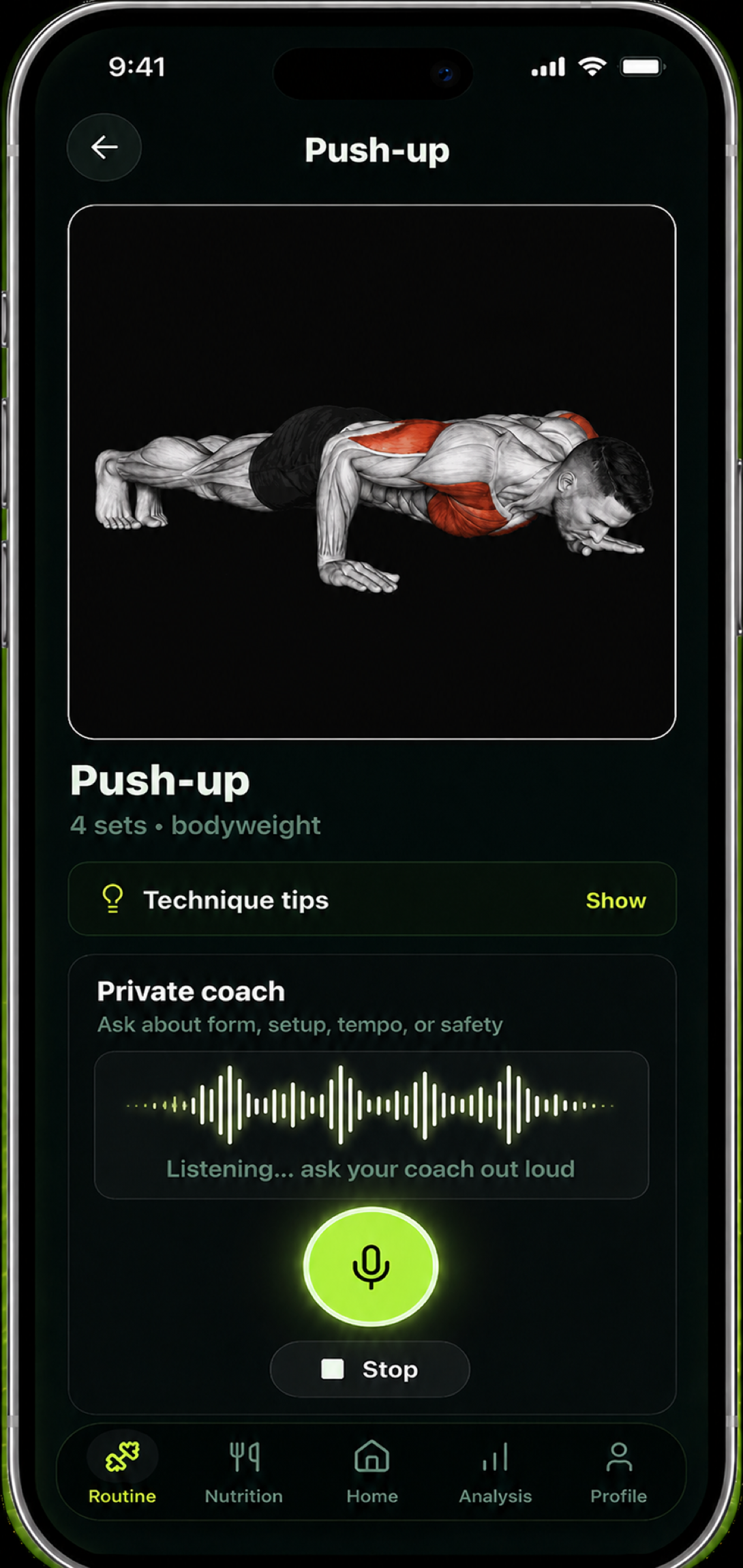
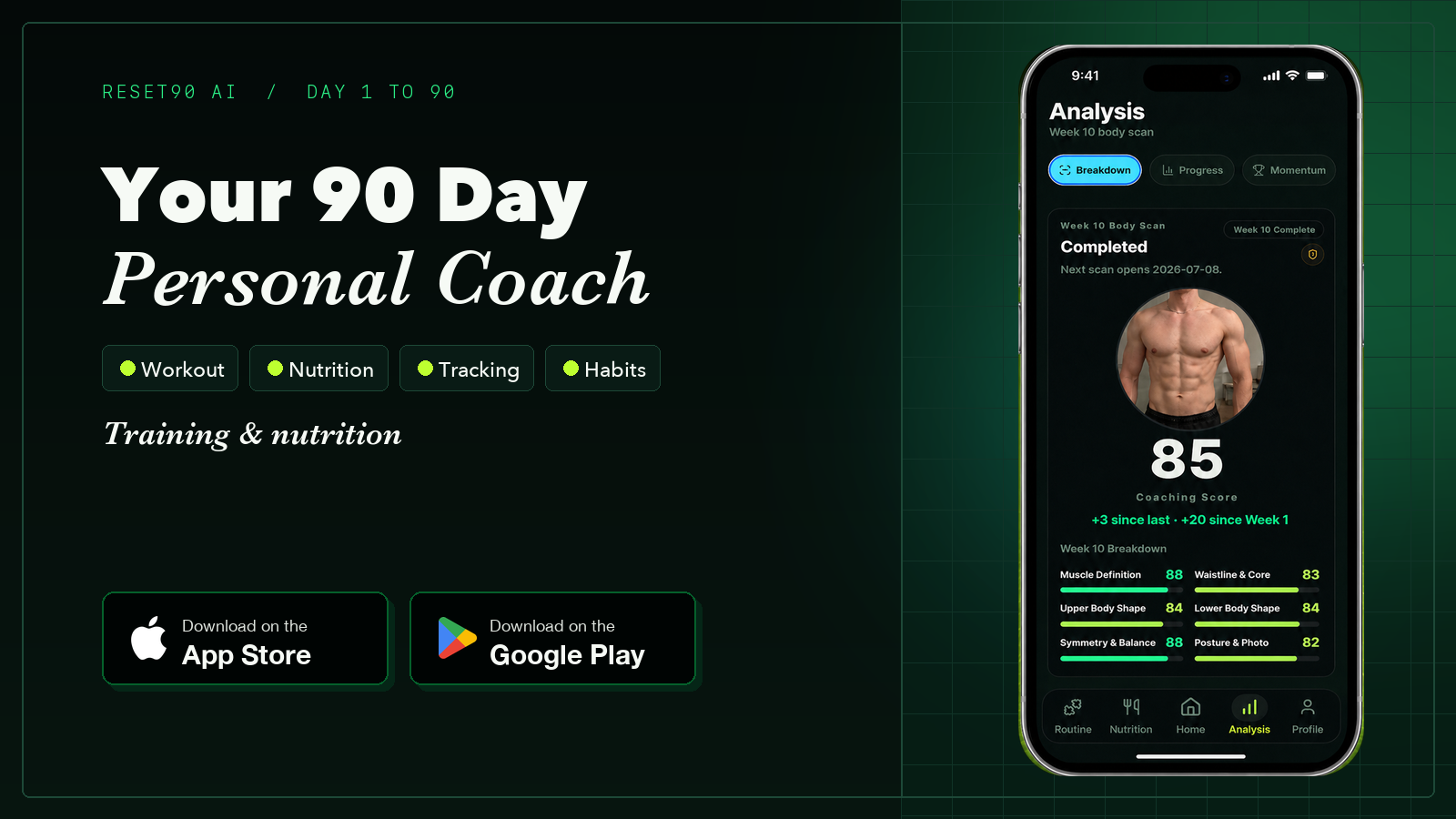
Reset90 is designed for the part that follows the measurement. Its guided check-in helps make a visual progress signal more comparable, then places that signal inside a 90-day training and nutrition loop.
That means Reset90 should not be treated as a clinical body-composition scanner or diagnostic service. The useful output is a more consistent check-in and a clearer next decision: keep the plan steady, adjust a training target, review nutrition adherence, or wait for another comparable reading.
If you want a broader category comparison, start with our guide to AI body-scan apps. If you are tracking on Android, our guide to AI body-scan and progress-photo apps covers platform trade-offs. The body-fat visualizer can help you explore a visual estimate, but it should be read as an estimate rather than a medical measurement.
10When to stop treating an app as a measurement
Do not use an AI body scan to diagnose a condition, decide whether a symptom is safe, or replace a clinician’s assessment. Seek qualified medical guidance for unexplained or rapid changes, concerning symptoms, eating-disorder risk, pregnancy-related questions, or any decision that depends on a clinical body-composition measurement.
Use the Reset90 health and safety guidance for the boundaries of fitness and nutrition coaching. If the decision is medical, the measurement needs medical context.
11Frequently asked questions
Are AI body-scan apps accurate?
They can be useful for repeatable direction over time, but accuracy varies by app, method, device, population, and capture conditions. Treat a one-off result as an estimate and judge a trend across comparable check-ins.
What is the difference between accuracy and repeatability?
Accuracy is closeness to a defined reference. Repeatability is consistency when the same method is repeated under the same conditions. A result can be repeatable without being close to the reference, so both properties matter.
Is an AI body-fat percentage accurate?
It may be reasonably close for some people and conditions, but it is not automatically equivalent to DXA, BOD POD, or another reference method. The app’s validation evidence matters more than the word “AI.”
Are AI scans better than smart scales?
Neither method is universally better. Photo and 3D scans are sensitive to pose, lighting, clothing, and camera setup. BIA scales are sensitive to hydration, exercise, meals, temperature, and foot contact. Choose the method you can repeat and interpret.
How often should I use a body-scan app?
Weekly or biweekly is a practical starting point for most fitness tracking. Keep the conditions consistent and review several readings before changing your training or nutrition plan.
Can Reset90 diagnose body composition?
No. Reset90 is a fitness and nutrition planning tool, not a medical device or diagnostic service. Its check-in is meant to support consistent progress tracking and practical decisions.
12The practical answer
AI body-scan apps are most trustworthy when you ask them a modest question: can this method give me a comparable signal under a repeatable setup, and can that signal help me make a sensible next decision?
If yes, the app can earn a place in your routine. If it produces a dramatic number that you cannot reproduce, or a precise estimate with no transparent validation, keep your confidence low. Accuracy, repeatability, and directional usefulness are different properties. The best body-scan tool is not the one that promises perfect measurement. It is the one that gives you a stable enough signal to keep making better decisions.
The Reset90 system
Useful ideas for building a body you can keep.
Training notes, product updates, and practical ways to make your next 90 days count.
Start your next 90 days
Get your daily training, nutrition, and check-in priorities in one adaptive system.


Keep reading
Related articles
Ideal Body Measurements for Women
There is no single ideal body measurement set for women. Learn how averages, waist-to-height, body shape and repeatable tracking fit together without chasing a fixed beauty standard.
Read article
Bulk, Cut, or Recomp? A Practical Decision Guide
A practical way to choose a bulk, cut, recomp, or maintenance phase using your goal, training age, recovery, and repeatable progress signals.
Read article
How Often Should You Take Progress Photos?
How often should you take progress photos? Use this goal-based guide to choose weekly, biweekly, or monthly check-ins and make every comparison more consistent.
Read article