
How Much Muscle Can You Gain in a Month?
How much muscle can you gain in a month? The honest answer depends on training age, nutrition, recovery, genetics, and how you measure it. Here is a practical range—and a better way to track the trend.
By Reset90 AI Editorial Team
How much muscle can you gain in a month? A beginner may build roughly 0.5–2 lb (0.2–0.9 kg) of muscle in a strong month, while an experienced lifter will usually gain less. That is a planning range, not a promise. Your scale can move faster because of water, glycogen, food volume, and fat, so the useful question is not only “what do I weigh?” but “what is improving consistently?”
Monthly muscle gain is one of those fitness questions that looks like it should have one clean number. It does not. The answer changes with training age, genetics, nutrition, sleep, program quality, and how you define muscle.
A useful estimate can still help. It gives you a reality check for a bulk, stops you from changing your program every seven days, and helps you decide whether a month of training produced a meaningful trend. The key is to pair a realistic expectation with a measurement system that can separate actual progress from normal scale noise.
01How much muscle can you gain in a month?
Use the table below as a conservative planning range for natural resistance training. It describes a month in which training, food, and recovery are reasonably consistent. It does not predict what any individual will gain, and it should not be treated as a target you must force.
| Training experience | Practical monthly planning range | What to expect |
|---|---|---|
| New to structured lifting | About 0.5–2 lb (0.2–0.9 kg) | Progress can be quickest early, but the scale may also include extra water and glycogen. |
| Consistent intermediate | About 0.25–1 lb (0.1–0.45 kg) | Progress is slower and is easier to see across several months than in one weigh-in. |
| Advanced lifter | Often below the intermediate range | Small improvements in strength, measurements, and execution may matter more than scale weight. |
Those bands are deliberately broad. A person returning after time away may progress faster than their calendar age in the gym suggests. Someone sleeping poorly, dieting aggressively, or changing workouts every week may progress more slowly than a beginner estimate implies. Sex, age, genetics, previous training, and health also affect the result.
For most people, the best use of the number is to set expectations: a month is long enough to establish a trend, but usually too short to prove exactly how much new muscle tissue you added.
02Why the first month can look like a bigger gain
New lifters often see several changes at once. Their muscles store more glycogen as training and food intake become more consistent. Glycogen is stored with water, and a new routine can also change meal timing, sodium intake, inflammation, and the amount of food in the digestive system.
Strength can rise quickly for another reason: your nervous system is learning the movements. Better coordination and technique can help you lift more before you have added a large amount of muscle. That is excellent progress, but it is not the same as saying every pound on the scale is new muscle.
This is why “newbie gains” are better understood as a period of fast adaptation, not a guaranteed monthly muscle allowance. The early months can be productive, but you still need enough time and repeated measurements to tell which changes are lasting.
03Muscle gain, lean mass, and scale weight are different
These terms are often used as if they mean the same thing. They do not.
| What changed? | What it can include | Why it matters |
|---|---|---|
| Scale weight | Muscle, fat, water, glycogen, food, and waste | Useful for trends, but too noisy for a daily verdict. |
| Lean mass | Everything that is not classified as fat, including water and organs | A body-composition estimate, not a direct muscle biopsy. |
| Muscle mass | Muscle tissue, depending on the measurement method | Harder to measure precisely outside a controlled setting. |
| Strength performance | Muscle, technique, coordination, leverage, and fatigue | A valuable signal, but not a perfect muscle meter by itself. |
For example, gaining three pounds in a month does not mean you gained three pounds of muscle. It may be a productive month, but the total can be a mixture of several compartments. The reverse is also possible: your scale may stay nearly flat while your waist measurement, photos, and gym performance improve during a body-recomposition phase.
That is why a useful progress system combines multiple signals. If you want a deeper explanation of why body-composition change can hide behind the scale, see our guide to food tracking for muscle gain.
04What determines your muscle gain per month?
Your monthly rate is the result of several inputs rather than one magic exercise or supplement.
- Training stimulus: You need challenging resistance training, enough hard work for the major muscle groups, and a plan that you can repeat.
- Progressive overload: Over time, you need to improve load, reps, sets, range of motion, control, or another meaningful training variable. More weight is not the only form of progress.
- Protein and total nutrition: Consistent meals and adequate protein support recovery. A small, controlled calorie surplus can help muscle gain, but a larger surplus mostly makes the scale move faster.
- Sleep and recovery: Muscles adapt between sessions. Poor sleep, excessive fatigue, and too little rest can reduce the quality of the work you are trying to recover from.
- Training age and biology: Early progress is often faster. Genetics, age, sex, hormones, health, and previous training history all influence the response.
- Adherence: The best program is the one you can execute repeatedly. Missing sessions and constantly changing the plan make a monthly comparison harder to interpret.
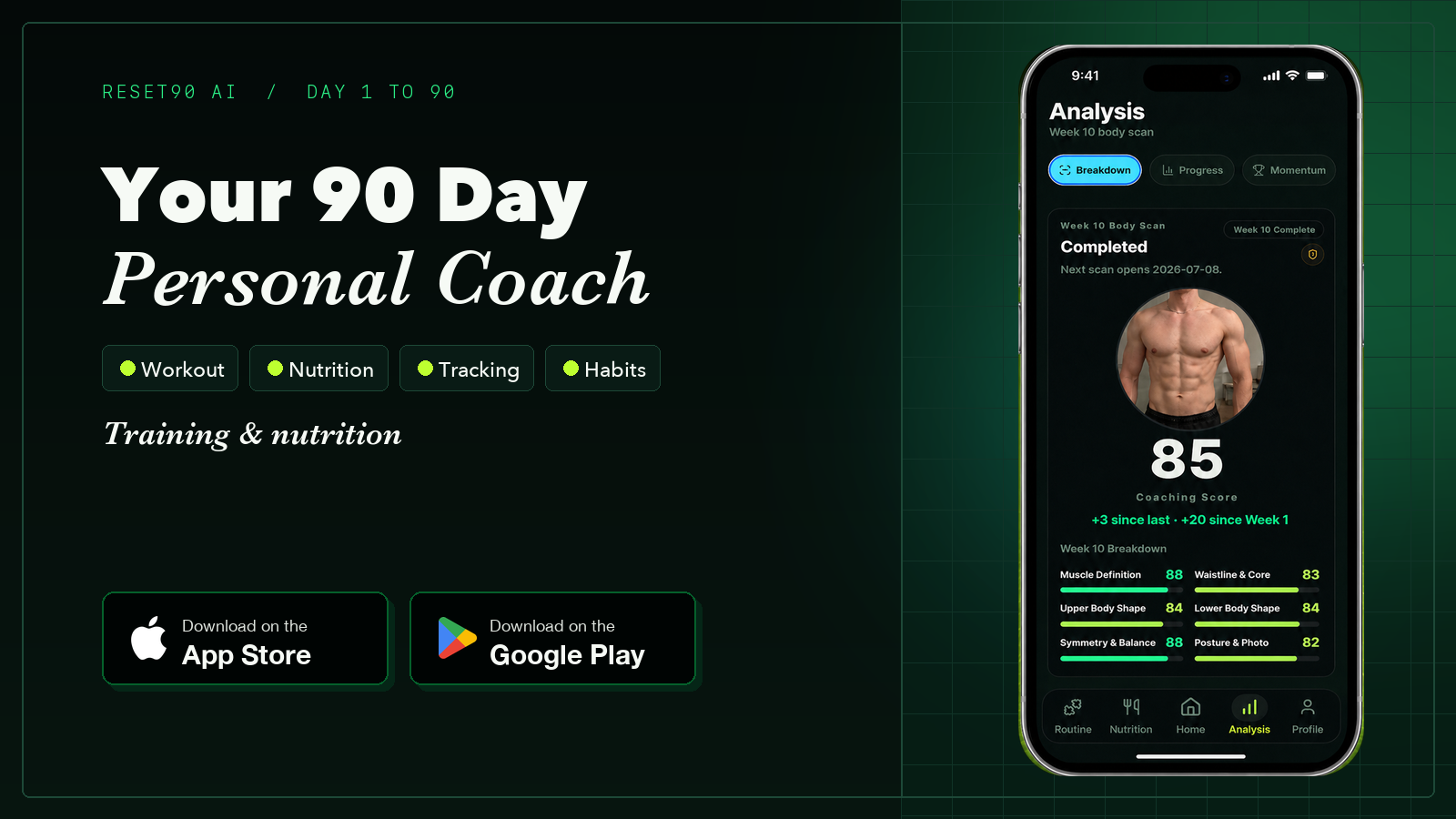
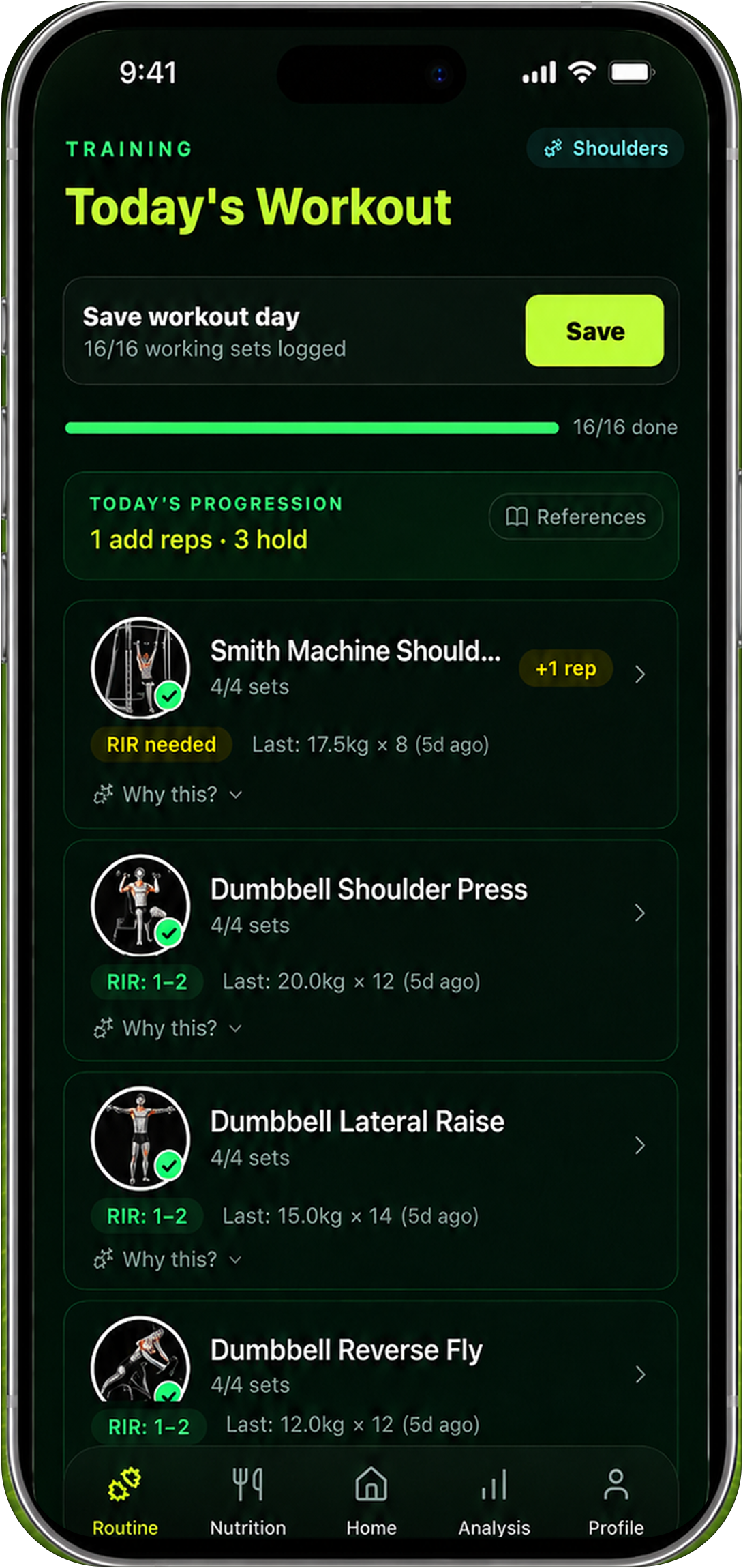
Reset90 can help turn these inputs into a repeatable routine. Use the App to see the day’s workout, follow progression and RIR guidance, keep nutrition targets visible, and record check-ins instead of trying to remember what happened at the end of the month.
05How to track whether the gain is real
Start with a baseline week, then compare trends rather than isolated readings. You do not need perfect equipment; you need consistent conditions.
- Average your body weight. Weigh under similar conditions and look at a seven-day average. Compare one week to the next, not Monday to Sunday.
- Record performance. Keep the exercise, load, reps, sets, and how the set felt. A repeatable improvement in performance is more useful than a single personal record on a high-energy day.
- Measure your waist and selected body parts. Use the same tape placement and posture. Do not measure every body part every day.
- Take progress photos. Use the same lighting, distance, clothing, pose, and time of day. Monthly photos are easier to compare than random snapshots.
- Log the context. Note training consistency, nutrition adherence, sleep, and unusual stress. These explain many “mysterious” changes.
The Reset90 App is designed for this multi-signal view: workouts and strength progression, nutrition targets, weight trends, photos, and check-ins can live in one ongoing record. That means you can review whether your month was productive without asking the scale to answer every question by itself.
If your main question is whether your program is actually progressing, our guide to tracking progressive overload explains what to record beyond “I lifted heavier once.”
06How long does it take to gain 10 pounds of muscle?
Usually much longer than a few months. Ten pounds of scale weight can arrive quickly because it may include water, glycogen, food, and fat. Ten pounds of actual muscle is a much larger project, especially as your training age increases.
A beginner who trains consistently, eats appropriately, and recovers well may make visible progress across a year. An intermediate lifter may need longer, and an advanced lifter may spend years accumulating smaller improvements. These are broad expectations, not a schedule that every body must follow.
Do not turn “gain 10 pounds of muscle” into permission to force rapid weight gain. A faster scale rate can increase fat gain without proportionally increasing muscle gain. Track the trend, review your waist and photos, and adjust gradually.
07How nutrition supports a productive month
Muscle gain does not require eating without limits. It requires enough total food to train and recover, enough protein distributed across your meals, and a plan you can follow consistently.
A practical approach is to choose a modest nutrition target, watch the four-week trend, and adjust only when the evidence supports it. If weight is not moving and performance is stalled, your intake may be too low—or the problem may be training, sleep, or adherence. If weight is rising rapidly while your waist is rising much faster than your performance, the surplus may be larger than you need.
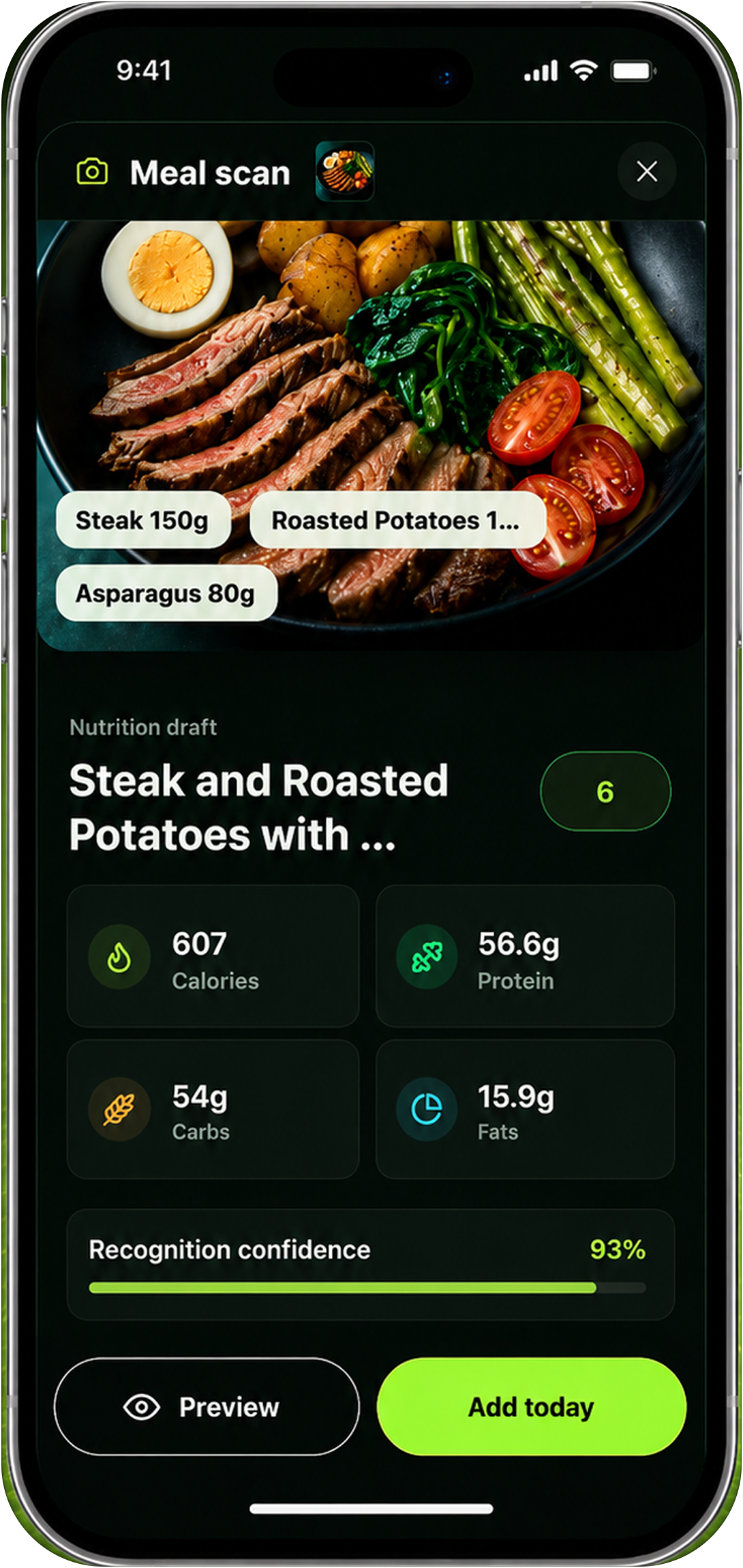
Reset90’s nutrition dashboard can keep calorie and macro targets visible while you log meals and review adherence. That makes the monthly question more useful: not “Did I eat perfectly?” but “Did my planned intake support the training trend I wanted?” For the protein side of the setup, read how much protein you need to build muscle.
08Common mistakes that make monthly progress hard to read
- Using one weigh-in as the result: hydration and digestion can move the scale more than a week of muscle growth.
- Changing the program too soon: a plan needs repeated sessions before you can judge its trend.
- Adding calories too aggressively: faster weight gain is not the same as faster muscle gain.
- Ignoring performance: body measurements are useful, but the quality and repeatability of your training matter too.
- Chasing soreness: being sore is not a reliable monthly scorecard.
- Comparing different measurement conditions: a morning photo and a post-workout photo are not a fair before-and-after pair.
09Frequently asked questions
Can you gain 1 lb of muscle in a month?
It can be a reasonable planning estimate for some beginners or people returning to training, but it is not guaranteed. The closer you are to your current potential, the less useful a fixed monthly promise becomes.
Is 3 lb of muscle in a month good?
First check what “3 lb” measures. If it came from a scale or a body-composition device, it may include water and other lean tissue. Look for a consistent combination of performance, measurements, photos, and weight trend before calling it new muscle.
How much muscle can a beginner gain in a month?
A beginner may progress near the upper end of a broad range during the first months, especially when training, food, and recovery improve together. Early strength changes can also come from better technique and coordination, so do not translate every stronger set into a precise amount of muscle.
Does gaining weight mean I am gaining muscle?
No. Weight gain can include muscle, fat, water, glycogen, and food volume. A gradual trend paired with improving training performance and stable measurements is more informative than scale weight alone.
Should women expect a different monthly muscle-gain number?
There is no single number that applies to every woman or every man. Training history, program quality, nutrition, recovery, age, genetics, and health all matter. Use the same measurement framework and judge your own trend.
10The bottom line
A realistic answer to “how much muscle can you gain in a month?” is usually a fraction of a pound to around two pounds for a productive beginner month, with slower rates as training experience increases. The range is useful only when you keep its limits in view.
Build your expectation around a repeatable month: train with progression, eat enough protein and total food, recover, and track strength, measurements, photos, and weight trends together. Download Reset90 from the App Store or Google Play using the buttons on this page to keep that process in one place, then review the trend after four weeks instead of chasing a number every morning.
The Reset90 system
Useful ideas for building a body you can keep.
Training notes, product updates, and practical ways to make your next 90 days count.
Start your next 90 days
Get your daily training, nutrition, and check-in priorities in one adaptive system.


Keep reading
Related articles

Ideal Body Measurements for Women
There is no single ideal body measurement set for women. Learn how averages, waist-to-height, body shape and repeatable tracking fit together without chasing a fixed beauty standard.
Read article
Bulk, Cut, or Recomp? A Practical Decision Guide
A practical way to choose a bulk, cut, recomp, or maintenance phase using your goal, training age, recovery, and repeatable progress signals.
Read article
How Often Should You Take Progress Photos?
How often should you take progress photos? Use this goal-based guide to choose weekly, biweekly, or monthly check-ins and make every comparison more consistent.
Read article