
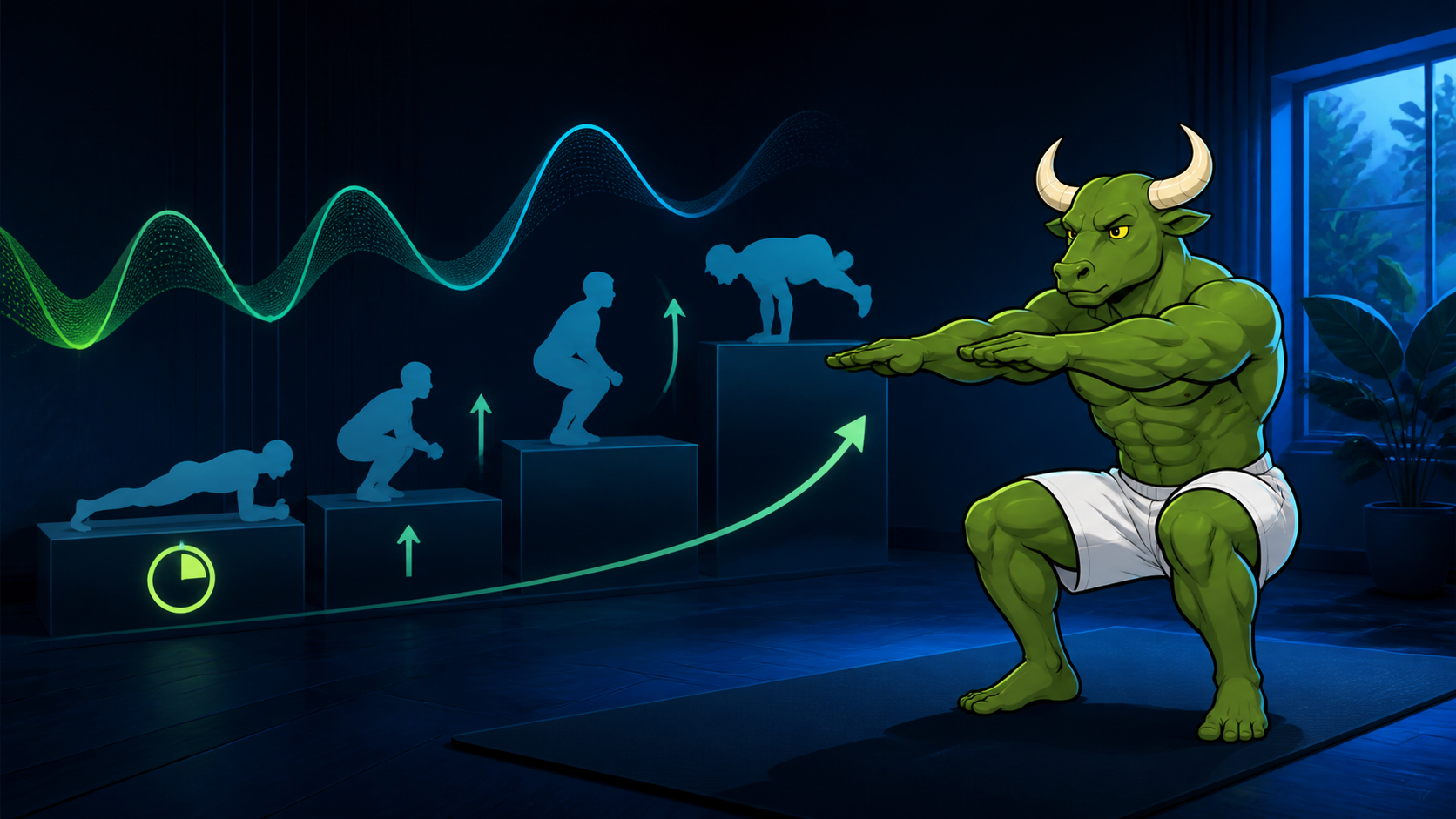
No-Equipment Home Strength Plan: How to Progress Without a Gym
Build a repeatable home strength plan without equipment by progressing bodyweight variations through repetitions, tempo, isometrics, range of motion, and smarter weekly structure.
By Reset90 AI Editorial Team
Short answer: You can build a useful home strength plan without weights by progressing the movement, not just repeating the same workout. Start with a version you can control, then increase repetitions, sets, range of motion, pauses, tempo, leverage difficulty, or density one at a time. Keep the weekly plan simple enough to repeat and use a lower-demand version when recovery or space is limited.
01Build around movement patterns, not random workouts
A no-equipment plan works best when it has a small number of movement patterns that repeat often enough to improve. A random collection of exercises may create fatigue, but it makes progression and recovery difficult to evaluate.
Use a basic pattern map:
| Pattern | Example starting options | What to progress |
|---|---|---|
| Squat | Chair squat, bodyweight squat | Depth, pauses, repetitions, single-leg assistance |
| Hinge | Hip hinge, bridge, single-leg bridge | Range, pause, leverage, controlled tempo |
| Push | Wall push-up, incline push-up, floor push-up | Leverage, range, repetitions, pause position |
| Pull substitute | Prone row pattern, reverse snow angel, isometric back squeeze | Time under tension, control, range, repeated quality |
| Core | Dead bug, plank, side plank | Time, breathing control, leverage, movement quality |
| Carry or conditioning | Marching, step pattern, brisk walk | Time, pace, coordination, recovery between rounds |
The goal is not to imitate every gym exercise with a floor variation. The goal is to train the main patterns often enough that you can see whether control, capacity, or tolerance is improving.
02Choose a starting version you can own
The right starting variation is the hardest version you can perform with stable technique for the planned repetitions. If the movement breaks down immediately, it is too difficult for the current phase. If it feels effortless and gives you no useful feedback, it may be too easy.
Use a simple three-level choice:
- Accessible: use a wall, chair, shorter range, or two-leg version to learn the pattern.
- Standard: use the full bodyweight variation with controlled repetitions.
- Challenging: use a longer range, unilateral variation, pause, or slower lowering phase.
Start one level below the version you could barely complete. A plan that leaves room for repeatable progress is more useful than a test that creates soreness and uncertainty on day one.
03Use tempo, pauses, and range of motion
When you cannot add external load, you can change how the movement is performed. Tempo, pauses, and range of motion are useful because they make the same exercise more demanding without requiring equipment.
Progress one control variable at a time:
- Tempo: slow the lowering phase while keeping the path controlled.
- Pause: briefly hold the position where the movement is hardest.
- Range: gradually use a larger, repeatable range of motion.
- Leverage: move from an incline or supported version toward a less assisted variation.
- Density: complete the same quality work with slightly less unnecessary rest.
Do not slow every exercise indefinitely. If a slower tempo makes your technique worse or turns the movement into a painful position, return to a version you can control.
04Progress repetitions before adding more exercises
Repetitions are an easy progression signal because they are simple to record. Choose a broad range and keep the movement standard stable. For example, you might begin with sets that fall between six and twelve controlled repetitions.
| Week | Example push-up progression | What changed |
|---|---|---|
| 1 | Incline push-up: 3 × 6 | Learn the position and stop before technique slips |
| 2 | Incline push-up: 3 × 8 | More quality repetitions at the same variation |
| 3 | Incline push-up: 3 × 10 | Build capacity before changing leverage |
| 4 | Lower the incline: 3 × 6 | Increase difficulty and rebuild the repetition range |
The numbers are examples, not a universal prescription. The principle is to earn a harder variation through repeatable work instead of changing exercises every session.
05Use isometrics as a bridge, not the whole plan
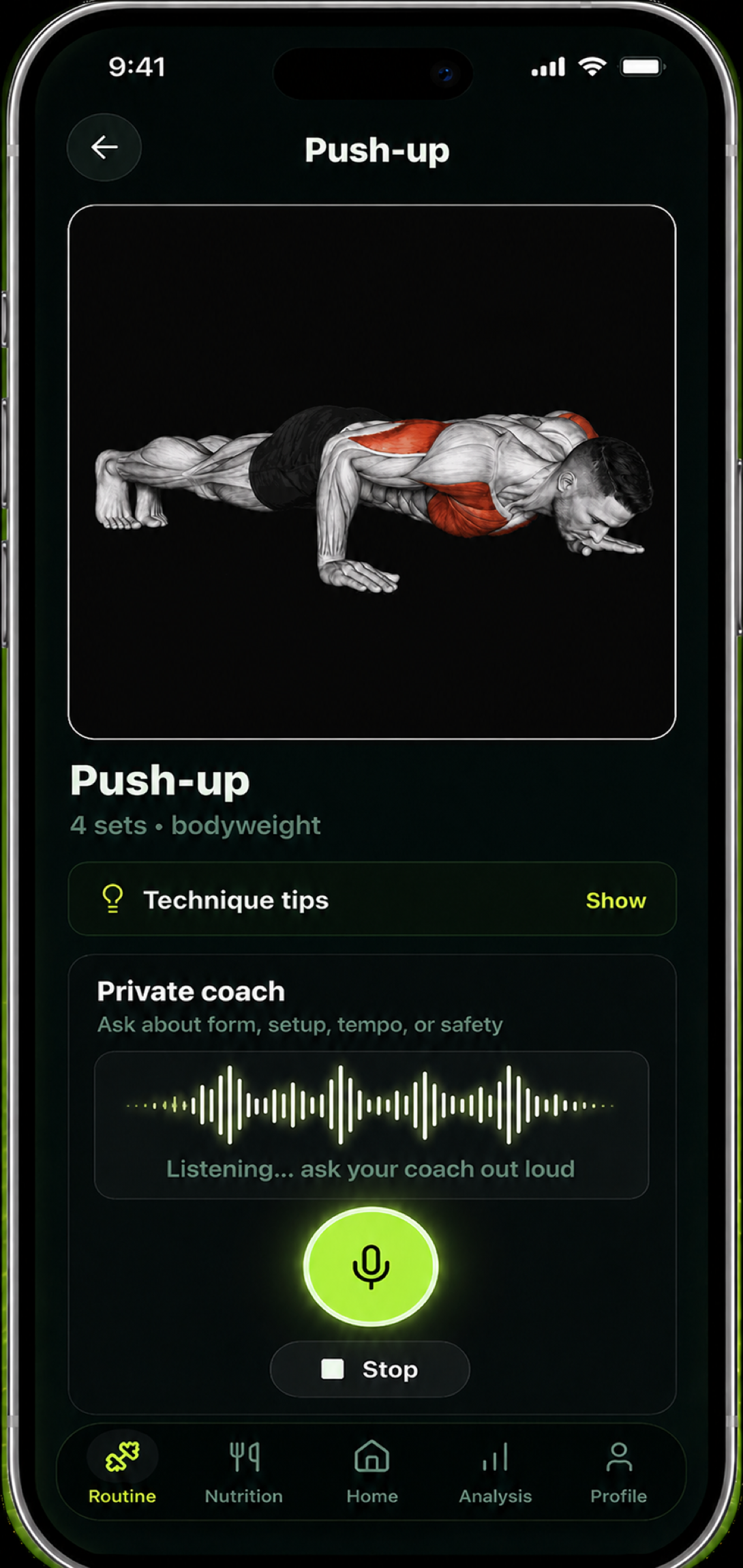
Isometric holds can help when the full movement is too difficult, when you need to practice a position, or when your space makes dynamic exercise awkward. A plank, split-squat hold, or paused push-up position can teach control and build tolerance.
Use holds with a clear purpose:
- Hold the position only while you can breathe and maintain alignment.
- Increase time gradually rather than turning every set into a maximal test.
- Pair the hold with a controlled movement when possible.
- Progress leverage or position when longer holds stop creating a useful challenge.
Isometrics are one progression tool. They do not need to replace every dynamic movement in the plan.
06Balance push, legs, core, and conditioning
A home plan should cover the work you can perform safely and consistently, but it does not need to pretend that every movement pattern is equally easy without equipment. Pressing and leg training often have obvious bodyweight progressions. Pulling may require more creativity, and a safe setup matters.
Build the week around:
- One squat or single-leg pattern.
- One hinge or posterior-chain pattern.
- One push variation.
- One upper-back or scapular-control pattern that fits your environment.
- One core pattern with controlled breathing.
- Optional walking, marching, or low-impact conditioning.
If you do not have a secure place for a pulling movement, do not improvise with a weak door, unstable furniture, or an object that can move unexpectedly. Use a safer substitute and treat equipment access as a future planning constraint.
07Build a two-, three-, or four-day week
The best frequency is the one you can repeat through normal and difficult weeks. A no-equipment plan can use full-body sessions at different frequencies without changing the entire movement library.
| Frequency | Structure | Best use |
|---|---|---|
| Two days | Full body A / Full body B | Busy schedules or a reliable minimum plan |
| Three days | Full body / lower emphasis / upper-core emphasis | More practice without making every session long |
| Four days | Two strength-focused pairs repeated with small changes | People who recover well and want shorter sessions |
Keep at least one easier day or rest day between demanding sessions for the same patterns. More calendar entries do not automatically create more progress.
08Use a simple full-body session template
A session does not need twelve exercises. Start with a small menu and make the work repeatable.
- Prepare: use a short warm-up that rehearses the movements and checks how the body feels today.
- Lower body: choose a squat, split-squat, bridge, or hinge pattern.
- Push: choose a variation whose range and technique you can control.
- Upper back and core: choose safe scapular-control and trunk exercises.
- Conditioning: finish with walking, marching, or a low-impact circuit only if it supports recovery.
Use the adaptive workout plan guide if your week changes frequently. The home plan should have a full version and a shorter fallback version before you need the fallback.
09Make the short version part of the plan
Consistency improves when a busy day has a predefined option. A short version is not a failed full session. It is a deliberate way to preserve the pattern while reducing the demand.
A short session might include:
- One lower-body movement for two controlled sets.
- One push or upper-body substitute for two controlled sets.
- One core or breathing-focused movement.
- A short walk if it helps you transition out of the session.
Do not try to make up every missed set the next day. Resume the normal plan when capacity returns and use the log to understand why the fallback was needed.
10Track progress without equipment
A bodyweight plan still needs a progression record. Track enough to know whether the work is becoming more controlled or more demanding.
| Field | Example | Why it helps |
|---|---|---|
| Variation | Incline push-up | Shows the leverage and difficulty level |
| Work | 3 sets of 8 | Shows total repetitions and sets |
| Control | Three-second lowering phase | Explains why the same variation became harder |
| Effort | About two reps in reserve | Shows proximity to current capacity |
| Quality note | Depth consistent; last reps slow | Separates real progress from rushed repetitions |
For a broader explanation of progression audits, read how to track progressive overload when the weight stops moving. The same principle applies: change one variable, keep the comparison fair, and review more than one session.
11Use difficulty levels instead of chasing fatigue
A hard workout is not automatically a good workout. A plan should challenge the target movement while leaving enough recovery to repeat it. If every session becomes a test of exhaustion, you lose the ability to tell whether capacity is improving.
Use a simple effort guardrail:
- Controlled: finish with clear technique and room for more.
- Challenging: the final repetitions slow, but the movement standard holds.
- Too difficult: range shortens, alignment changes, or you cannot repeat the pattern.
If a variation is too difficult, regress it. If it is always easy, progress one variable. The goal is a useful training signal, not a dramatic finish.
12Plan around the space you actually have
Home training is partly a logistics problem. Measure the space before choosing movements that require a long floor area, overhead clearance, or a stable surface.
Check:
- Can you lie down without hitting furniture?
- Can you step or lunge without slipping?
- Is the floor stable enough for the chosen movement?
- Can you see your alignment without creating a distraction?
- Can you store a mat or towel so setup takes less than a minute?
Reducing setup friction is a form of progression support. A plan that is technically excellent but difficult to start will not create much training history.
13Know when to stop or reduce the plan
Bodyweight training still has safety boundaries. Stop or reduce the movement when pain, dizziness, instability, or unusual symptoms change the session. Do not turn a home workout into a test of willpower.
Use these rules:
- Stop a movement if pain changes the way you move.
- Choose a simpler variation when balance or control is not reliable.
- Reduce volume after an unusually difficult week instead of adding more work to compensate.
- Seek appropriate professional guidance for persistent symptoms, injury concerns, or complex medical situations.
This article is a training-planning guide, not a medical assessment. A safe minimum that you can repeat is more valuable than a hard session that interrupts the next two weeks.
14Review the plan every seven days
A weekly review prevents the plan from becoming a list of workouts detached from your actual life. Keep the review short:
| Review area | Question | Adjustment |
|---|---|---|
| Completion | How many full, short, or missed sessions? | Change frequency or define a clearer fallback |
| Progression | Did reps, sets, range, tempo, or leverage improve? | Keep the current version or progress one variable |
| Recovery | Did the next session feel repeatable? | Reduce density or add an easier day |
| Friction | What made starting difficult? | Remove one setup step or simplify the menu |
If you want a longer container for the review, use a 90-day plan as a framework rather than a promise. The 90-day exercise programs comparison shows how different progression structures can serve different constraints.
15Frequently asked questions
Can I build strength without weights?
Yes, especially when you choose an appropriate movement variation and progress repetitions, leverage, range of motion, pauses, tempo, or total work. The available progression options depend on the movement and your starting level.
How many days per week should I train at home?
Choose the frequency you can recover from and repeat. Two full-body sessions can be a strong minimum, while three or four days can work when sessions are shorter and recovery is good.
What if bodyweight squats become too easy?
First confirm that range, control, and depth are consistent. Then try a pause, slower lowering phase, larger range, split-squat variation, or additional quality repetitions before adding more exercises.
How do I train my back without equipment?
Use safe floor-based scapular-control, prone, and trunk exercises that fit your environment. Do not improvise hanging or pulling setups with unstable furniture or weak fixtures.
Should every home workout be hard?
No. A sustainable week includes challenging work, easier options, and enough recovery to repeat the movement patterns. The goal is a useful progression signal, not maximum fatigue every session.
16Progress by making the next version slightly better
No-equipment strength training becomes sustainable when the plan gives you a clear next step. Start with a movement you can control, repeat it often enough to learn, and progress one variable when the current version becomes reliable.
You do not need a new workout every day. You need a small set of patterns, a full and short version, a safe progression ladder, and a weekly review that keeps the plan connected to real life.
The Reset90 system
Useful ideas for building a body you can keep.
Training notes, product updates, and practical ways to make your next 90 days count.
Start your next 90 days
Get your daily training, nutrition, and check-in priorities in one adaptive system.


Keep reading
Related articles
Ideal Body Measurements for Women
There is no single ideal body measurement set for women. Learn how averages, waist-to-height, body shape and repeatable tracking fit together without chasing a fixed beauty standard.
Read article
Bulk, Cut, or Recomp? A Practical Decision Guide
A practical way to choose a bulk, cut, recomp, or maintenance phase using your goal, training age, recovery, and repeatable progress signals.
Read article
How Often Should You Take Progress Photos?
How often should you take progress photos? Use this goal-based guide to choose weekly, biweekly, or monthly check-ins and make every comparison more consistent.
Read article