
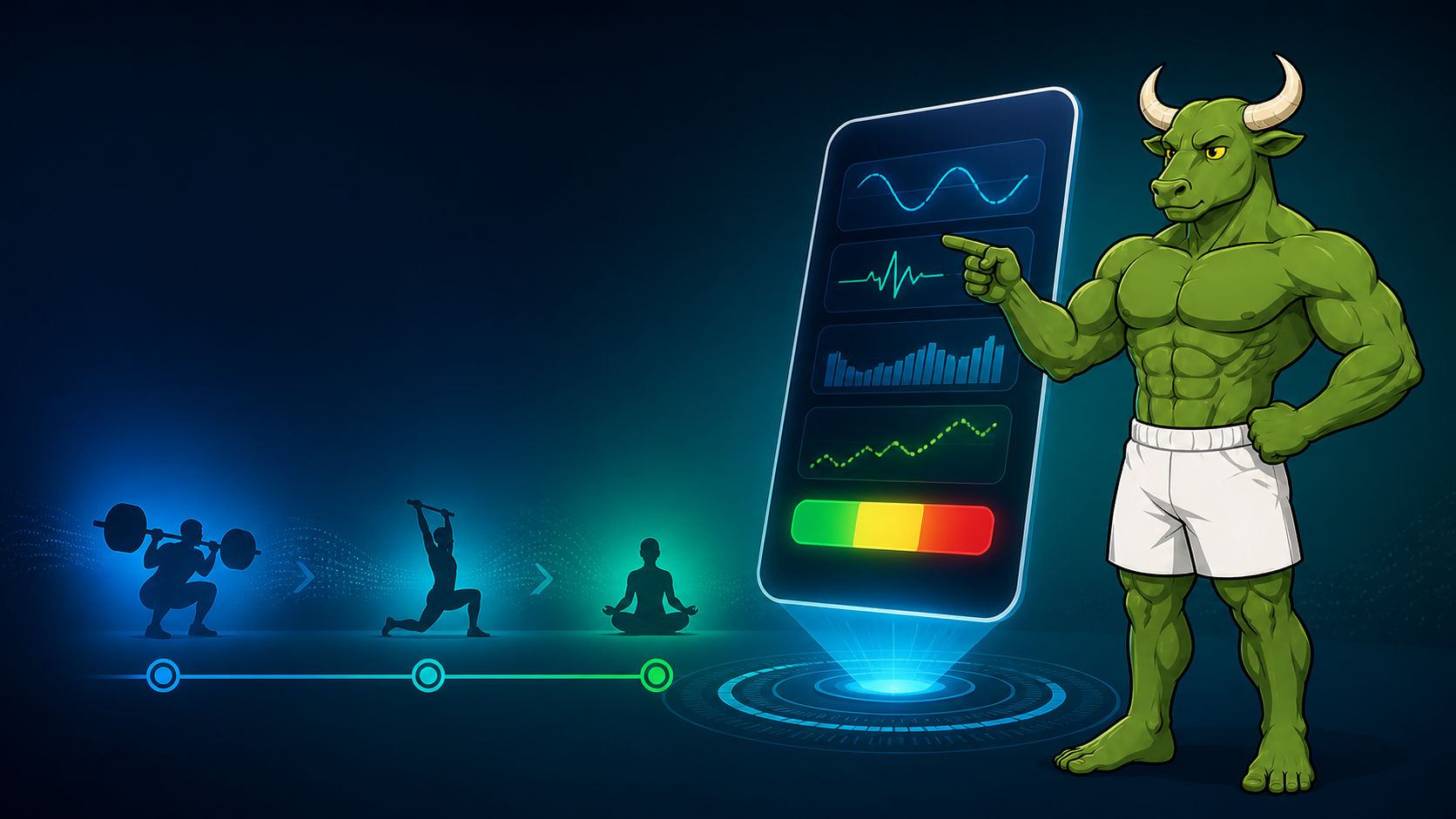
Recovery Score for Lifters: When to Train Hard and When to Back Off
A recovery score is a readiness signal, not an order. Here is how a lifter should use it to train hard, trim volume, or back off without abandoning consistency.
By Reset90 AI Editorial Team
Short answer: A recovery score is a readiness signal, not an order. Use a high score as permission to train hard if your warm-up and how you feel agree. Use a moderate score to cap intensity or optional volume. Use a low score to adjust the session, especially when it stays low for several days. A score cannot diagnose illness or measure exactly how recovered a muscle is.
01What a recovery score actually measures
Most recovery or readiness scores combine overnight and recent-training inputs into one simplified signal. Depending on the product, those inputs may include sleep duration, sleep regularity, heart-rate variability, resting heart rate, wrist temperature, respiratory rate, recent training strain, and how your current reading compares with your personal baseline.
The number is a weighted heuristic. It is not a direct scan of your muscles, nervous system, glycogen stores, or motivation. Two apps can use similar inputs and produce different scores because they choose different baselines, weights, windows, and thresholds.
GainFrame’s recovery-score guide for lifters describes the practical version of this idea: the useful detail is often the signal pulling the score down, not the score itself. That is a product perspective rather than independent validation, but it is a good reading rule. A low result caused by four hours of sleep deserves a different response from a low result after several weeks of accumulating training load.
02Readiness is not the same as recovery
“Recovery” sounds like a single biological state, but training affects several systems at once. Your heart-rate variability may look normal while a sore joint still needs attention. You may sleep well and still have poor local recovery in a muscle group you trained hard yesterday. You may feel tired because of work stress rather than because the last workout exceeded your capacity.
For a lifter, a readiness score is therefore best treated as one piece of context around the session. It can help identify a day when pushing the planned top set is less attractive. It cannot prove that you are ready for a personal record, and it cannot overrule sharp pain, fever, dizziness, unusual shortness of breath, or another symptom that needs medical attention.
The right question is not “What does my score command me to do?” It is “What level of training quality can I produce safely today, given the score, my symptoms, my warm-up, and the goal of this phase?”
03Why lifters should use readiness scores defensively
Endurance platforms often frame readiness around optimizing a performance peak. A lifter usually has a different job: accumulate high-quality work over months while keeping fatigue from quietly degrading the next session.
A recovery score is useful in that context as an early-warning system. It can reveal a run of short sleep, an elevated resting heart rate, a downward HRV trend, or a training-load spike before your logbook looks obviously bad. It cannot tell you whether the program is building muscle by itself; that still shows up in progressive performance, body-composition trends, nutrition adherence, and repeatable check-ins.
The International Olympic Committee consensus statement on training load and illness recommends considering sport and non-sport load together with performance, well-being, and illness monitoring. That is the broader principle behind a readiness score: use multiple inputs to understand the training response, then modify load when the pattern says your current plan is not being absorbed well.
04Check input quality before you trust the score
A score built from poor input is polished noise. Before changing the workout, check whether the measurement is comparable to your baseline.
- Same measurement conditions: HRV and resting heart rate are easier to compare when collected at a similar time, position, and point in your wake-up routine.
- Enough baseline: A personal baseline needs repeated readings. The first few days on a new wearable should not become an absolute standard.
- Sensor quality: Loose contact, a missing night, a device change, or an algorithm update can create a false trend.
- Context: Travel, alcohol, illness, unusually late meals, stress, heat, and a hard session can all affect overnight signals.
- Signal agreement: A score is more useful when sleep, soreness, mood, and warm-up performance tell a similar story.
HRV-guided training research supports this cautious approach. A systematic review and meta-analysis found that HRV-guided programs may improve vagal-related HRV measures, but their advantage for aerobic fitness and endurance performance was small; the authors also noted that baseline methods and daily-change thresholds need further study. Read that as evidence for using HRV as a trend, not as a magic readiness meter.
05How sleep changes the training decision
Sleep is often the easiest readiness input to understand because it affects both the score and how the session feels. One poor night does not automatically erase your training plan. A repeated pattern of short or disrupted sleep deserves more respect than a single red tile.
A systematic review of resistance-exercise studies found that consecutive nights of sleep restriction can reduce force output in multi-joint movements, although the evidence was not uniform across every exercise. A broader meta-analysis also found that acute sleep loss can impair physical performance. These studies do not tell you exactly what to lift today, but they support a conservative rule: when sleep is poor, use the warm-up and the first working sets to decide whether the planned intensity is realistic.
If sleep is repeatedly poor, the solution is not an endless sequence of lighter workouts. Look at the cause, including schedule, caffeine timing, stress, environment, and training time. If persistent sleep problems or other symptoms are affecting daily life, speak with a qualified health professional.
06How a recovery score becomes a training action
| Readiness pattern | Training response | Guardrail |
|---|---|---|
| High or green, with normal warm-up and no concerning symptoms | Train as planned; a hard top set or planned progression can be reasonable | Do not turn one green reading into extra volume everywhere |
| Moderate or yellow, with normal movement but lower energy | Keep the main work, cap effort, and remove optional sets or finishers | Preserve technique and leave room before failure |
| Low or red for one day, without illness or injury symptoms | Use lighter loads, fewer sets, or a technique and movement session | One low day is not a diagnosis and does not require abandoning the plan |
| Low for several days, with declining performance or worsening well-being | Reduce training stress and investigate sleep, schedule, nutrition, and recent load | Use a planned deload or recovery block rather than repeatedly forcing hard sessions |
| Any score with acute pain, fever, dizziness, or concerning symptoms | Stop and seek appropriate medical guidance | A wearable score never clears a medical warning sign |
This table is intentionally conservative. It does not turn a consumer score into a prescription. It gives you a way to reduce the cost of a bad day without making a low number the reason you stop training altogether.
07Use the three-filter check before a hard session
Before deciding whether to push, run three quick filters.
- Readiness trend: Is today’s score meaningfully different from your recent baseline, or is it just one noisy reading?
- Human context: How was your sleep, stress, soreness, motivation, and general well-being? Do you have any symptom that changes the safety question?
- Warm-up response: Do the first easy sets move normally? Does the planned load feel technically stable, or are you compensating and grinding earlier than usual?
If all three filters agree, the decision is easier. If the score is low but you feel normal and the warm-up is strong, keep the session conservative rather than chasing a maximum. If the score is fine but you have sharp pain or feel ill, the score loses the argument immediately.
08What a deload guardrail should look like
A deload is not punishment for a low score. It is a controlled reduction in training stress when your recent pattern suggests that more hard work is no longer producing high-quality output.
Use a guardrail based on a cluster of signs: readiness remains low for several days, anchor lifts regress, soreness is not resolving, sleep is deteriorating, and normal sessions feel unusually hard. One green or red reading should not trigger a week-long change.
When a deload is appropriate, keep the habit of training while reducing the part that is creating the most fatigue. That might mean fewer hard sets, no failure work, lighter variations, longer rest, or a lower-intensity technique session. The exact adjustment depends on the program and the person. Return to normal progression when performance and well-being stabilize, not simply when an app changes color.
09How to build a two-week personal baseline
If you have never used a readiness score, start with observation rather than immediate automation.
- Collect consistent readings for two weeks. Keep the device, measurement position, and wake-up routine as stable as you can.
- Log the session beside the score. Record the main lift, perceived effort, sleep, soreness, and whether the warm-up felt normal.
- Mark obvious disruptions. Note travel, alcohol, illness, late nights, unusually hard sessions, and sensor gaps.
- Find your useful range. Look for which scores or trends actually coincide with poor sessions for you, rather than borrowing another athlete’s cutoff.
- Test a small adjustment. On a lower-readiness day, reduce optional volume and compare the next-day and next-session response.
Your baseline is personal and can move as your training, schedule, device, or life changes. A universal red line is appealing because it looks precise, but it is often less useful than a rolling personal range with context.
10When the score disagrees with your performance
Scores and training logs can disagree without either one being “wrong.” A readiness algorithm sees a limited set of signals. Your log sees the actual exercise, load, technique, and result.
If the score is low but your anchor lifts and warm-up are normal, do not use that as permission to ignore every future low score. Instead, keep the session controlled and record the outcome. If the score is high but performance is repeatedly poor, look for local muscle fatigue, exercise selection, insufficient food, technique changes, or a programming problem that a whole-body readiness score cannot see.
Over several weeks, the disagreement itself becomes information. A score that never lines up with your sessions may not deserve much weight in your decision. A score that consistently flags the same fatigue pattern can become a useful supporting input, even if it never predicts an exact number of reps.
11How Reset90 should use readiness data
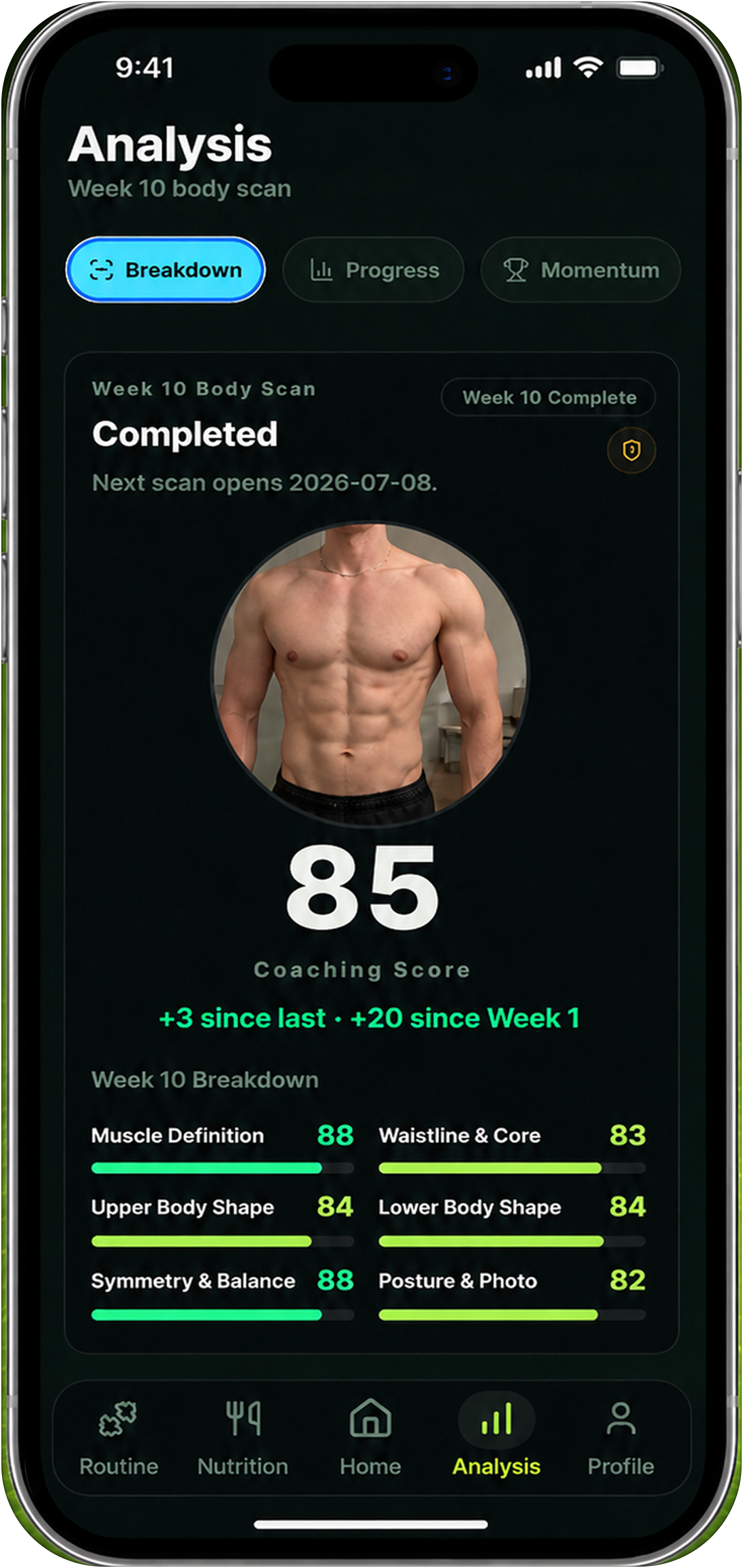
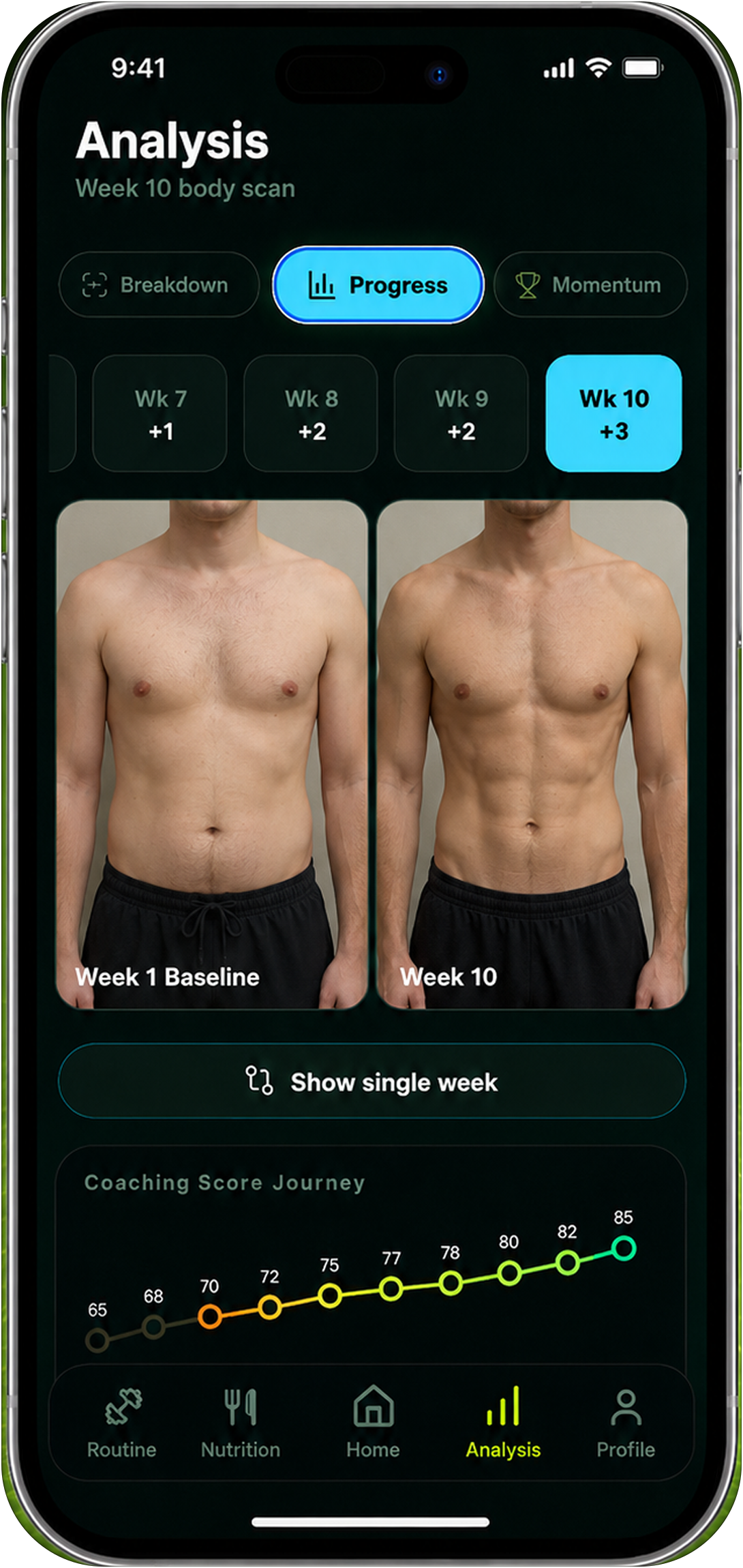
Reset90’s job is to connect readiness context to an adaptive 90-day plan, not to diagnose recovery or hand down a command. A check-in can help you decide whether to keep the planned session, reduce optional work, or review the previous week’s training and nutrition.
The decision should still be grounded in the outcome you are trying to create: quality sessions, sustainable nutrition, and progress you can observe over time. That is why recovery data belongs alongside training logs and progress check-ins, not above them.
Our guide to training, nutrition, and recovery apps covers the wider category. If the problem is repeatedly missing sessions rather than physiological fatigue, read what a fitness app should do when motivation drops. The appropriate tool depends on whether the bottleneck is readiness, planning, adherence, or health.
12When a readiness score is not enough
Do not use a recovery score to diagnose overtraining syndrome, infection, heart problems, a sleep disorder, depression, or any other medical condition. Do not use a green score to override chest pain, faintness, fever, severe shortness of breath, sharp injury pain, or symptoms that concern you.
If your readiness stays unusually low, your performance continues to fall, or your sleep and mood change persistently, reduce training stress and speak with a qualified clinician. Wearable data can help you describe a pattern, but it cannot establish the cause.
See the Reset90 health and safety guidance for the boundary between fitness planning and medical advice.
13Frequently asked questions
Should I train hard when my recovery score is high?
A high score can support the decision to follow a hard session if your warm-up, symptoms, and plan agree. It does not mean you need to add extra sets or attempt a personal record.
Should I skip the gym when my recovery score is low?
Usually, a low score for one day is a reason to adjust the session rather than automatically skip it. Use lighter work, less volume, or technique practice. Skip training and seek appropriate guidance when you have illness, injury, or concerning symptoms.
Is HRV a reliable recovery metric?
HRV can be a useful personal trend, but it is sensitive to measurement conditions and normal day-to-day variation. Use a consistent baseline and combine it with sleep, well-being, training performance, and recent load.
How many low-readiness days mean I need a deload?
There is no universal cutoff. A run of low readings is more meaningful when it appears with declining performance, poor sleep, persistent soreness, or worsening well-being. Use the cluster and your program context rather than one number.
Can Reset90 diagnose recovery or overtraining?
No. Reset90 is a fitness and nutrition planning tool, not a medical device or diagnostic service. Readiness context can support a training decision, but it cannot establish a medical cause.
14The practical answer
A recovery score is most useful when it keeps you from making two predictable mistakes: forcing a hard session when your system is clearly under-recovered, or abandoning your plan because of one imperfect morning.
Use the score as a dashboard light. Green can support the plan. Yellow can trim the plan. Red can make the session easier, especially when it persists. Then let performance, well-being, and the next few weeks of training tell you whether the adjustment worked. That is how lifters use readiness data without letting a number replace judgment.
The Reset90 system
Useful ideas for building a body you can keep.
Training notes, product updates, and practical ways to make your next 90 days count.
Start your next 90 days
Get your daily training, nutrition, and check-in priorities in one adaptive system.


Keep reading
Related articles

Ideal Body Measurements for Women
There is no single ideal body measurement set for women. Learn how averages, waist-to-height, body shape and repeatable tracking fit together without chasing a fixed beauty standard.
Read article
Bulk, Cut, or Recomp? A Practical Decision Guide
A practical way to choose a bulk, cut, recomp, or maintenance phase using your goal, training age, recovery, and repeatable progress signals.
Read article
How Often Should You Take Progress Photos?
How often should you take progress photos? Use this goal-based guide to choose weekly, biweekly, or monthly check-ins and make every comparison more consistent.
Read article