

Workout Logbook vs Reset90: Which System Helps You Keep Going?
A workout logbook records what happened. Reset90 adds a plan for what happens next. Use this comparison to decide which layer is missing for you.
By Reset90 AI Editorial Team
Short answer: Choose a logbook if you already own the plan and only need an accurate record. Choose Reset90 if you need the system to decide the next step and connect training with nutrition, check-ins, and progress. A logbook records; Reset90 fills the blank spaces around it.
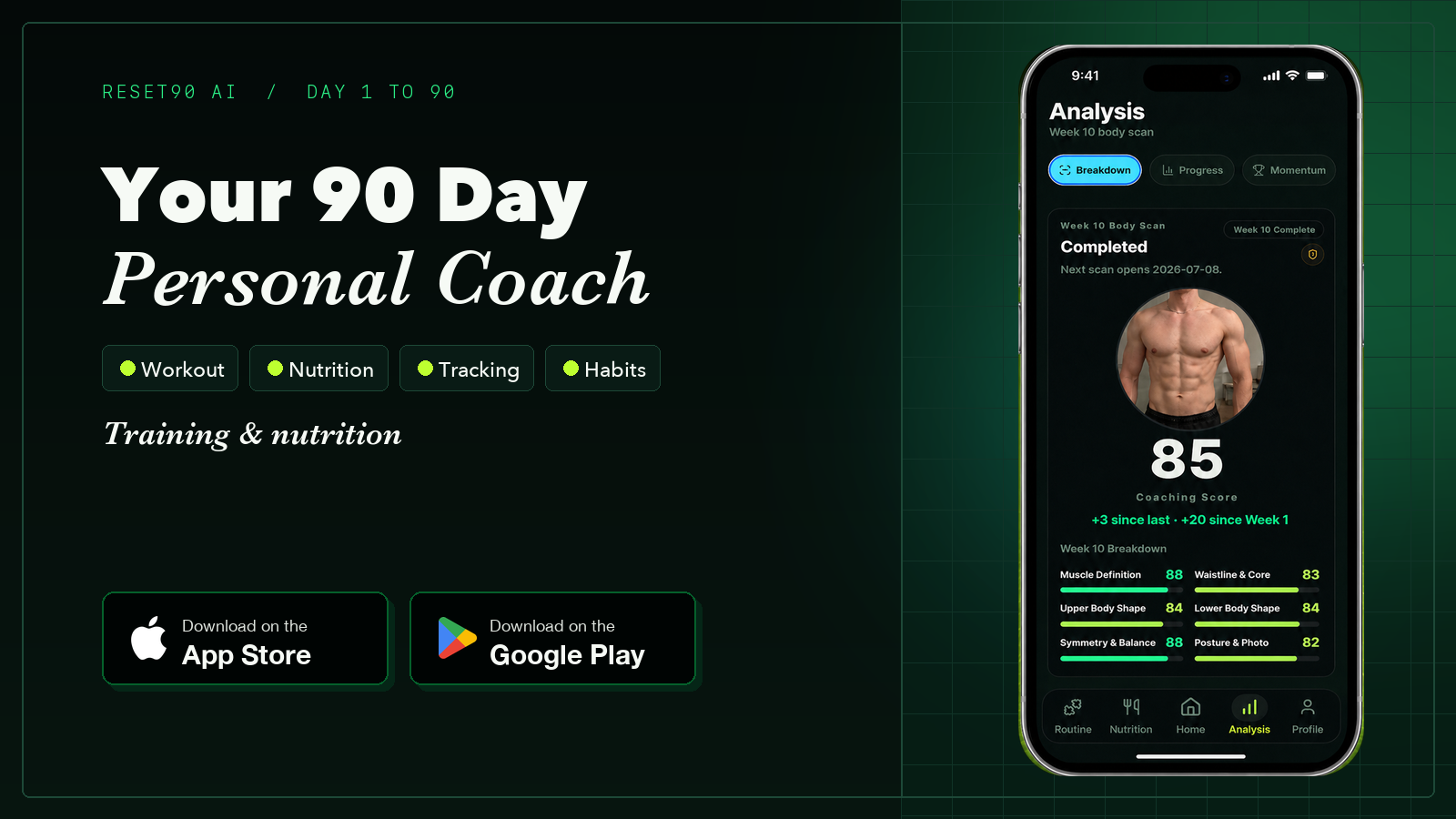
A three-dollar notebook has outlived dozens of app generations. That is not nostalgia—it is a design lesson. The notebook does one job, never crashes, never expires, and never asks for a subscription.
This comparison is about why that durability matters, what the data says happens in the weeks where most people quit, and who fills the blank spaces a notebook leaves open.
01Why the notebook endures
A workout logbook is honest about its scope: you write down the sets, reps, and loads you completed, and you own every decision. It works with a pencil, it has no onboarding, and it is yours forever. For an experienced trainee with a coach, a written program, or a personal system already working, that is not a limitation—it is the point.
The durability comes from the narrowness. The notebook does not try to plan your week, coach your technique, or nudge your nutrition. It records. That is exactly why it never gets in the way.
02What the data says about tracking and quitting
Here is the uncomfortable part: the notebook wins on durability, but the data says the failure is rarely about recording.
- Strava named the second Friday of January “Quitter’s Day” after its own user data showed that about 80% of New Year’s fitness resolutions are abandoned by the second week of January.
- Habit research (Lally et al., 2010) found it takes on average 66 days for a behavior to become automatic—with a range from 18 to 254 days. The first nine weeks are the danger zone.
- Health and fitness app benchmarks put week-1 retention in the high teens to mid-20s percent, meaning three of every four installs are gone within a week.
- Behavioral research consistently finds self-monitoring is one of the strongest correlates of sticking with exercise—but logging alone does not get someone through the weeks where motivation dies.
The pattern is the same everywhere: people do not quit because recording was hard. They quit in weeks two through nine, when the plan stops fitting real life. A faster or more durable log does not fix that—it just records the failure more reliably.
03The blank spaces a notebook leaves open
A logbook cannot design the week, help you recover from a missed session, or connect what you eat to what you train. It faithfully records the plan, even when the plan is no longer realistic. The blank spaces—what to do next, how to recover, how food fits—are where most resets actually die.
The founder’s own early numbers tell the same story from inside Reset90: in the first 33 days, the app generated 32 plans, but only 5 workouts were completed. The gap was never recording. It was making the session happen.
04What Reset90 fills in
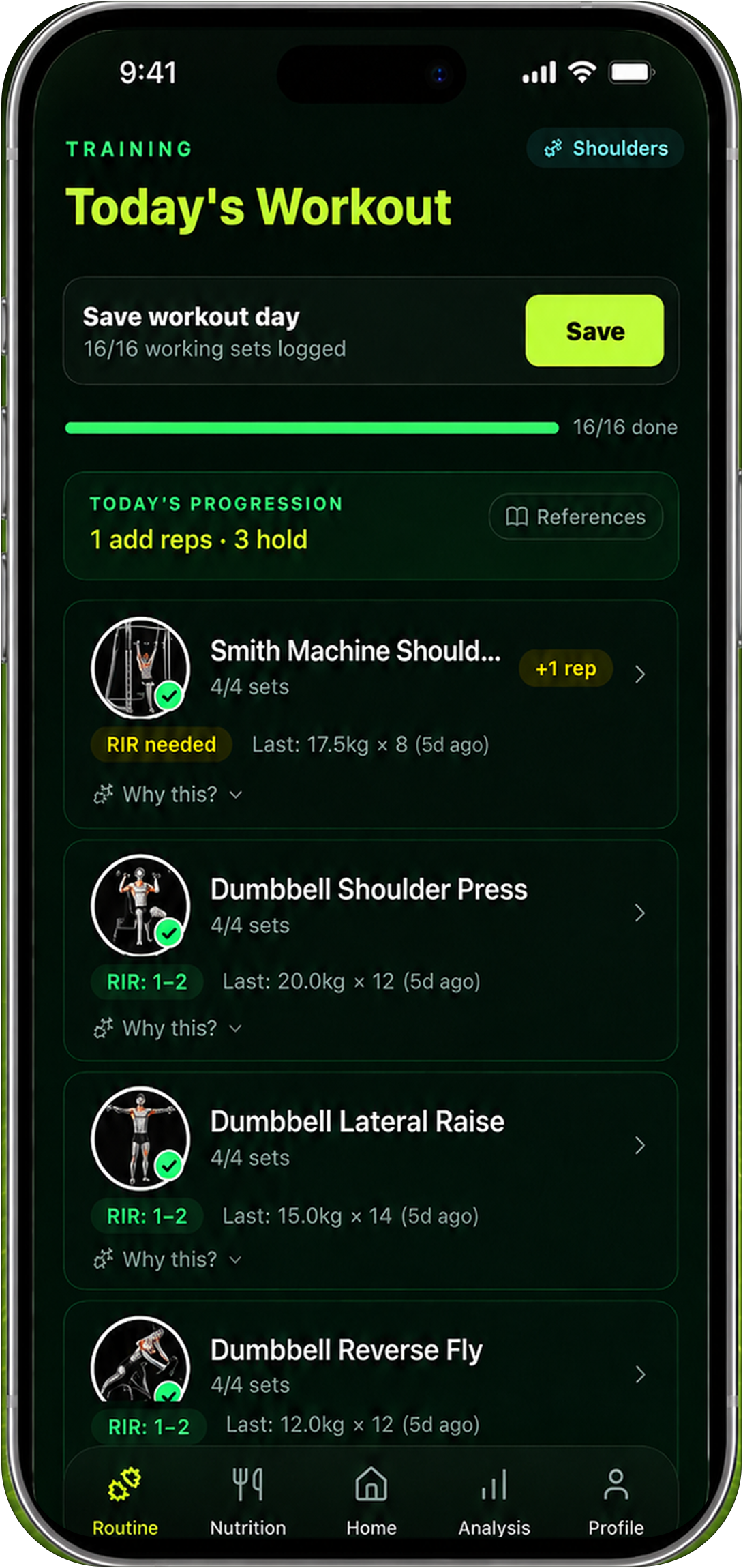
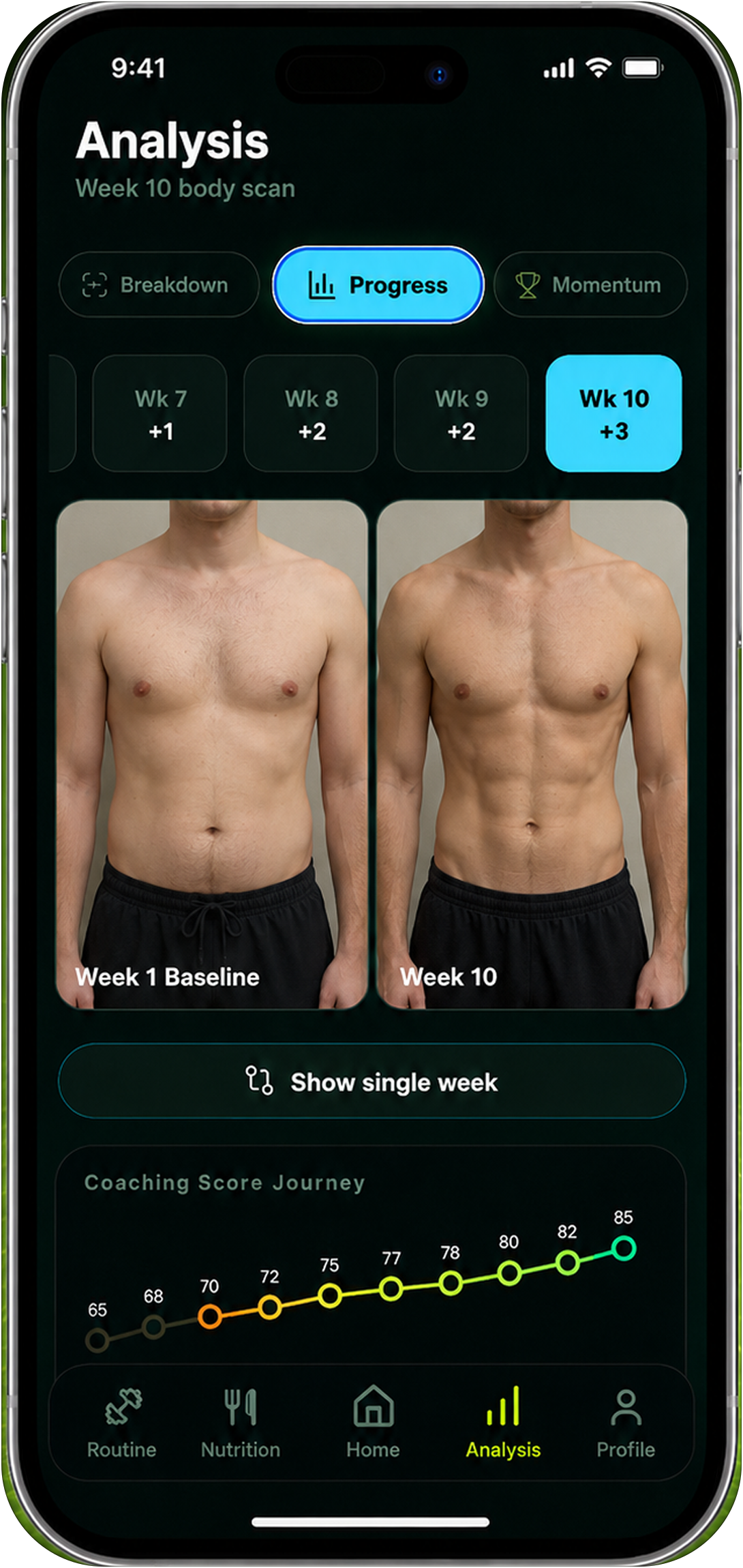
Reset90 is built around the 90-day window that habit research says matters: long enough to form a routine, short enough to feel real. Inside it, the app carries the planning load—a Home dashboard with today’s priority, an adaptive training plan with recovery days, meal targets with optional meal photo scans, daily coach messages, streaks, and weekly body-photo check-ins.
It is free on iOS and Android, works with AI features off, and deliberately keeps the surface small so the user sees the next decision instead of a dashboard. The log is still there for people who want it; the point is that Reset90 works on the side of the problem a notebook cannot touch.
05The notebook vs the system, side by side
| Traditional logbook | Reset90 AI | |
|---|---|---|
| Durability | A notebook and a pencil, forever | Free app; runs without AI features |
| The job | Recording completed work | Planning, guiding, and learning from daily actions |
| After a missed session | Blank space | A decision rule: move, shorten, or continue |
| Habit support | None—it records | 90-day frame + streaks + daily messages |
| Nutrition | Not included | Meal targets + optional photo scan |
| Recovery | Not included | Recovery days, check-ins, weekly photo reviews |
| Price | A few dollars, once | Free |
| Best for | Self-directed trainees with a stable routine | Users whose routine changes or keeps restarting |
06The interrupted-week test
The fastest way to see the difference: take a week where everything goes wrong—two missed sessions, low energy, a schedule change. The notebook will faithfully show the missing workouts. Reset90 will help you decide whether to move them, shorten them, or continue with the next priority. Both are honest tools. Only one of them makes the next decision easier.
07Which one should you choose?
Choose a logbook if you have a stable plan, enjoy full control, and genuinely like deciding every training detail yourself. Choose Reset90 if the blank spaces around the logbook—what to do next, how to recover, how to connect food—are what cause the reset to fail. They work together: a logbook can record the work while a 90-day system decides how the work fits together.
Try the related tool: Reset90 Plan Fit Check turns those constraints into a quick starting recommendation before you download.
08Frequently asked questions
Is a paper logbook enough?
For an experienced trainee with a coach or a written program, yes. It is especially useful when you want ownership of every exercise and do not want an app making recommendations. Its limitation is the planning and recovery around the record.
How long does it really take to form a habit?
Habit research (Lally et al., 2010, University College London) found the average time to automaticity was 66 days, with a range from 18 to 254 days. That is why Reset90 uses a 90-day frame—it roughly matches the window where a routine either becomes automatic or dies.
Why do most people quit their fitness resolutions?
Strava named the second Friday of January “Quitter’s Day” after its user data showed about 80% of New Year’s fitness resolutions are abandoned by the second week of January. The common thread is not hard workouts—it is plans that do not survive real life.
What does Reset90 do that a notebook cannot?
It carries the planning and recovery load: what to train, what to eat, and what to check in today, plus a return path after a missed session—inside a free 90-day loop.
Can I use both?
Yes. A logbook is the right foundation when your plan works; Reset90 becomes the upgrade when the blank spaces around the logbook are what cause the reset to fail.
Is Reset90 free?
Yes. Reset90 is currently free to download and use on iOS and Android, with no paywall, and it works even with AI features turned off.
09References and related Reset90 reads
- Official a traditional workout logbook product information
- Google guidance on helpful, people-first content
Reset90 vs traditional workout trackers, what to do when you miss a workout, and best workout planning apps for busy people continue the comparison from the Reset90 side.
Ready to test the plan? Download Reset90 AI on the App Store or get it on Google Play.
The Reset90 system
Useful ideas for building a body you can keep.
Training notes, product updates, and practical ways to make your next 90 days count.
Start your next 90 days
Get your daily training, nutrition, and check-in priorities in one adaptive system.


Keep reading
Related articles

Ideal Body Measurements for Women
There is no single ideal body measurement set for women. Learn how averages, waist-to-height, body shape and repeatable tracking fit together without chasing a fixed beauty standard.
Read article
Bulk, Cut, or Recomp? A Practical Decision Guide
A practical way to choose a bulk, cut, recomp, or maintenance phase using your goal, training age, recovery, and repeatable progress signals.
Read article
How Often Should You Take Progress Photos?
How often should you take progress photos? Use this goal-based guide to choose weekly, biweekly, or monthly check-ins and make every comparison more consistent.
Read article