
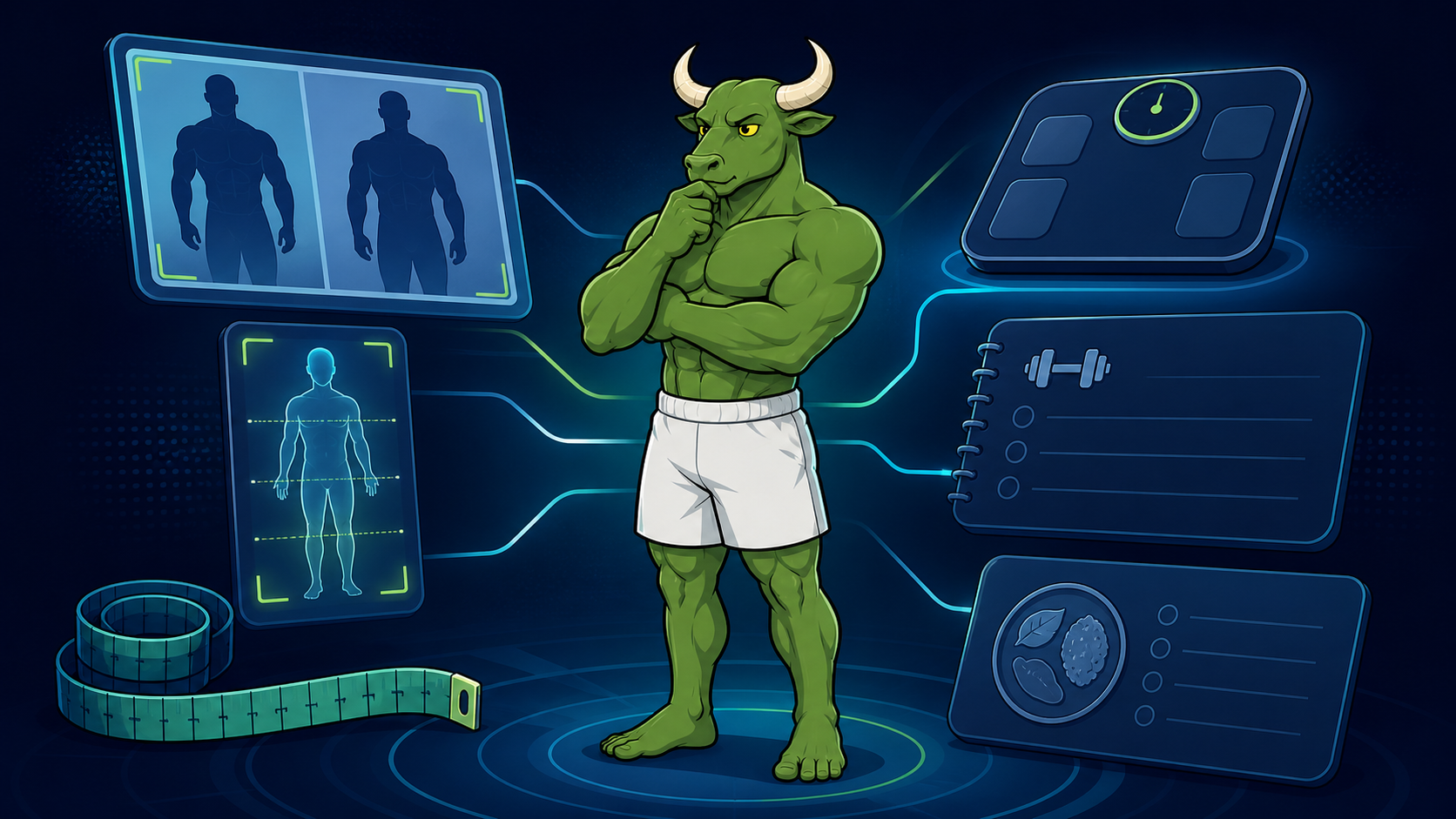
Best Body Tracking Apps in 2026: Every Type Compared
The best body tracking app depends on what you want to see: photos, body composition, measurements, weight, strength, or nutrition. Compare every type and choose the smallest stack that fits your goal.
By Reset90 AI Editorial Team
Short answer: The best body tracking app depends on the signal you need. Photo-based tools show visible change, scan apps estimate composition, measurement tools track dimensions, scales track weight and sometimes impedance, and workout or nutrition apps track the behaviors that create change. For most people, the smallest useful setup is one repeatable body-side signal plus one behavior-side log—not one app promising to measure everything.
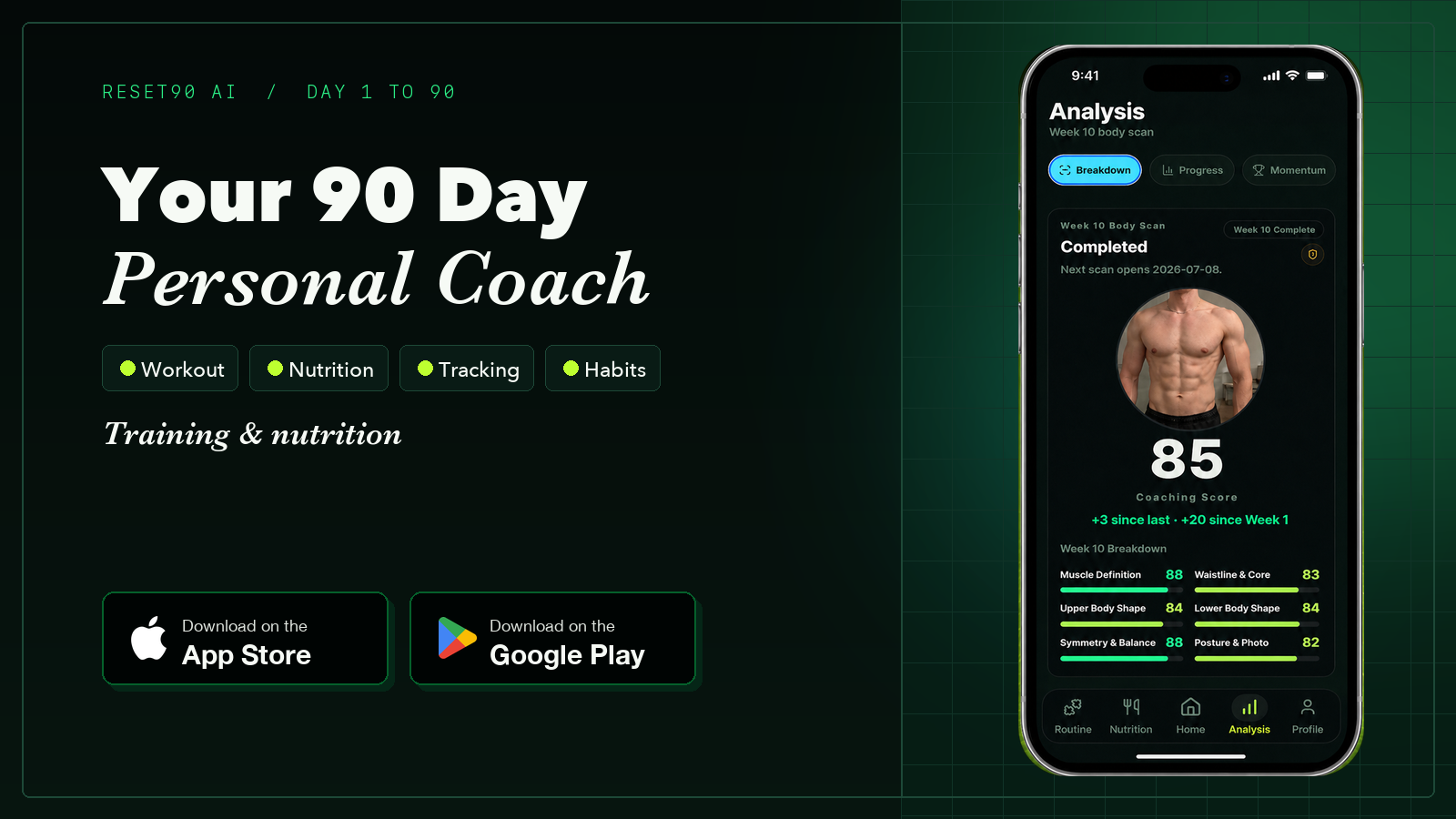
“Body tracking” is a broad label. It can mean comparing progress photos, estimating body fat, recording waist measurements, watching a weight trend, logging lifts, or checking whether your protein and calories are consistent. Those are related jobs, but they are not interchangeable. A good choice starts with the decision you want the data to help you make.
01What “body tracking” means in fitness
A body tracking app collects a signal about your body or the actions that change it, then gives you a way to compare that signal over time. The useful part is not the first reading. It is a repeatable process that helps you answer a question such as “Am I losing fat while keeping strength?” or “Is my waist changing even when scale weight is flat?”
There are three important distinctions:
- Observation versus estimate: a photo, tape measurement, or scale reading is an observation; body-fat percentage, visceral-fat score, and muscle-mass estimates are interpretations built from inputs.
- Body-side versus behavior-side: photos, scans, measurements, and scales describe an outcome; workouts, meals, steps, and check-ins describe the behaviors that may explain it.
- Snapshot versus trend: a single result can be noisy. A consistent protocol repeated under similar conditions is more useful for decisions.
That is why the “best” app is rarely the one with the longest feature list. It is the one that captures the right signal with low enough friction that you will still use it next month.
02The six types of body tracking apps
Use this table to identify the category before comparing individual apps. The categories overlap, but each one answers a different question.
| Type | What it captures | What it can miss | Best starting question |
|---|---|---|---|
| Photo and visual AI | Visible shape, pose-to-pose change, and visual progress | Internal composition and camera or lighting differences | Can I see a consistent change? |
| Composition scan | Estimated body-fat, lean-mass, or composition values from photos or scans | Lab-grade certainty and stable readings when inputs vary | Do I need an estimate to guide a trend? |
| 3D measurement | Body circumference, shape, and sometimes a 3D model | Daily convenience and perfectly independent fat estimates | Which dimensions are changing? |
| Weight and BIA | Scale weight and, on some devices, impedance-derived estimates | Hydration, meals, timing, and the limits of consumer algorithms | What is my weight trend under a consistent routine? |
| Workout tracking | Exercises, sets, reps, load, volume, and progression | Whether the visible result is changing without a body-side check | Am I applying progressive training? |
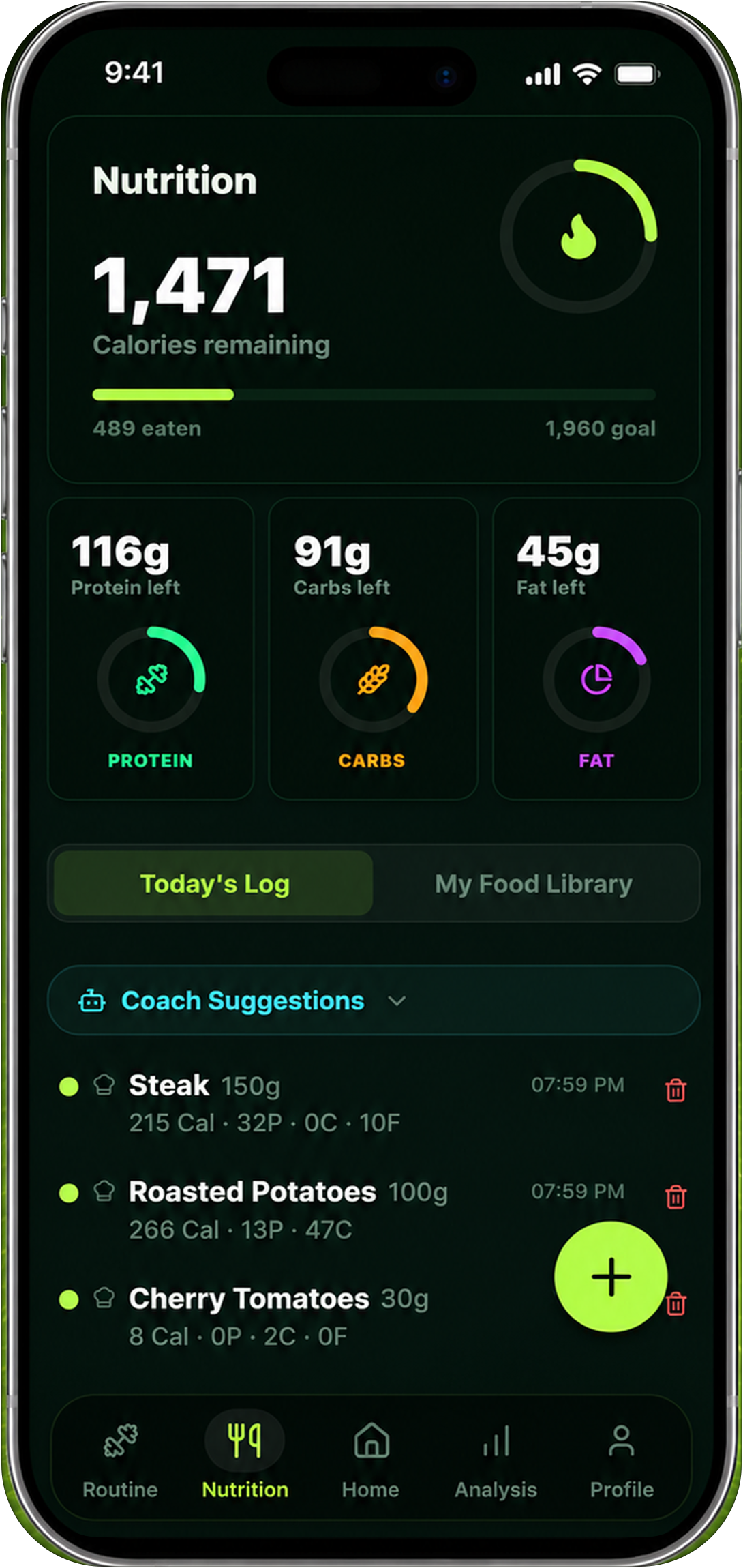
| Nutrition tracking | Calories, protein, meals, and adherence to a target | Body shape, strength, and the accuracy of food entries | Is my intake aligned with my goal? |
The first four are primarily body-side tools. The last two are behavior-side tools. A body-side app tells you what changed; a behavior-side app helps you test why. If you want more detail on narrow categories, compare the guides to body composition apps, body scanning and measurement apps, and workout tracker apps.
03Best body tracking apps by job
There is no universal ranking because these apps do different work. The list below is organized by job, so you can choose a signal instead of choosing a brand first.
Best for an integrated progress routine: Reset90
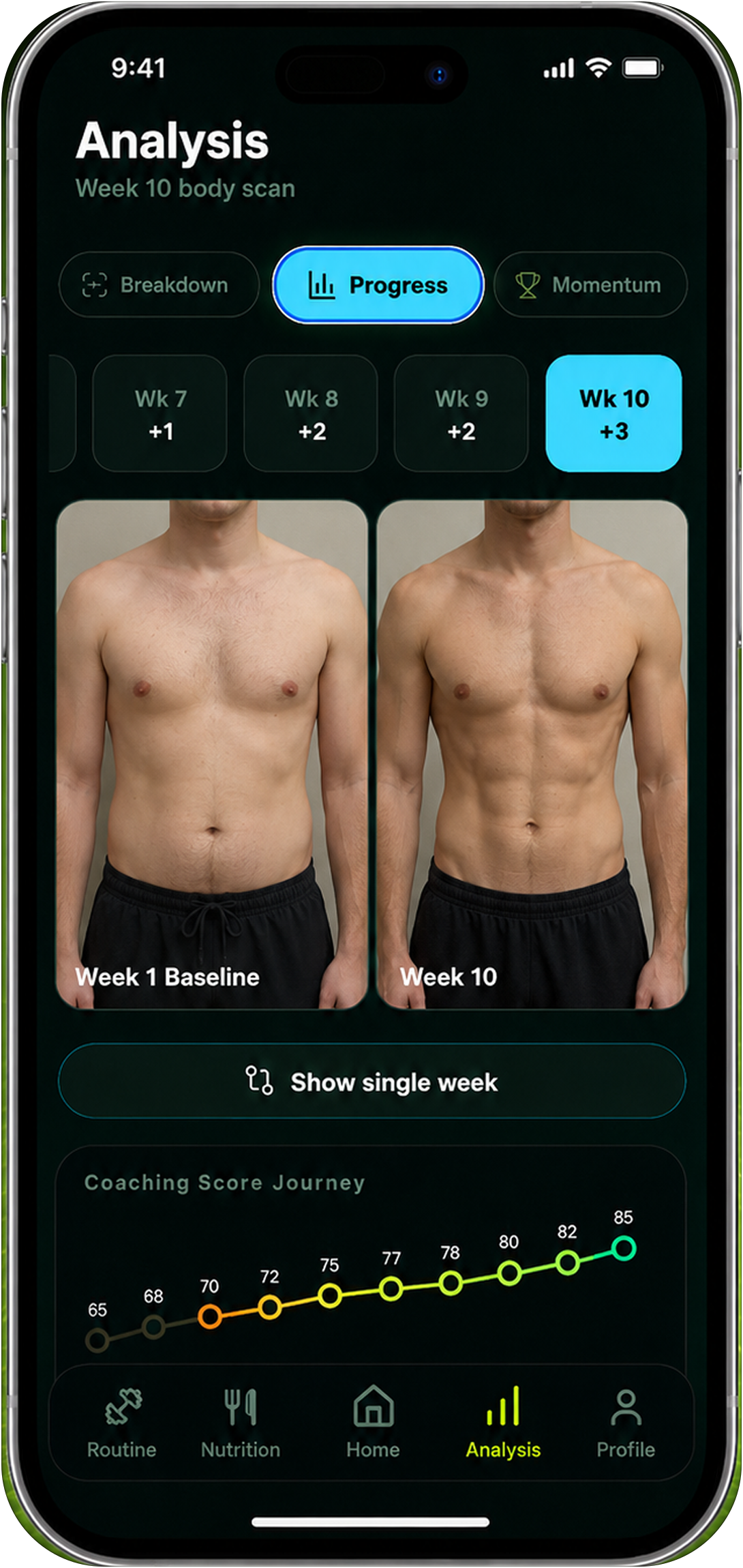
Reset90 is the strongest fit when you want body observations connected to a 90-day training and nutrition routine. It combines guided progress photos and check-ins with measurements, workouts, nutrition targets, and plan adjustments. That makes it a behavior-side system with body-side inputs rather than a standalone scanner.
Choose it when: you want one place to check in, follow a plan, see progress, and decide what to adjust next.
Important limitation: Reset90 is not a clinical body-composition instrument and does not make a lab measurement replaceable. If you specifically need a 3D model, a smart-scale reading, or a professional assessment, use the dedicated tool for that job and treat its output as one signal inside the wider routine.
Best for visual change: photo-based progress tracking
Photo tracking is often the most understandable way to see a gradual change in shape. It works best when the app or protocol keeps camera height, distance, lighting, clothing, and poses consistent. Visual AI can help organize comparisons or highlight changes, but it should not be treated as a precise body-fat test.
Choose a photo-first tool if your main question is whether your physique looks different over several weeks. If you want a fuller workflow, the guide to body transformation apps explains how to use visual comparisons without letting dramatic image effects replace a real trend.
Best for a periodic composition estimate: scan-based apps
Scan apps use photos, video, or other inputs to estimate measures such as body-fat percentage or lean mass. They can be useful for a consistent check-in, especially when you repeat the same protocol. Their value is comparison under similar conditions, not the idea that a phone can remove every source of measurement error.
Before choosing one, check what you must provide, how the result is explained, whether historical readings are easy to export, and whether the app makes uncertainty clear. For an app-by-app category comparison, see AI body scan apps.
Best for body dimensions: 3D measurement tools
3D measurement tools are aimed at circumference and shape changes: waist, hips, chest, arms, thighs, and related dimensions. They can answer a question that a body-fat estimate cannot: “Which part of my body is changing?” They often require a careful scan, specific clothing, or a dedicated capture routine, so convenience matters.
These tools are a good match for people whose goals involve clothing fit, tailoring, or tracking a particular measurement. They are less useful if you will only scan once and never repeat the process.
Best for a weight trend: scale and BIA apps
Scale apps are practical when weight is a meaningful part of your goal and you want automatic history. Some scales also show impedance-based estimates of body fat, muscle, or water. Those extra values can be interesting, but they are affected by hydration, skin contact, meals, exercise, and the algorithm used by the device.
Use a scale primarily for a consistent weight trend unless you have a clear reason to follow its other estimates. Weigh under similar conditions and look at a multi-day or multi-week pattern. The question is not whether a consumer scale agrees with every other method; it is whether the signal is consistent enough to support your next decision. Read how accurate smart scales are before treating a BIA number as a verdict.
Best for strength progress: workout log apps
A workout tracker records the inputs that build performance: exercises, sets, reps, load, rest, and progression. It does not directly tell you whether your waist or body-fat estimate changed, but it can reveal whether the training stimulus is becoming more structured.
Choose a workout log when your main bottleneck is remembering what you did or progressing consistently. Pair it with photos or measurements if visible body change is also a priority.
Best for intake consistency: nutrition tracking apps
Nutrition trackers record meals, calories, protein, and other targets. Their usefulness depends on the quality and consistency of the entries, not on the number of available food items. They are a behavior-side signal: they can show whether your intake is aligned with your goal, but they cannot prove how your body composition changed from one day to the next.
Use nutrition tracking when your plan is unclear at mealtimes or when you need a measurable way to test protein or calorie consistency. The nutrition tracking guide for muscle gain covers that narrower use case.
04Which app type should you choose?
Match the tool to the decision you need to make. You can add another signal later if the first one does not answer the question.
| Your goal | Start with | Add later if needed |
|---|---|---|
| See whether your physique is changing | Consistent progress photos | Waist measurement or strength log |
| Lose fat while protecting muscle | Weight trend plus strength log | Photos, waist, or a periodic composition estimate |
| Gain muscle | Workout log plus body-weight trend | Photos, measurements, and nutrition targets |
| Track clothing fit | Tape measurements or a repeatable photo routine | 3D measurement tool |
| Understand a body-composition estimate | One repeatable scan method | A second body-side signal, not five competing calculators |
| Keep the routine simple | One integrated workflow with a weekly check-in | Only the signal that answers an unresolved question |
For most goals, start with one outcome signal and one behavior signal. For example, pair a weekly photo or waist measurement with a workout log. Or pair a weight trend with nutrition targets. The point is to create a feedback loop, not to collect every available number.
05Why one app is rarely enough
Different tracking jobs have different strengths. A scan may estimate composition but say nothing about yesterday’s training. A workout log can show progression but not whether your waist changed. A nutrition log can show adherence but not how consistent your photos were.
That does not mean you need six apps. It means you should identify the missing side of the loop. If you already have a trusted body-side measurement, add a behavior-side tool. If you already log every workout and meal but cannot see the result, add one consistent body-side check-in.
The smallest useful stack usually has:
- One outcome signal: photos, waist, weight, or a periodic scan.
- One behavior signal: workouts, nutrition, or check-ins.
- One review moment: a weekly or biweekly decision about what to keep, change, or measure next.
A body tracking app is most useful when it changes a decision. If a number never changes your training, nutrition, or measurement routine, it is probably adding noise rather than clarity.
06How to compare body tracking apps in 2026
Features change quickly, and prices or platform availability can change too. Before committing, compare the workflow rather than relying on a feature checklist.
- Input burden: Can you complete the scan, photo set, meal log, or workout entry in the time you actually have?
- Repeatability: Does the app help you reproduce the same conditions, or does every reading use a different setup?
- History: Can you see trends, compare dates, and recover older entries without friction?
- Interpretation: Does it distinguish a recorded value from an estimate and explain what the number can and cannot tell you?
- Privacy: Understand how sensitive photos, measurements, and health-related logs are stored and controlled.
- Platform fit: Confirm that the app works on your phone and with any scale, camera, or wearable you already use.
- Exit cost: Check subscriptions, hardware, export options, and whether your history remains useful if you stop paying.
Do not choose an app because it produces the most impressive single score. Choose the one whose method you can repeat and whose output you understand well enough to act on.
07Where Reset90 fits
Reset90 fits between a body tracker and a coaching workflow. You can use measurements, progress photos, check-ins, workouts, and nutrition targets as inputs to a 90-day routine, then review whether the plan needs an adjustment. That is useful when the hard part is not collecting data but turning it into a consistent next step.
It is a good starting point if you want your body-side check-in and behavior-side plan in one workflow. It is not a replacement for a clinical assessment, a dedicated 3D measurement system, or every specialist tool. If a specific signal matters to you, keep that tool and use Reset90 to connect the signal to training, food, and follow-through.
For a more focused route, start with the guide to AI fitness apps that track your body, or compare the broader set of AI body-tracking alternatives.
08Frequently asked questions
What is the best body tracking app?
The best app is the one that captures the signal tied to your goal and that you will repeat. A photo-first app is better for visible change, a measurement tool is better for dimensions, a workout app is better for progressive training, and an integrated workflow is better when you need the signals connected.
What is the best free body tracking app?
A phone camera, a simple notes or spreadsheet routine, and a tape measure can cover the basics without requiring a specialized subscription. The trade-off is that you must create the protocol yourself. If an app has a free tier, check what happens to history, exports, and key comparisons before building your routine around it.
Are AI body tracking apps accurate?
AI body tracking outputs are usually estimates or structured visual comparisons, not guarantees of lab-grade measurement. Accuracy depends on the method, input quality, lighting, pose, device, algorithm, and consistency. Use the same method over time, read the limitations, and avoid treating one result as a diagnosis.
What is the difference between body tracking and fitness tracking?
Body tracking focuses on outcomes such as photos, measurements, weight, or composition estimates. Fitness tracking usually focuses on behaviors or performance such as workouts, steps, heart rate, and nutrition. They complement each other: body tracking shows what changed, while fitness tracking helps explain what you did.
Do I need more than one app?
Not necessarily. Start with one outcome signal and one behavior signal. If a single workflow covers both without making either part unreliable, that may be enough. Add another app only when it answers a specific question your current routine cannot answer.
Can a body tracking app measure body fat?
Some apps estimate body fat from photos, measurements, scales, or scans. “Estimate” is the important word: the result depends on the method and inputs. For personal progress, compare readings collected under similar conditions and combine them with weight, measurements, photos, strength, and how you feel rather than relying on one percentage.
09Bottom line
Body tracking apps are not one category. They are a set of tools for photos, composition estimates, dimensions, weight, workouts, and nutrition. Choose the signal that matches the decision you need to make, keep the protocol repeatable, and pair an outcome signal with a behavior signal when you need to understand both what changed and why.
If you want the fewest moving parts, use a weekly check-in and a 90-day plan to connect your measurements, training, and nutrition. That is the role Reset90 is designed to play: not promising one perfect number, but helping you turn several imperfect signals into a routine you can actually follow.
The Reset90 system
Useful ideas for building a body you can keep.
Training notes, product updates, and practical ways to make your next 90 days count.
Start your next 90 days
Get your daily training, nutrition, and check-in priorities in one adaptive system.


Keep reading
Related articles
Ideal Body Measurements for Women
There is no single ideal body measurement set for women. Learn how averages, waist-to-height, body shape and repeatable tracking fit together without chasing a fixed beauty standard.
Read article
Bulk, Cut, or Recomp? A Practical Decision Guide
A practical way to choose a bulk, cut, recomp, or maintenance phase using your goal, training age, recovery, and repeatable progress signals.
Read article
How Often Should You Take Progress Photos?
How often should you take progress photos? Use this goal-based guide to choose weekly, biweekly, or monthly check-ins and make every comparison more consistent.
Read article