
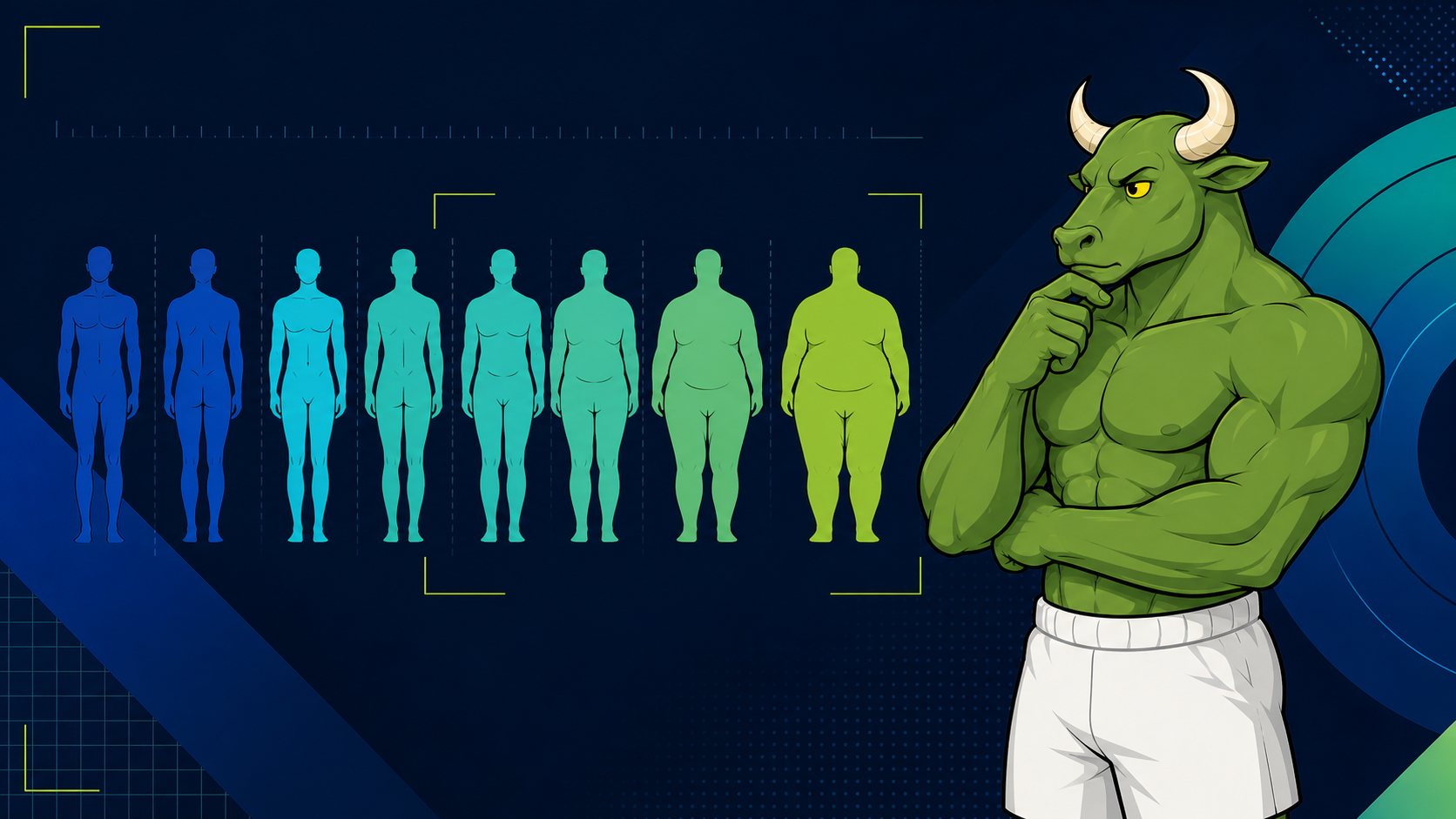
Body Composition Pictures: What Different Levels Actually Look Like
Body composition pictures can teach visual patterns, but they cannot give you an exact body-fat percentage. Learn how to read them, why the same number looks different, and how to track your own change.
By Reset90 AI Editorial Team
Short answer: Body composition pictures are useful for learning visual patterns, but they cannot tell you an exact body-fat percentage or define what your body should look like. The same percentage can look very different because muscle, frame, height, age, sex, and fat distribution all change the picture. Use visual examples to find a broad reference band, then use consistent photos, measurements, body-weight trends, and performance to track your own change.

Search for body composition pictures and you usually get a collage of strangers: different heights, builds, muscle mass, lighting, poses, camera lenses, and confident-looking labels. That makes visual comparison harder than it needs to be. If five things change at once, you cannot tell which difference belongs to body fat and which belongs to the image.
A better reference teaches you what different levels can look like while keeping the limits visible. A picture can show the appearance of definition, softness, waist shape, and muscle separation. It cannot show your exact internal fat distribution, health status, or the number on a clinical assessment. The goal is orientation, not self-judgment.
01What body composition pictures can show
Body composition pictures are most helpful when you use them to recognize broad visual patterns. They can help you notice how a change in fat mass may affect the waist, lower back, hips, chest, arms, or legs. They can also show why “leaner” is not one universal look: muscle size and distribution change the outline just as much as fat does.
| Visual cue | What it may suggest | Why it is not proof |
|---|---|---|
| More visible muscle separation | Less fat covering the muscles, more muscle mass, or both. | Lighting, a training pump, flexing, and camera contrast can exaggerate definition. |
| A softer or rounder waist | More visible subcutaneous fat around the midsection for that person. | Posture, digestion, bloating, clothing, and lens perspective can change the silhouette. |
| Visible veins or deep lines | Possibly lower subcutaneous fat, higher muscularity, genetics, heat, or a temporary pump. | Vascularity is not a body-composition test and is not a health score. |
| More fullness in the hips, thighs, chest, or lower back | A personal pattern of fat and muscle distribution. | People store fat differently, so one angle cannot represent total body composition. |
Think of a visual reference as a map with large regions, not a ruler with precise millimeter marks. It can help you say “I am probably closer to this general pattern than that one.” It should not make you believe that a stranger’s image gives you a reliable exact percentage.
02Why the same body-fat percentage can look different
Body-fat percentage is a ratio: fat mass divided by total body mass. Two people can share a percentage while carrying different amounts of muscle, standing at different heights, and storing fat in different places. The percentage describes the proportion; it does not prescribe the shape.
- Muscle mass: A trained person at the same percentage as an untrained person may show more shoulder, chest, back, leg, and abdominal shape.
- Fat distribution: One person may store more around the waist while another stores more in the hips, thighs, chest, or lower back.
- Frame and height: The same amount of fat can be spread over a different skeleton, changing the visual result.
- Age and sex: Reference ranges and typical distribution patterns differ, so the same number should not be interpreted with one universal picture.
- Skin and tissue: Loose skin, scars, stretch marks, and how tissue sits after weight change can affect appearance without changing the percentage in a simple way.
- Image conditions: Relaxed versus flexed posture, warm versus flat lighting, distance from the camera, and clothing can all shift the apparent result.
This is why it is misleading to ask, “What does 20% body fat look like?” A better question is, “What are several ways a person in this broad range might look, and what other information should I use?” Our body-fat percentage chart explains why category boundaries vary by source, age, sex, and measurement method.
03How to read body composition pictures by broad range
There is no single visual appearance for any percentage. Still, broad reference bands can make a gallery easier to understand. Use the descriptions below as visual orientation, not as a diagnosis or a target.
| Broad visual band | Common patterns you may see | Important caution |
|---|---|---|
| Very lean or competition-lean | More visible separation, a tighter waist, and clearer lines in favorable conditions. | Often difficult to maintain, and appearance can be strongly affected by dehydration, lighting, and flexing. |
| Lean and athletic | Muscle shape may remain visible at rest, while the body looks less “stage ready” than the leanest examples. | Athletic does not mean automatically healthier, stronger, or more sustainable for every person. |
| Fit to moderate | Muscle may be easy to see in the shoulders, arms, legs, or back, while resting abdominal definition varies. | Training age can make two people in this band look completely different. |
| Soft or average-looking | Less resting separation and a smoother waist or lower back, with wide variation in muscle underneath. | “Average” describes a reference population; it is not a judgment about worth or health. |
| Higher visible storage | More fullness through the waist, trunk, hips, or limbs, depending on the person’s distribution. | A front or back image cannot measure visceral fat or establish medical risk. |
For women, the same numeric scale cannot simply be overlaid on men’s pictures. Essential fat requirements, typical distribution, and reference ranges differ. For everyone, the visual transition between bands is gradual rather than a set of hard biological borders.
04Why standardized pictures are easier to use
A standardized sequence controls the variables that normally make visual comparisons noisy. If the build, pose, crop, lighting, and camera perspective stay similar while the illustrated composition changes, you can focus on the pattern instead of wondering whether the lighting created the difference.
That does not make a standardized image a photograph of you. It makes it a teaching aid. Rendered or edited examples can show a clean progression, but real bodies express the progression with their own muscle, skin, proportions, and distribution. Use the image to learn the concept, then return to your own consistent data.
One practical use is to compare front and side views without treating either one as complete. A side view can make waist depth easier to see; a front view can show shoulder-to-waist balance and where fullness sits. A back view may reveal changes that are invisible from the front. None of them can expose internal tissue directly.
05How to compare your own photos fairly
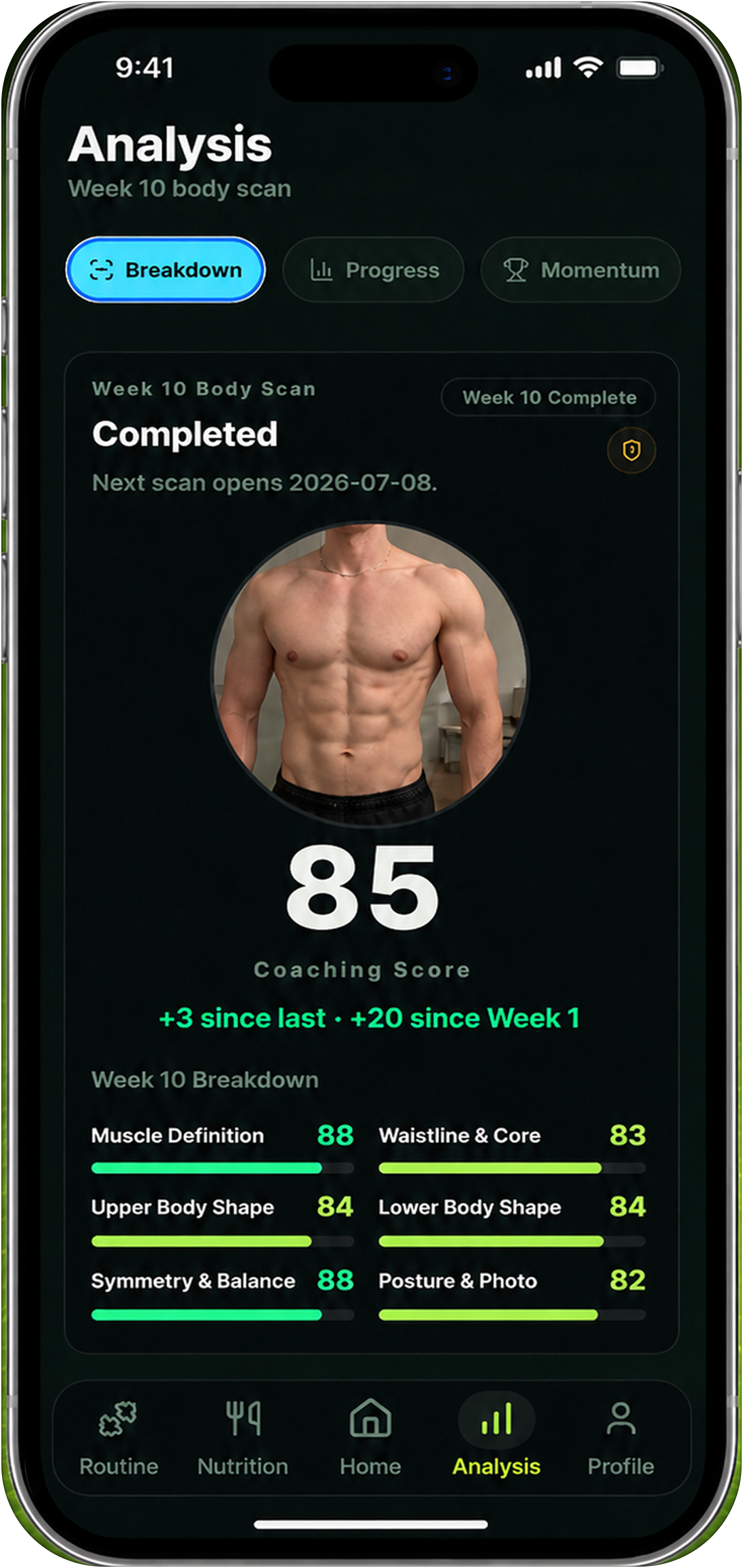
Most people do not need a studio. They need a repeatable setup. Your own photo series is more useful when the conditions stay close enough that a change in the image is more likely to reflect a change in you.
- Use the same camera and distance. Keep the phone at a similar height and use the same lens setting. Avoid switching between a close wide-angle shot and a distant zoomed shot.
- Match the background and lighting. Soft, even light makes contours easier to compare than dramatic overhead shadows.
- Choose a relaxed, repeatable pose. Stand naturally, keep the camera level, and avoid comparing a flexed or twisted photo with a relaxed one.
- Keep clothing comparable. Wear similar fitted clothing or use the same level of coverage each time so the waist and limbs are not hidden differently.
- Take more than one angle. Front, side, and back views can reduce the chance that one angle tells the whole story.
- Space out your comparisons. Look at weekly or monthly patterns, not tiny day-to-day changes caused by food, water, digestion, or training.
Our guide to taking body measurements covers the same principle from a tape-measure perspective: mark the method, repeat it, and interpret the trend rather than one noisy reading.
06What pictures cannot tell you
A picture is a surface-level view. It cannot directly measure bone density, muscle quality, organ fat, blood markers, or total fat mass. It also cannot tell you whether a specific body composition is healthy for you without medical and personal context.
Even a DEXA scan, often used as a reference for body composition, is an estimate influenced by the scanner, software, positioning, body thickness, hydration, and analysis assumptions. A photo should therefore be treated as an even lower-friction estimate with a different set of limitations—not as a replacement for a clinical assessment when one is needed.
Do not use body composition pictures to diagnose obesity, decide whether you are “allowed” to eat, or determine whether a medication or medical plan is working. If you have unexplained weight change, symptoms, pregnancy, a history of disordered eating, or a clinical question, speak with a qualified healthcare professional.
07Turn pictures into a useful progress record
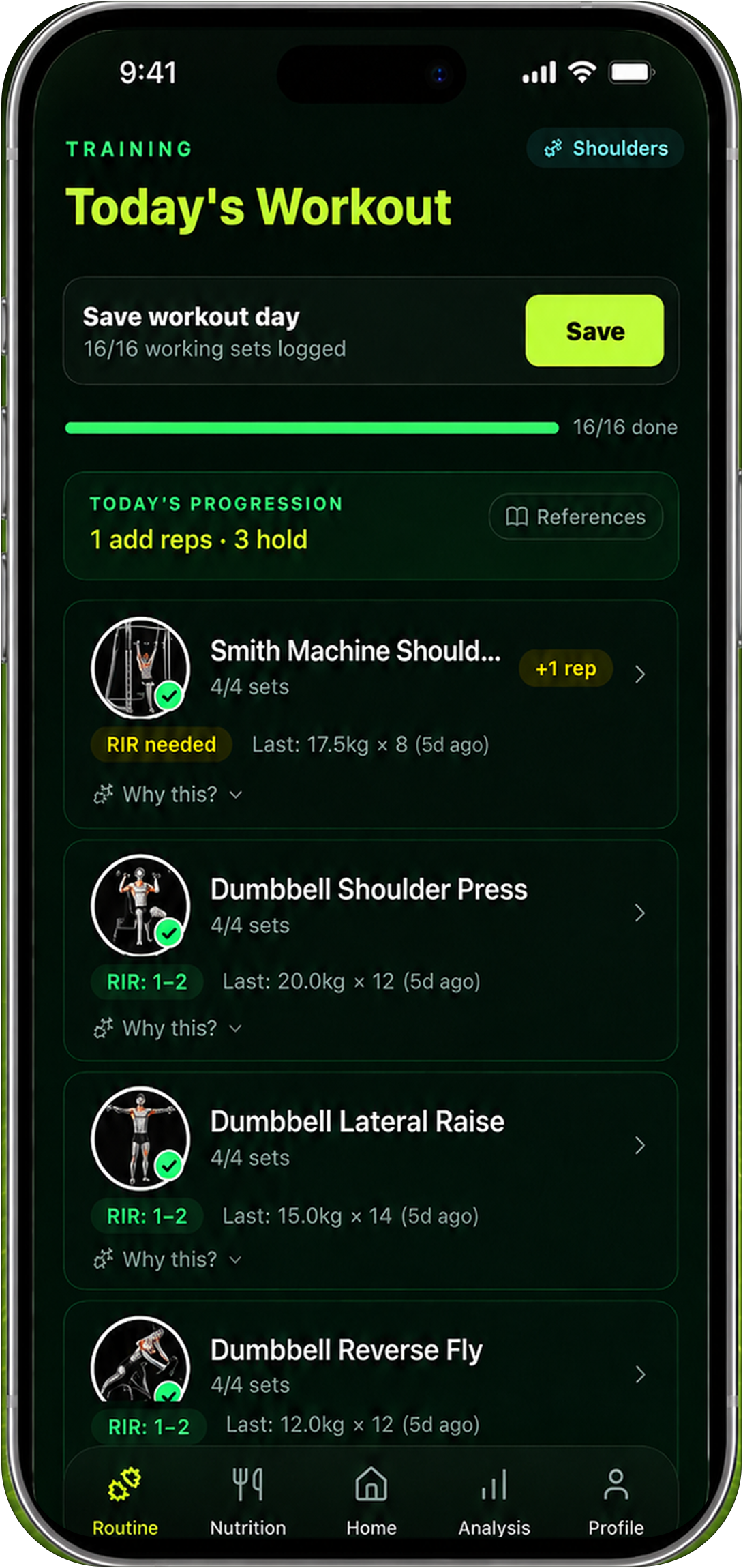
A single picture invites a verdict. A dated series invites a better question: is the direction of change consistent with the plan?
Pair your photos with a small set of signals:
- Body weight: Use a consistent routine and look at an average when daily readings are noisy.
- Waist or other measurements: Keep the landmarks and tape tension consistent.
- Training performance: Note whether strength, reps, work capacity, or technique are holding steady or improving.
- Nutrition adherence: Review whether your actual meals and protein intake match the plan you intended to follow.
- Recovery and wellbeing: Energy, sleep, mood, and recovery affect whether a plan is sustainable.
When several signals point in the same direction, the conclusion is stronger than any single image. When they disagree, pause before making a drastic change. Check your photo setup, timing, hydration, training load, and measurement method first.
08How Reset90 fits into body-composition tracking
Reset90 helps organize the surrounding routine that makes progress photos meaningful: workouts, nutrition targets, check-ins, weight, measurements, and habits. It is a place to track what you did and how the trend is moving, not a promise that a picture can reveal an exact body-fat percentage.
You can use the body-fat visualizer to learn how broad visual ranges are represented, then use your own repeatable photos and measurements to follow change. You can also review the progress photos versus scale guide when the two signals appear to disagree. The important step is to keep the method stable long enough to learn something from it.
If you want an app-based estimate from a standardized photo, the body-fat estimator can provide a convenient reference. Treat the result as directional and pair it with the rest of your record. Convenience is useful when it helps you check in consistently; it becomes misleading when it encourages you to treat an uncertain number as a medical measurement.
09Frequently asked questions
Are body composition pictures accurate?
They can be useful for identifying a broad visual pattern, but they are not accurate enough to establish an exact body-fat percentage. Lighting, pose, muscle mass, distribution, and camera perspective all affect appearance. Use them for orientation and compare your own photos under consistent conditions.
Can two people look different at the same body-fat percentage?
Yes. Muscle mass, height, frame, age, sex, skin, and fat distribution can all change how the same ratio appears. A muscular person and an untrained person at the same percentage may have very different outlines.
What does 20% body fat look like?
There is no single answer. One person may show clear muscle shape, while another may look softer because they carry less muscle or store fat differently. A number without the measurement method and personal context is incomplete.
Are body-fat visualizer images real photos?
Some visualizer galleries use standardized illustrations or AI-generated renders so that the sequence can control the build, pose, and lighting. That makes the pattern easier to teach, but it does not make the image a photograph of your body or a diagnostic reference.
How should I track changes in body composition?
Choose a repeatable method, standardize the conditions, collect readings over several weeks, and pair photos with weight averages, measurements, training performance, nutrition adherence, and recovery. A consistent estimate with a stable error can still reveal direction.
10The bottom line
Body composition pictures are best used as a visual vocabulary. They can help you understand what “more defined,” “softer,” or “more muscular” might look like, but they cannot tell you exactly where you fall or what your body should become.
Look for a broad band, not a perfect match. Keep your own photos repeatable, compare more than one angle, and use multiple signals over time. That approach gives you useful context without turning a picture into a verdict.
The Reset90 system
Useful ideas for building a body you can keep.
Training notes, product updates, and practical ways to make your next 90 days count.
Start your next 90 days
Get your daily training, nutrition, and check-in priorities in one adaptive system.


Keep reading
Related articles

Ideal Body Measurements for Women
There is no single ideal body measurement set for women. Learn how averages, waist-to-height, body shape and repeatable tracking fit together without chasing a fixed beauty standard.
Read article
Bulk, Cut, or Recomp? A Practical Decision Guide
A practical way to choose a bulk, cut, recomp, or maintenance phase using your goal, training age, recovery, and repeatable progress signals.
Read article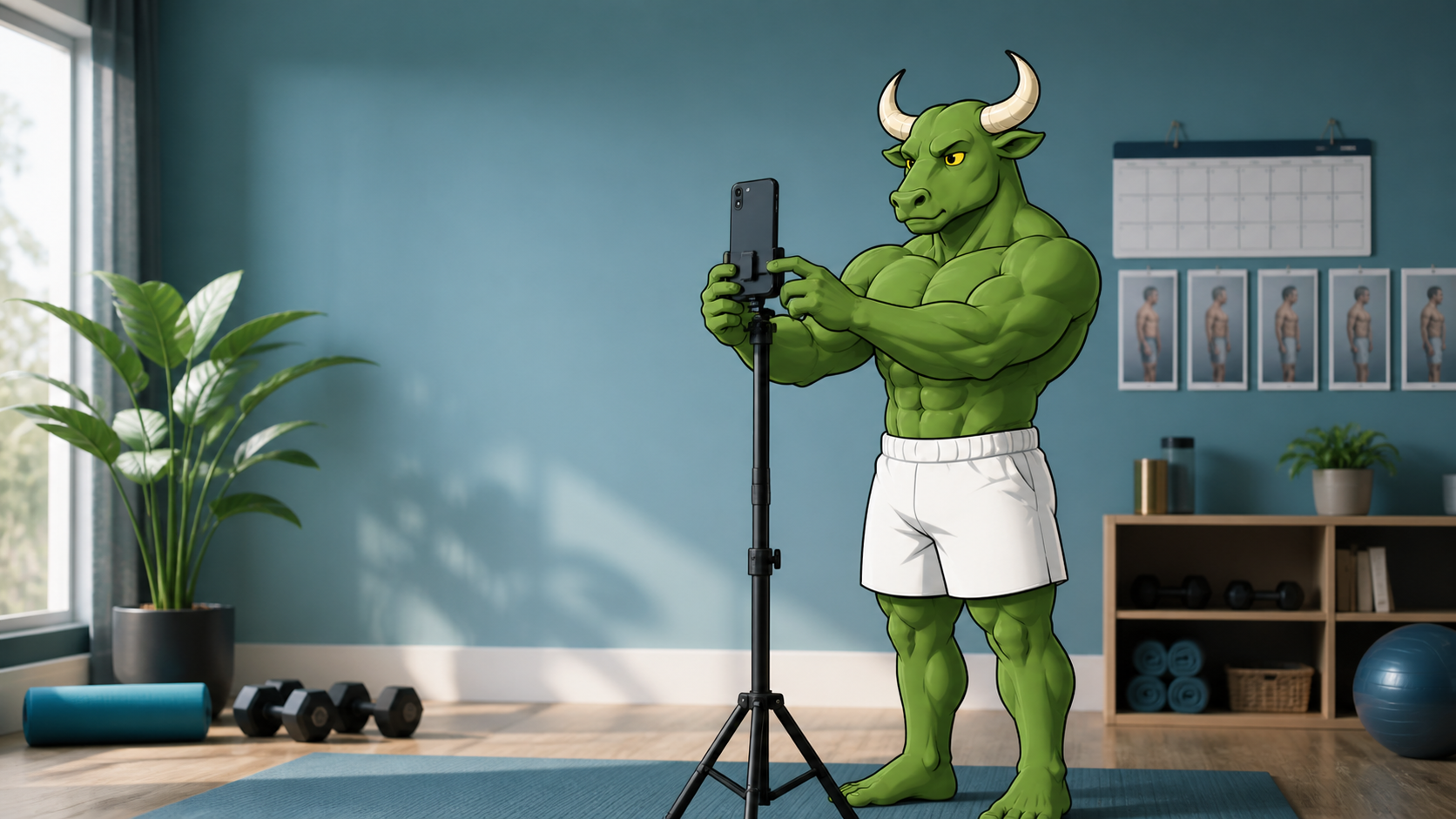
How Often Should You Take Progress Photos?
How often should you take progress photos? Use this goal-based guide to choose weekly, biweekly, or monthly check-ins and make every comparison more consistent.
Read article