

Lean Bulk vs. Dirty Bulk: Which Approach Should You Use?
Lean bulk or dirty bulk? Compare surplus size, muscle gain, fat gain, food flexibility, and the four-week tracking loop that helps you choose.
By Reset90 AI Editorial Team
Lean bulk vs. dirty bulk: For most lifters, a lean bulk—or controlled bulk—is the better default. You use a modest calorie surplus, train consistently, eat enough protein, and monitor the rate of weight gain so you can add muscle without creating a large amount of fat to lose later. A dirty bulk can move the scale faster, but the extra calories do not make muscle grow without limits. They mostly increase the amount of body fat, digestion discomfort, and future cutting work. Reset90 can help you track the decision with training, nutrition, photos, measurements, and weight trends together.
The debate is usually presented as clean food versus junk food. That framing is too simple. A lean bulk and a dirty bulk are better understood as two different levels of calorie surplus and control. Food quality matters, but the size of the surplus, the quality of your training, your protein intake, your appetite, and your ability to follow the plan matter too.

The practical question is not “Which label is morally better?” It is: How much weight do you need to gain, how much fat are you willing to gain with it, and can you follow the strategy long enough to learn whether it is working?
01What is a lean bulk?
A lean bulk—also called a clean bulk—is a muscle-building phase where you aim for a controlled calorie surplus rather than trying to gain weight as quickly as possible. The usual idea is to eat a little more than maintenance, lift with progressive overload, get enough protein, and allow body weight to rise slowly.
There is no official definition of “lean bulk.” One person may use the term for a 200-calorie surplus, while another may use it for a flexible plan that includes restaurant food and desserts but keeps the weekly trend under control. The important feature is not perfect food purity. It is that the surplus is intentional and measured against your response.
A lean bulk generally prioritizes:
- a modest surplus relative to your actual maintenance intake;
- enough protein to support resistance training and recovery;
- carbohydrates and fats that make training and daily life sustainable;
- mostly nutrient-dense foods without banning enjoyable foods;
- a slow weight trend that can be adjusted before fat gain runs away.
The trade-off is patience. The scale may move slowly, and visible change can be difficult to notice week to week. That is not evidence that the strategy is failing. It is the cost of keeping the amount of unnecessary weight gain smaller.
02What is a dirty bulk?
A dirty bulk is an aggressive weight-gain approach. The person eats a large surplus, often with little attention to food quality or portion size, because gaining scale weight feels more urgent than staying lean. High-calorie foods can make it easier to eat enough, especially for someone with a low appetite or very high activity level.
Dirty bulking has an understandable appeal. The scale moves quickly, meals require less planning, and a person who has struggled to gain weight may finally see progress. More food can also improve gym performance when the previous problem was simply under-eating.
The problem is that the body does not build muscle at an unlimited speed. Once your training, protein, and energy intake support the rate at which you can adapt, pushing the surplus much higher does not create a proportional increase in muscle. The extra weight is more likely to include fat, water, glycogen, and food volume.
Dirty bulking is therefore not “no results.” It can build muscle. Its cost is that you may gain more fat than you needed to gain, spend more time cutting later, and lose a clearer view of what the training is actually doing.
03What is the real difference between a lean bulk and a dirty bulk?
| Question | Lean / controlled bulk | Dirty / aggressive bulk |
|---|---|---|
| Surplus | Small and adjusted from the trend | Large or loosely monitored |
| Scale speed | Slow enough to review | Fast and highly visible |
| Muscle gain | Supports your current training capacity | Can be similar once the muscle-building ceiling is reached |
| Fat gain | Usually easier to limit | More likely to be substantial |
| Food flexibility | Flexible, but planned | Often prioritizes convenience and calorie density |
| Tracking burden | More attention to weight, food, and rate of gain | Less precision now, more cleanup later |
| Cut afterward | May be shorter or less urgent | Often longer if fat gain was large |
| Best default | Most lifters who want muscle with a manageable physique change | Specific situations where under-eating is the main obstacle |
The table is a decision aid, not a promise. Individual outcomes vary with training age, starting body composition, sleep, stress, genetics, adherence, and the accuracy of your maintenance estimate. A “lean bulk” that quietly adds 800 calories is not controlled just because the meals are homemade. A flexible bulk that includes pizza but keeps the weekly rate stable may be more controlled than a supposedly clean plan.
04Does dirty bulking build muscle faster?
It can make your body weight and gym numbers rise faster, but that is not the same as building muscle faster. A heavier body may have more leverage on some movements. More carbohydrates may improve training energy. More total food may improve recovery if you were previously under-eating. Those are real effects, but they do not mean every extra calorie becomes new muscle.
Muscle growth is constrained by the quality and amount of training stimulus, recovery, protein availability, training history, and your individual capacity to adapt. A bigger surplus can remove an energy shortage; it cannot remove every other limit.
That is why the useful comparison is not “How many pounds did I gain?” It is “How much of the change supported my goal, and how much will I need to reverse later?” A fast bulk can look successful for a month because the scale rewards it. The more informative review comes when you compare waist, photos, performance, and the amount of cutting required afterward.
05Why the surplus is more important than the food label
“Clean” and “dirty” can make people judge individual foods instead of managing the full plan. Rice, chicken, vegetables, oats, nut butter, burgers, and ice cream can all appear in a diet that supports muscle gain. The difference is usually the total pattern, not whether a single food belongs on an approved list.
Food quality still matters. A diet built mostly from varied, nutrient-dense foods tends to make it easier to get protein, fiber, vitamins, minerals, and meals that support training. A diet built mostly from highly palatable calorie-dense foods can make it very easy to overshoot your surplus and may be harder on digestion, appetite control, and day-to-day energy.
The flexible middle ground is simple: prioritize foods that help you recover and perform, then use convenient or enjoyable foods to make the plan livable. You do not need to eat perfectly to run a controlled bulk. You do need enough awareness to notice when “flexible” has become “the surplus is no longer controlled.”
06How to choose between a lean bulk and a dirty bulk

Choose based on the problem you are actually trying to solve, not on which approach sounds more hardcore.
| If this sounds like you | Start with | Why |
|---|---|---|
| You want muscle but want to stay relatively lean | Lean / controlled bulk | It gives you more time to build before needing a cut. |
| You are new to lifting and have never tracked a consistent baseline | Maintenance baseline, then a modest surplus | You need to learn how your body responds before making the plan aggressive. |
| You have a low appetite and your weight has stayed flat for weeks despite honest effort | Flexible controlled bulk | More calorie-dense foods and liquid calories can solve under-eating without abandoning the trend. |
| You are already uncomfortable with your current body-fat level | Consider maintenance, fat loss, or recomposition first | A bulk may make the problem you care about more frustrating. |
| You are preparing for a specific deadline | Use a conservative plan and define the trade-off | A large surplus can create a later cut that conflicts with the deadline. |
| You dislike tracking and tend to quit precise plans | Flexible bulk with a few non-negotiable checks | A plan you can follow beats a perfect plan you abandon. |
Do not make “skinny” a diagnosis or assume that every thin person needs a dirty bulk. The useful question is whether you have actually been eating enough to gain, whether your training is consistent, and whether your current goal is compatible with more body fat.
Reset90 can help with this choice by keeping the plan visible: training progression and RIR notes show what stimulus you are providing, while nutrition targets and meal logging show whether the intended surplus is happening. Weekly check-ins, photos, measurements, and weight trends help you decide whether to stay steady or reduce the surplus.
07How to run a bulk without losing the plot
Start with a baseline instead of guessing that every calculator is correct. Track your normal intake and morning body weight for long enough to estimate the level at which your weight is roughly stable. Then make a modest change and observe the response. A TDEE calculator can provide a starting estimate, but your repeated weight trend is what tells you whether the estimate matches reality.
- Choose one goal. Decide whether the priority is muscle gain, body-weight gain, staying lean, or simply making eating enough easier.
- Set a modest starting surplus. Avoid jumping to a large number before you know how your body responds. The right starting point is relative to your maintenance and your training age.
- Keep protein consistent. Use a reasonable target that fits your body size, preferences, and context. Our guide to protein per meal for muscle gain covers distribution without turning every meal into a math test.
- Train with a progression you can repeat. Record load, reps, sets, technique, and effort. More food cannot rescue training that is random or impossible to recover from.
- Use a flexible food structure. Build most meals around protein, useful carbohydrates, fats, and foods you enjoy. Add calorie-dense options when appetite is the bottleneck, not simply because faster gain feels exciting.
- Review the trend before adjusting. Compare multi-day weight averages, waist, photos, performance, and actual intake. Do not change the plan because of one heavy morning.
For meal execution, our food-tracking guide for muscle gain is more useful than copying a generic bulking menu. A menu can show possibilities; your weekly log shows what you can actually sustain.
08How to audit your bulk every four weeks
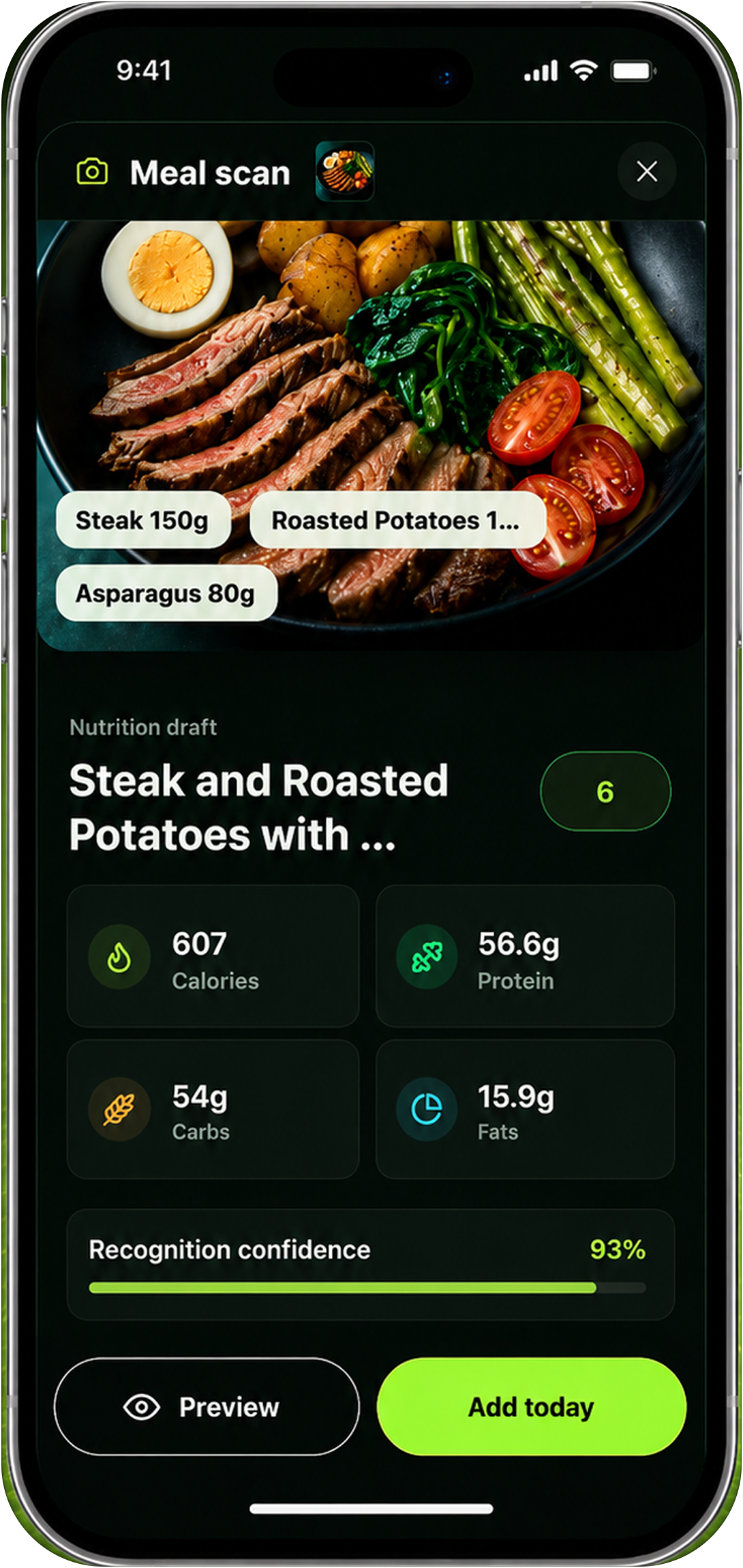
A bulk becomes much easier to steer when you treat it as a series of four-week experiments. You do not need to collect every possible metric. You need enough evidence to answer whether the gain is moving toward your goal.
| Signal | What to record | What it helps you decide |
|---|---|---|
| Weight trend | Several morning readings and a weekly average | Is the surplus producing no gain, a manageable gain, or a jump that is too fast? |
| Measurements | Waist and selected limb measurements under repeatable conditions | Where is the added size showing up? |
| Progress photos | Same lighting, distance, clothing, and poses | Does the visual change match the scale story? |
| Performance | Anchor lifts, reps, load, form, and effort | Is training quality improving or are you only gaining body weight? |
| Nutrition adherence | Actual meals, protein consistency, appetite, and digestion | Did the planned surplus happen, and is it livable? |
Use the evidence to make one small adjustment. If the scale is flat and adherence is real, add a little food. If weight is climbing quickly and waist gain is outpacing performance, reduce the surplus. If performance is improving and the broader pattern looks favorable, resist the urge to change a working plan simply because the scale is not dramatic.
Reset90 is designed for this kind of loop: the App can keep workouts and progression near the nutrition targets, then give you a place to review check-ins and longer-term changes. It does not determine how much muscle you will gain. It helps make the inputs and signals visible enough for a calmer next decision.
09What is the best middle ground?
For many people, the best answer is neither a strict “clean bulk” nor an uncontrolled dirty bulk. It is a flexible, controlled bulk:
- Start with a modest surplus rather than an aggressive jump.
- Base most meals on nutrient-dense foods that make protein and recovery easier.
- Include calorie-dense and enjoyable foods when they help adherence.
- Set a weight-trend guardrail before you begin.
- Use waist, photos, and performance to check what the scale cannot tell you.
- Adjust the plan when the four-week pattern changes, not when one meal feels imperfect.
This approach keeps the useful part of a dirty bulk—the permission to eat enough—without treating extra fat as proof that the plan is working. It also keeps the useful part of a lean bulk—the controlled feedback loop—without requiring every meal to be perfectly “clean.”
10When should you stop bulking?
There is no universal calendar date when every person should stop. A bulk may end because you have reached a planned body-weight range, your waist is rising faster than you accept, your appetite or digestion is suffering, your training goal has changed, or you would rather spend the next block maintaining or losing fat.
Use the same signals you used to start. If performance is improving, weight is rising gradually, and the physique change is acceptable, you may choose to continue. If the scale is rising rapidly while training quality is flat and you feel less comfortable, the surplus is probably doing more than you need. A pause at maintenance can also be a useful option; not every phase has to be a bulk or a cut.
If you are unsure whether to bulk, cut, or recomp, the goal is to choose the phase that fits your current priority rather than copying someone else’s cycle. Our body-recomposition tracking guide explains the multi-signal logic for people who want to improve body composition without making scale weight the only target.
11Frequently asked questions
Is a 400-calorie surplus a lean bulk?
It can be, but the label depends on your maintenance, training age, and response. Four hundred calories is a very different percentage for someone with a low versus high maintenance intake. Use it as a starting estimate, then check the multi-week trend rather than assuming the number guarantees a lean result.
Can dirty bulking build muscle?
Yes. Resistance training, adequate protein, and enough energy can support muscle gain during a dirty bulk. The problem is that the aggressive surplus may add more fat than necessary, and the extra calories do not make muscle grow without a rate limit.
Is dirty bulking good for skinny people?
Someone who genuinely cannot eat enough to gain may benefit from more calorie-dense foods and a less rigid plan. That does not require eating without limits. Start by checking actual intake and weight trends, then use a flexible controlled surplus that solves the under-eating problem.
Do you need clean foods to lean bulk?
No. “Clean” is an informal label, not a requirement. A lean bulk is mainly about controlling the surplus and supporting training. Nutrient-dense foods should make up a strong foundation, but enjoyable foods can fit if the overall pattern remains adequate and sustainable.
How long should a lean bulk last?
Long enough to see a meaningful training and body-composition trend, often several months, but not so long that the phase no longer fits your goal. Review every four weeks and make a larger phase decision after several checkpoints.
How fast should you gain weight on a bulk?
There is no single rate for every person. A slower rate is usually easier to keep lean, while beginners or genuine hardgainers may tolerate a faster rate. Start conservatively, track the weekly average, and adjust based on waist, photos, performance, and how you feel.
12The practical verdict
For most lifters, choose a lean or controlled bulk. It gives you enough energy to train and recover while limiting the amount of fat you have to lose later. Do not confuse it with a diet of bland foods or a ban on treats. Control the surplus, keep protein and training consistent, and let the weekly data guide the next adjustment.
A dirty bulk is best understood as a situational tool for someone whose main problem is failing to eat enough—not as a faster route around the limits of muscle growth. If you use it, keep guardrails. The scale moving quickly is not the same as the plan working well.
Download Reset90 from the App Store or Google Play using the buttons on this page to connect your training progression, nutrition targets, meal logs, measurements, photos, and weight trends. The goal is not to win the lean-bulk-versus-dirty-bulk argument. It is to build a phase you can measure, adjust, and continue.
The Reset90 system
Useful ideas for building a body you can keep.
Training notes, product updates, and practical ways to make your next 90 days count.
Start your next 90 days
Get your daily training, nutrition, and check-in priorities in one adaptive system.


Keep reading
Related articles

Ideal Body Measurements for Women
There is no single ideal body measurement set for women. Learn how averages, waist-to-height, body shape and repeatable tracking fit together without chasing a fixed beauty standard.
Read article
Bulk, Cut, or Recomp? A Practical Decision Guide
A practical way to choose a bulk, cut, recomp, or maintenance phase using your goal, training age, recovery, and repeatable progress signals.
Read article
How Often Should You Take Progress Photos?
How often should you take progress photos? Use this goal-based guide to choose weekly, biweekly, or monthly check-ins and make every comparison more consistent.
Read article