
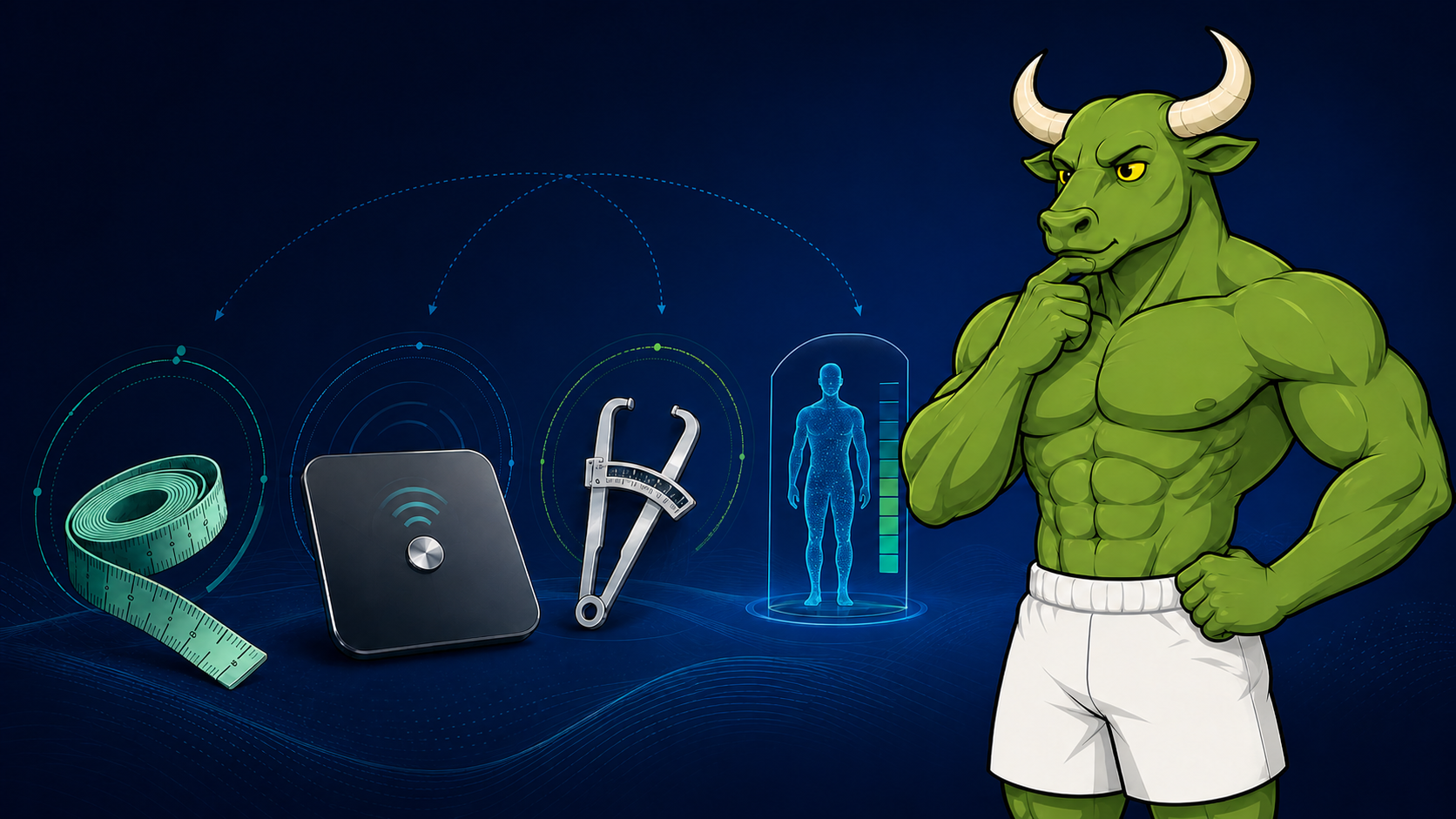
How Accurate Are Body Fat Calculators? Method by Method
Body-fat calculators are useful estimates, not direct measurements. Compare tape, BIA, calipers, photos, DEXA, and density-based methods without false precision.
By Reset90 AI Editorial Team
Short answer: Body-fat calculators are useful estimates, not direct measurements. A tape-measure formula, smart scale, skinfold test, photo estimate, and DEXA scan are answering related questions with different inputs and different sources of error. For most fitness decisions, a repeatable method tracked over time is more useful than treating one percentage as an exact verdict.
The number on a body-fat calculator can feel more precise than the process behind it. Enter a few measurements, tap a button, and the result appears with a decimal point. That presentation is convenient, but it can hide an important distinction: the calculator is estimating a difficult-to-measure property from a model. It is not directly weighing your fat tissue.
This guide compares the main methods, explains why results disagree, and gives you a practical way to decide which number deserves attention. The goal is not to find a magical “perfect” body-fat percentage. It is to choose a measurement process that is honest enough to support your next training, nutrition, or progress-tracking decision.
01What does a body-fat calculator actually calculate?
Most online body-fat calculators use an equation. The equation takes inputs such as height, body weight, waist circumference, neck circumference, hip circumference, age, or sex category and turns them into an estimated percentage. The result depends on the formula, the population used to develop it, and how accurately you collect the inputs.
That means a calculator can be internally consistent without being perfectly accurate for every individual. If you enter the same measurements into the same formula, you will usually get the same output. But the equation cannot see where your fat is stored, how much water you are carrying, how much muscle you have, or whether your body shape matches the population behind the formula.
It helps to separate two questions:
- Validity: How close is this estimate to a reference measurement taken with another method?
- Repeatability: If I repeat the process under similar conditions, does it give me a comparable result?
A method can be imperfect as an absolute estimate and still be useful for observing a personal trend. A number can also look scientifically precise while changing too much from one measurement to the next to guide a sensible decision.
02How accurate is the tape-measure or Navy method?
Tape-measure calculators are among the most accessible ways to estimate body fat at home. The commonly used U.S. Navy-style approach combines height with circumference measurements. Depending on the version, the inputs usually include waist and neck for men, and waist, hip, neck, and height for women.
Its main strength is that it uses a body-size signal rather than relying only on scale weight. It is inexpensive, repeatable, and fast. If you take the measurements carefully, it can help you monitor whether your waist and overall proportions are moving in the direction of your goal.
Its limitations are just as important. Tape position, posture, breathing, tape tension, time of day, and the exact landmark can change the inputs. A formula built around average relationships may also fit some bodies better than others. Muscularity, fat distribution, age, and population differences can all affect how closely the estimate matches another method.
The best use of a tape-based calculator is a consistent personal trend. Measure at the same time, use the same landmarks, keep the tape level, and avoid pulling it tight enough to compress the skin. If you want the method to be more useful, follow a repeatable setup such as the one in our guide to taking body measurements. You can also compare the output with your waist trend and photos rather than treating it as a standalone score.
03How accurate are smart scales and BIA calculators?
Smart scales use bioelectrical impedance analysis, or BIA. The scale sends a very small electrical current through the body, measures resistance, and combines that signal with inputs such as height, weight, age, and sex category. An algorithm then estimates body fat, water, muscle, or other metrics.
The scale is usually more dependable for body weight than for body-fat percentage. Weight is measured by load cells. The composition numbers are model-based estimates built from a limited electrical pathway and a set of assumptions. Different devices can therefore give different body-fat results on the same day without either display being a direct view of your tissue.
Hydration, food, sodium, recent exercise, skin temperature, foot contact, posture, time of day, and the scale’s profile settings can all affect a BIA reading. A large change overnight is often a reason to check the measurement conditions before concluding that your body composition changed dramatically.
Smart scales are not automatically useless. They can be convenient for repeated tracking when you use the same device in the same way. If this is the method you use, read our deeper guide to smart-scale accuracy. The practical rule is to trust the weight trend more than the composition estimate, and to trust a multi-week pattern more than one reading.
04What about skinfold calipers?
Skinfold calipers measure the thickness of selected skinfolds. An equation then uses those measurements to estimate body density or body-fat percentage. The method is inexpensive and portable, but the quality of the result depends heavily on technique.
Small differences in locating the measurement site, grasping the fold, waiting for the caliper to settle, and applying the same pressure can change the reading. A trained tester using the same protocol can usually produce more useful comparisons than someone measuring casually in different places each time. Self-measurement can be difficult, especially at sites that are hard to reach or view.
Calipers may be a reasonable option when you have a consistent tester and a defined protocol. They are less helpful when the method, tester, sites, or equation keeps changing. Like tape measurements, the safest interpretation is usually directional: “the repeated measurements moved this way,” not “this percentage is an exact map of my body.”
05Is DEXA the most accurate body-fat method?
DEXA, or dual-energy X-ray absorptiometry, is often treated as a higher-detail reference for body composition. It can provide estimates of total and regional bone, lean tissue, and fat tissue using different X-ray attenuation patterns. It is more informative than a basic home calculator for many assessment purposes, but it is still not a magical truth machine.
DEXA results can vary with the scanner, software, operator, hydration, meal timing, positioning, and how the report is interpreted. A follow-up scan is most useful when it is performed with the same service and reasonably similar conditions. A change between two different methods may reflect method difference rather than a true change in your body.
DEXA also has practical trade-offs: cost, access, scheduling, and a small amount of radiation exposure. It makes more sense when you have a specific reason to obtain a higher-detail assessment, not simply because a home estimate made you anxious. For routine training decisions, a repeatable home method plus weight, waist, photos, and performance may be enough.
06How do Bod Pod and underwater weighing compare?
A Bod Pod estimates body density using air displacement. Underwater weighing estimates body density from body weight on land, body weight underwater, and the volume of water displaced. Both methods rely on the idea that fat, lean tissue, and water have different densities.
These approaches can be useful in controlled settings, but they are not convenient home tests. They require specialized equipment, trained operators, and assumptions about lung volume, residual air, and tissue density. The testing environment and the equation used to convert density into body fat still matter.
The important takeaway is not that one method wins every argument. It is that each method has a measurement model. More equipment can reduce some types of error while introducing cost, access, and protocol constraints. When comparing two results, compare the method and conditions before comparing the percentages.
07Can a photo or AI body-fat estimate be trusted?
Photo-based and AI-assisted estimates are attractive because they reduce friction. A person can take a photo or upload an image and receive a visual estimate without a tape, calipers, or appointment. That convenience can make it easier to create a regular check-in habit.
But a photo is highly sensitive to lighting, camera distance, lens distortion, pose, clothing, muscle pump, shadows, and angle. An AI model may also be influenced by the examples and labels used to train it. A visually confident result does not mean the underlying estimate is clinically precise.
Use visual tools as context, not diagnosis. They can help you compare standardized photos over time or understand broad visual differences between ranges. They should not be used to diagnose visceral fat, determine medical risk, or justify an aggressive diet. Reset90’s body-fat visualizer is designed for education and visual context; it is not a measurement device.
08How to compare body-fat methods
When two methods disagree, do not immediately ask which number is “the real one.” Start by asking what each method can observe and what it has to assume.
| Method | What it uses | Main strength | Common limitation | Best everyday use |
|---|---|---|---|---|
| Tape-measure calculator | Height and body circumferences | Low cost and easy to repeat | Landmarks, tape tension, and body-shape assumptions | Personal trend with a consistent protocol |
| Smart scale / BIA | Electrical impedance plus profile inputs | Fast, convenient, and often paired with weight history | Hydration and algorithm sensitivity; limited current pathway | Weight trend and cautious composition trend |
| Skinfolds | Selected skinfold thicknesses | Portable and inexpensive with a skilled tester | Technique and equation variation | Repeated field assessment by the same tester |
| Photo or AI estimate | Image features and visual model | Very low friction and useful for standardized visual check-ins | Lighting, pose, camera, clothing, and model bias | Visual context, not an exact percentage |
| DEXA | X-ray attenuation patterns | Detailed regional and whole-body assessment | Cost, access, scanner variation, and measurement assumptions | Higher-detail assessment when there is a clear reason |
| Bod Pod / underwater weighing | Air or water displacement and body density | Controlled density-based assessment | Specialized equipment, access, and protocol assumptions | Controlled testing, not daily tracking |
A useful method is the one that matches the decision. If you want to know whether your waist is trending down during a cut, a consistent tape measurement may answer the question directly. If you want to know whether your total body weight is changing, a scale and a weekly average may be enough. If you need a clinical assessment, use an appropriate professional service rather than upgrading a consumer estimate.
09Why can two calculators give different results?
Different calculators may use different formulas, input definitions, and population assumptions. One may ask for waist circumference at the navel; another may ask for the narrowest point. One may use sex categories; another may use a different equation altogether. Even when two tools use the same label, they may not be calculating the same thing.
Common reasons for disagreement include:
- Different inputs: height, weight, waist, hip, neck, age, and sex category may be weighted differently.
- Different landmarks: a measurement taken at the navel is not interchangeable with one taken at the narrowest waist.
- Different formulas: equations developed from different samples can produce different estimates.
- Different body shapes: a model built around average relationships may fit some people better than others.
- Different measurement methods: a BIA estimate, tape estimate, and DEXA report are not one shared scale.
- Different timing: meals, hydration, training, and time of day can change the input or the signal.
Do not average several calculators together to manufacture a more authoritative number. That combines different assumptions without solving the underlying problem. Pick one method for one job, document how you use it, and compare it with other signals instead of treating the highest or lowest output as the truth.
10How to turn one estimate into a useful trend
If you are using a calculator for progress tracking, build a small measurement protocol. The protocol matters more than the decimal point.
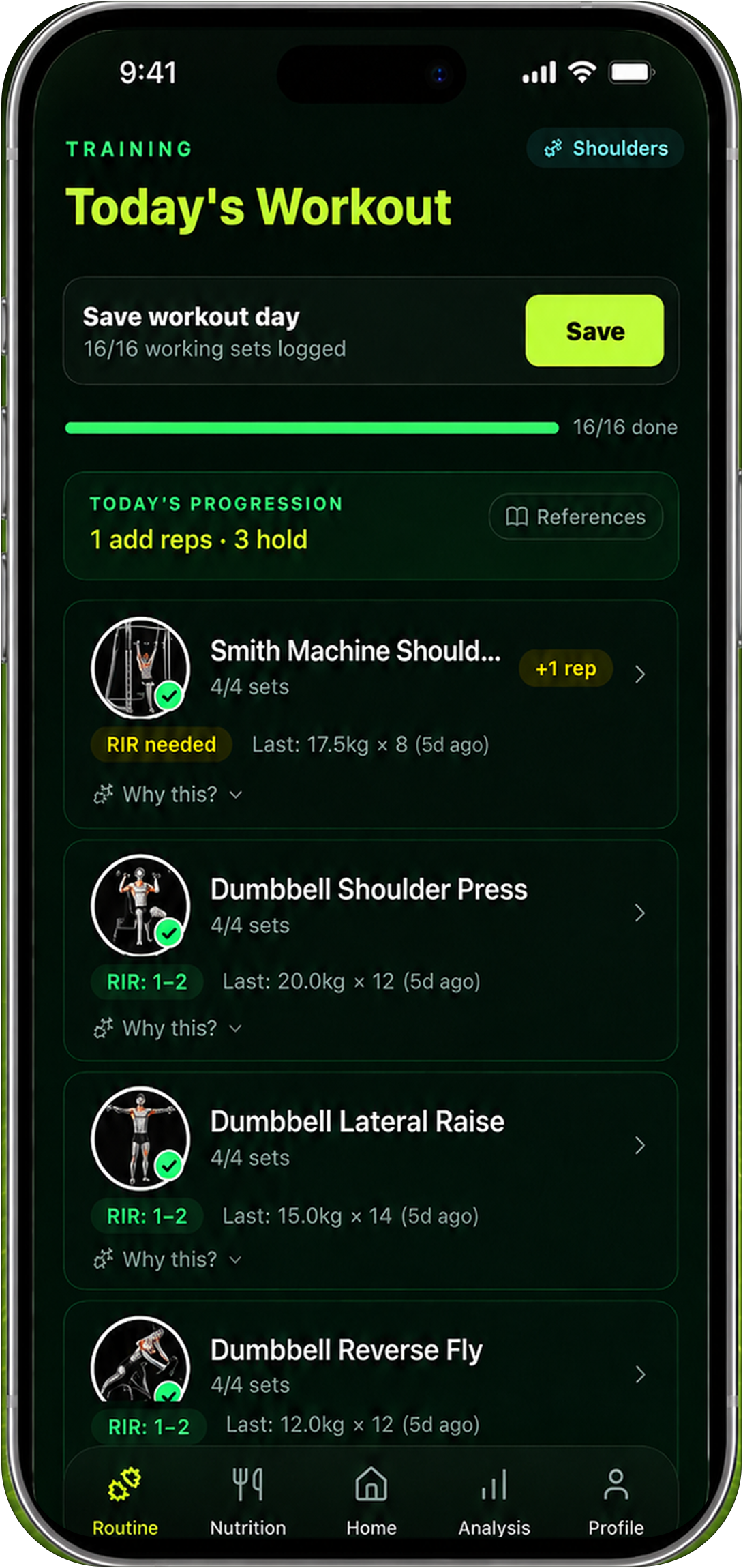
- Choose one primary method. Start with the method that fits your budget, access, and decision. Do not switch between BIA, tape, photos, and DEXA and draw one continuous line from all of them.
- Write down the setup. Record the measurement landmarks, device, profile settings, time, and whether the reading happened before food or training.
- Keep conditions similar. Similar timing and routine make changes easier to interpret. You do not need perfect conditions; you need conditions that are repeatable enough.
- Review a long enough window. A weekly or monthly review is usually more useful than reacting to a single percentage. Look for a pattern across several readings.
- Pair the estimate with other signals. Add waist, progress photos, weekly weight average, strength, training adherence, nutrition consistency, and recovery.
- Change one variable at a time. If a result is surprising, first check the measurement process. Do not change your whole plan because of one noisy reading.
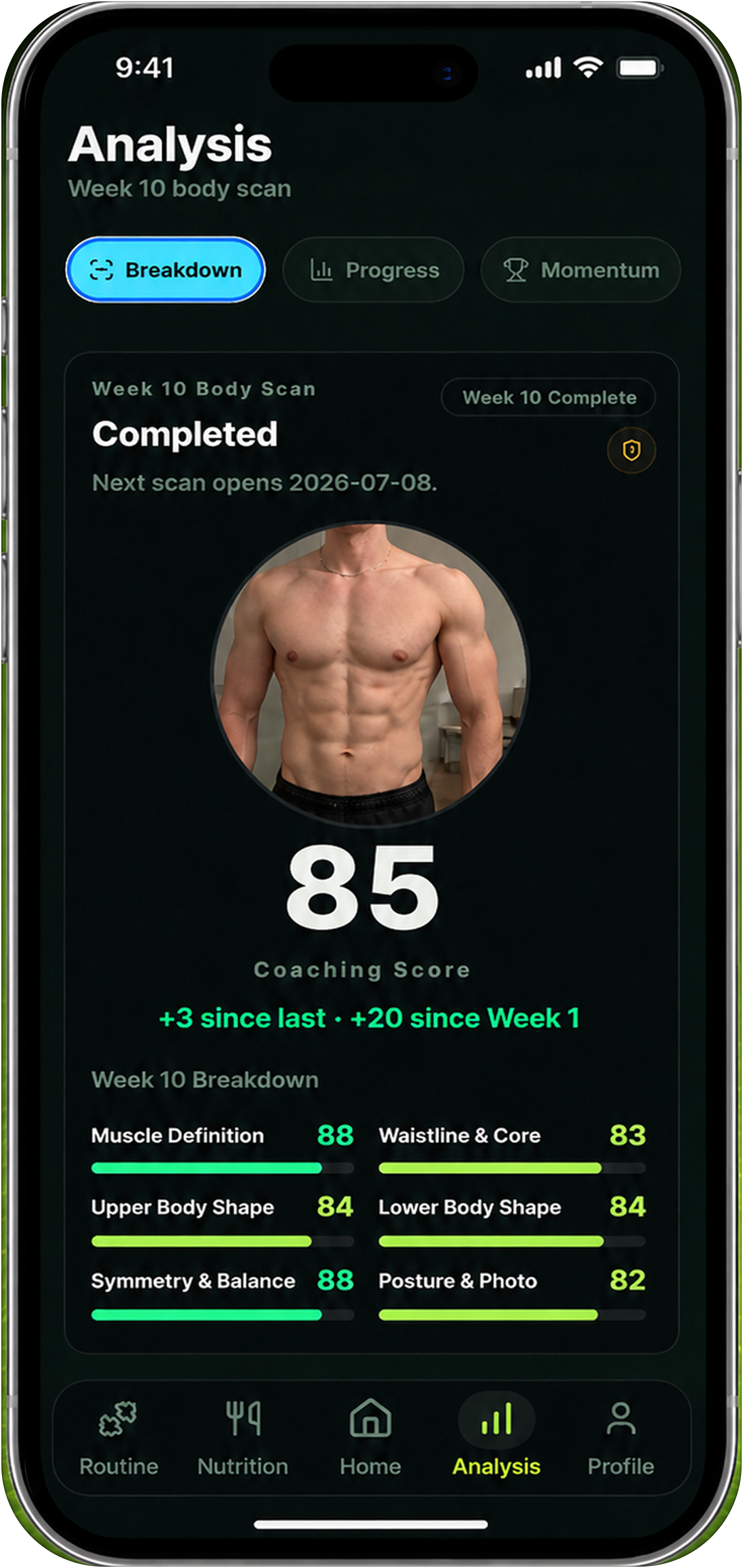
Reset90 can help organize this review by keeping workouts, nutrition targets, check-ins, weight trends, measurements, and progress photos in one routine. That is the useful product fit: a calmer system for comparing signals over time. It does not make an estimate clinically exact, and it cannot diagnose a health condition.
11Which body-fat number should you use for a goal?
For a fat-loss goal, use a combination of weekly weight averages, waist measurements, photos, training performance, and adherence. A body-fat estimate can be an additional signal, but it should not be the only reason to reduce food or increase exercise.
For muscle gain or recomposition, body weight may stay steady while strength, measurements, and appearance change. A noisy body-fat estimate can distract from the bigger pattern. Compare the estimate with performance and a longer time horizon. Our guide to reading body-fat percentage ranges explains why a reference chart is context rather than a pass/fail target.
For a question about BMI, remember that BMI is calculated from height and weight and does not directly measure body fat. A body-fat estimate is not automatically superior; it simply answers a different question with its own uncertainty. See body-fat percentage vs. BMI for the distinction.
12When should you stop relying on a home estimate?
A home calculator is not the right tool for diagnosing a condition, evaluating unexplained weight change, assessing visceral fat or bone health, or deciding whether a medical intervention is needed. Consumer tools can be useful for fitness tracking, but they are not substitutes for clinical assessment.
Consider professional guidance when the number is connected to symptoms, pregnancy, a history of disordered eating, a suspected health condition, or a high-stakes performance decision. If a measurement causes you to make increasingly restrictive or punishing choices, step back from the number and ask for qualified support.
Even a professional method should be interpreted with context. Ask what was measured, how the estimate was produced, what the uncertainty is, and whether a repeat assessment would use the same equipment and protocol.
13Frequently asked questions
Are online body-fat calculators accurate?
They provide estimates rather than direct measurements. Accuracy depends on the formula, your inputs, your body characteristics, and the method used to collect measurements. They are most useful for a consistent personal trend, not for treating one result as an exact percentage.
What is the most accurate way to measure body fat?
There is no single method that is perfect in every setting. DEXA, Bod Pod, and underwater weighing can provide higher-detail or controlled assessments, while tape, calipers, BIA, and photos are more accessible. The best choice depends on whether you need a professional assessment or a repeatable way to track change.
How accurate is the Navy body-fat calculator?
The Navy-style calculator can be a useful low-cost estimate when you measure the correct landmarks consistently. It can still differ from DEXA or another method because it uses an equation and body circumferences rather than directly measuring fat tissue. Use the direction of repeated results more confidently than the exact number.
Should I trust a smart scale’s body-fat percentage?
Use it cautiously. Smart scales are generally more useful for body weight than for exact body composition, and BIA results can shift with hydration, food, training, contact, and device settings. Keep the device and routine consistent, then compare the multi-week trend with waist, photos, strength, and adherence.
Why do body-fat calculators disagree with each other?
They may use different formulas, input definitions, measurement landmarks, population assumptions, or technologies. A tape calculator and a BIA scale are not measuring the same signal. Do not average them together; choose one method for one tracking job and document the conditions.
Can I use a body-fat estimate to decide how much to eat?
Do not base a major nutrition change on one estimate. Use body weight averages, waist, performance, training load, hunger, recovery, and adherence together. If you have medical concerns or a history of disordered eating, seek qualified guidance before making aggressive changes.
14The practical answer
Body-fat calculators are not equally accurate because they are not all measuring the same thing. Tape formulas estimate from body size, BIA scales estimate from electrical resistance and profile data, calipers estimate from skinfold thickness, photos estimate from visual information, and professional methods use more controlled equipment with their own assumptions.
Choose the least complicated method that can answer your actual question. Standardize it, repeat it, and pair it with weight, waist, photos, strength, training, nutrition, and recovery. A calm, comparable trend is usually more useful than a precise-looking number that changes whenever the method or conditions change.
If you want a structured way to keep those signals together, use Reset90 as a progress system—not as a promise that any calculator can replace a clinical measurement. For medical questions, symptoms, or high-stakes decisions, talk with a qualified healthcare professional.
The Reset90 system
Useful ideas for building a body you can keep.
Training notes, product updates, and practical ways to make your next 90 days count.
Start your next 90 days
Get your daily training, nutrition, and check-in priorities in one adaptive system.


Keep reading
Related articles
Ideal Body Measurements for Women
There is no single ideal body measurement set for women. Learn how averages, waist-to-height, body shape and repeatable tracking fit together without chasing a fixed beauty standard.
Read article
Bulk, Cut, or Recomp? A Practical Decision Guide
A practical way to choose a bulk, cut, recomp, or maintenance phase using your goal, training age, recovery, and repeatable progress signals.
Read article
How Often Should You Take Progress Photos?
How often should you take progress photos? Use this goal-based guide to choose weekly, biweekly, or monthly check-ins and make every comparison more consistent.
Read article