

How to Lean Bulk Without Gaining Excess Fat: A 30-Day Setup and Audit
Learn how to set up a controlled lean bulk with a modest surplus, consistent protein and training, then use a 30-day calibration and four-week audit to limit unnecessary fat gain.
By Reset90 AI Editorial Team
Short answer: To lean bulk without gaining excess fat, start with a small, intentional calorie surplus, keep protein and resistance training consistent, and judge the plan by a multi-week trend rather than one weigh-in. The goal is not zero fat gain—that is not a realistic promise for everyone. The goal is to give muscle growth enough fuel while using weight trends, waist measurements, photos, performance, and adherence to catch an oversized surplus early.

A lean bulk sounds simple until the scale refuses to cooperate. If weight barely moves, you may worry that nothing is growing. If it jumps quickly, you may wonder whether you are building muscle or just adding fat. The useful answer is not another rigid “clean food” list. It is a feedback loop.
01What does lean bulking actually mean?
A lean bulk is a muscle-building phase built around a controlled calorie surplus. You eat somewhat more energy than you use, train with a repeatable resistance program, consume enough protein, and monitor the rate and quality of change. The word lean describes the amount of unnecessary fat you are trying to limit—not a guarantee that every pound will be muscle.
That distinction matters because the scale can rise for several reasons at once. New training can increase glycogen and water storage. More food creates more digestive contents. A modest surplus can support new muscle over time. Some fat gain may still occur. You cannot identify the mix from a single morning number.
If you want the comparison between controlled and aggressive bulking, see our guide to lean bulk vs. dirty bulk. This article has a narrower job: setting up a controlled bulk and knowing when to adjust it.
02Can you lean bulk without gaining any fat?
Not reliably. A person can gain muscle while gaining very little fat, especially when new to resistance training, returning after a long break, or starting from a carefully measured maintenance baseline. But the body does not direct every extra calorie into muscle, and estimates of maintenance intake are never perfectly precise.
Use “without excess fat” as the practical goal. That means avoiding a surplus so large that the scale and waist move much faster than training performance. It also means accepting that the right decision may sometimes be maintenance, a slower gain phase, or a period of fat loss rather than a bulk.
03Start with a maintenance estimate, not a magic number
Your first calorie target is a hypothesis. A TDEE calculator can give you a starting estimate from body size, age, activity, and training. It cannot know your exact movement, appetite, digestion, sleep, or week-to-week schedule.
Begin with the estimate and collect consistent data for about two weeks if you can do so without creating an unhealthy relationship with tracking. Weigh under similar conditions, record your food as accurately as practical, and look at the average rather than reacting to each day. If your weight is stable, that intake is a useful maintenance hypothesis. If it is falling or rising, your actual maintenance is different from the calculator output.
Then choose a modest surplus. A common starting range is roughly 200–300 calories per day, but the right amount depends on your size, training age, activity, appetite, and confidence in the maintenance estimate. Treat the number as a starting setting, not a promise. The trend after several weeks is more informative than the label attached to the plan.
04Set the three inputs that matter most
A lean bulk is easier to steer when you separate the plan into three inputs: nutrition, training, and recovery.
Protein that you can repeat
Set a consistent daily protein target that fits your body size and eating preferences. A broad evidence-informed starting range often used by lifters is about 1.6–2.2 grams per kilogram of body weight per day, but more is not automatically better and a target is not a medical prescription. Spread protein across meals you can actually repeat rather than saving everything for dinner.
Our guide to protein per meal for muscle gain covers distribution in more detail. For this bulk, protein is one input—not the entire strategy. Extra protein cannot compensate for an uncontrolled surplus, inconsistent training, or poor recovery.
Progressive resistance training
Your body needs a repeatable reason to build muscle. That does not mean every workout must be maximal. It means you record enough context to see whether load, reps, sets, range of motion, technique, or effort are improving over time.
If the bar weight is not increasing, other forms of progression may still be happening. Our guide to tracking progressive overload explains how to audit those changes instead of assuming the bulk failed because one lift stalled.
Recovery that supports the plan
Sleep, rest days, stress, and the total amount of training affect what your surplus can accomplish. More food is not a substitute for a program you cannot recover from. A controlled bulk should make training more sustainable, not turn every week into a test of exhaustion.
05How fast should a lean bulk be?
Choose a rate that is slow enough to review. Beginners and people returning to training may see faster scale changes because of glycogen, water, food intake, and early adaptations. More experienced lifters usually need to be more patient because their potential rate of new muscle gain is lower.
As a practical guardrail, many lifters begin by aiming for a small fraction of body weight per month rather than trying to add a pound every week. The exact rate is not universal. Your starting body composition, training history, activity, and tolerance for fat gain all matter. A faster rate is not automatically better, and a flat week is not automatically a failure.
The most useful question is: Is body weight rising slowly enough that performance and physique signals can tell me whether the change is helping?
06Build your lean-bulk setup
Use this setup before you start changing calories every few days:
- Choose the phase. Decide whether the priority is muscle gain, a little body-weight gain, improved performance, or simply solving chronic under-eating. If you are already unhappy with your current body-fat level, maintenance or recomposition may fit better than a bulk.
- Record a baseline. Collect at least one to two weeks of comparable morning weights and normal food intake. A baseline makes later adjustments less speculative.
- Add a modest surplus. Start conservatively. Do not add more just because the first few days look flat; water and digestion can hide the direction.
- Set protein and training anchors. Pick meals that make protein easy and choose a training schedule you can repeat. Avoid changing the diet and the program on the same day unless safety requires it.
- Choose review signals. Use a seven-day weight average, waist measurement, standardized photos, a few anchor lifts, and a simple adherence note. You do not need to measure everything every hour.
- Schedule the review. Put a four-week audit on the calendar before the first surplus meal. This keeps you from making a major decision because of one heavy or light weigh-in.
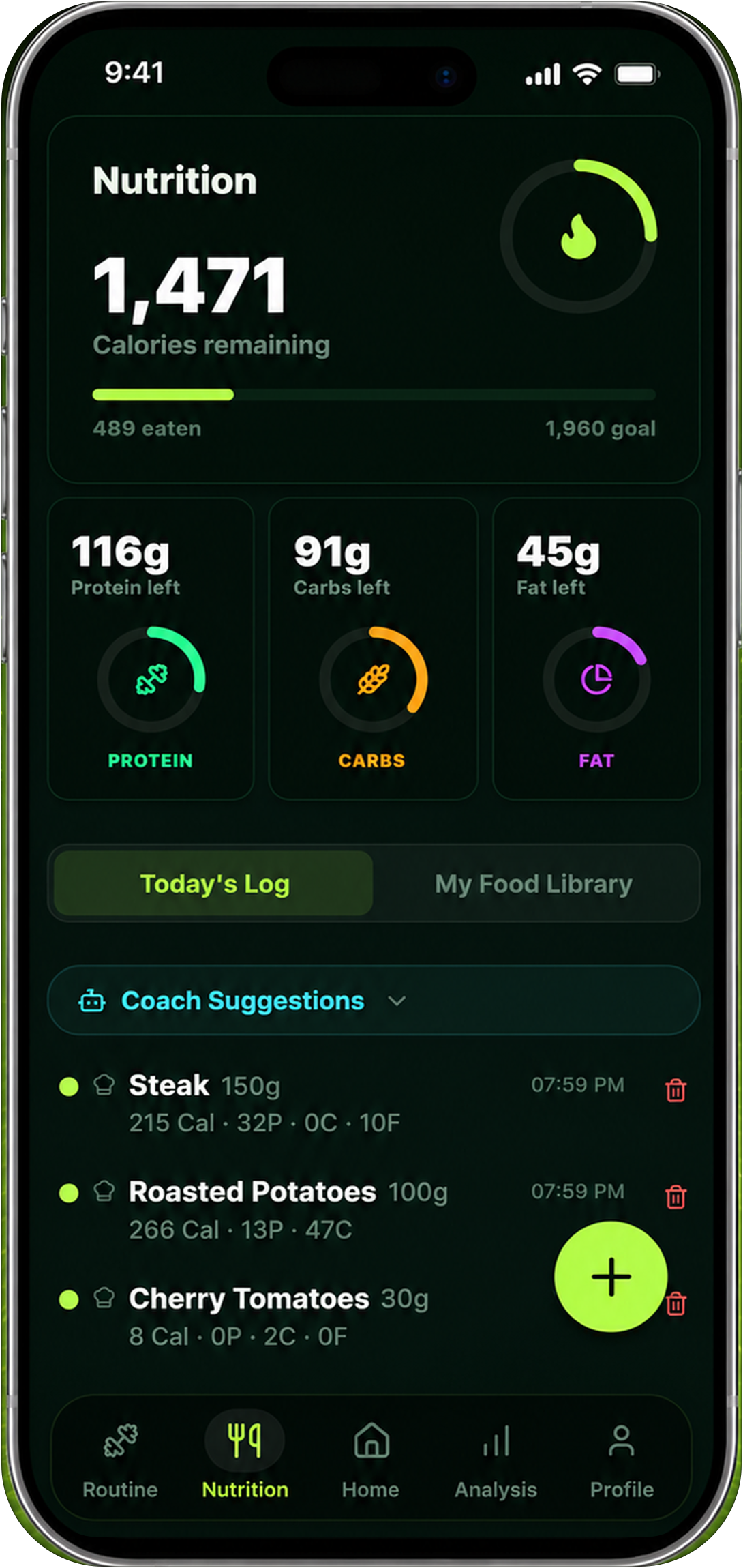
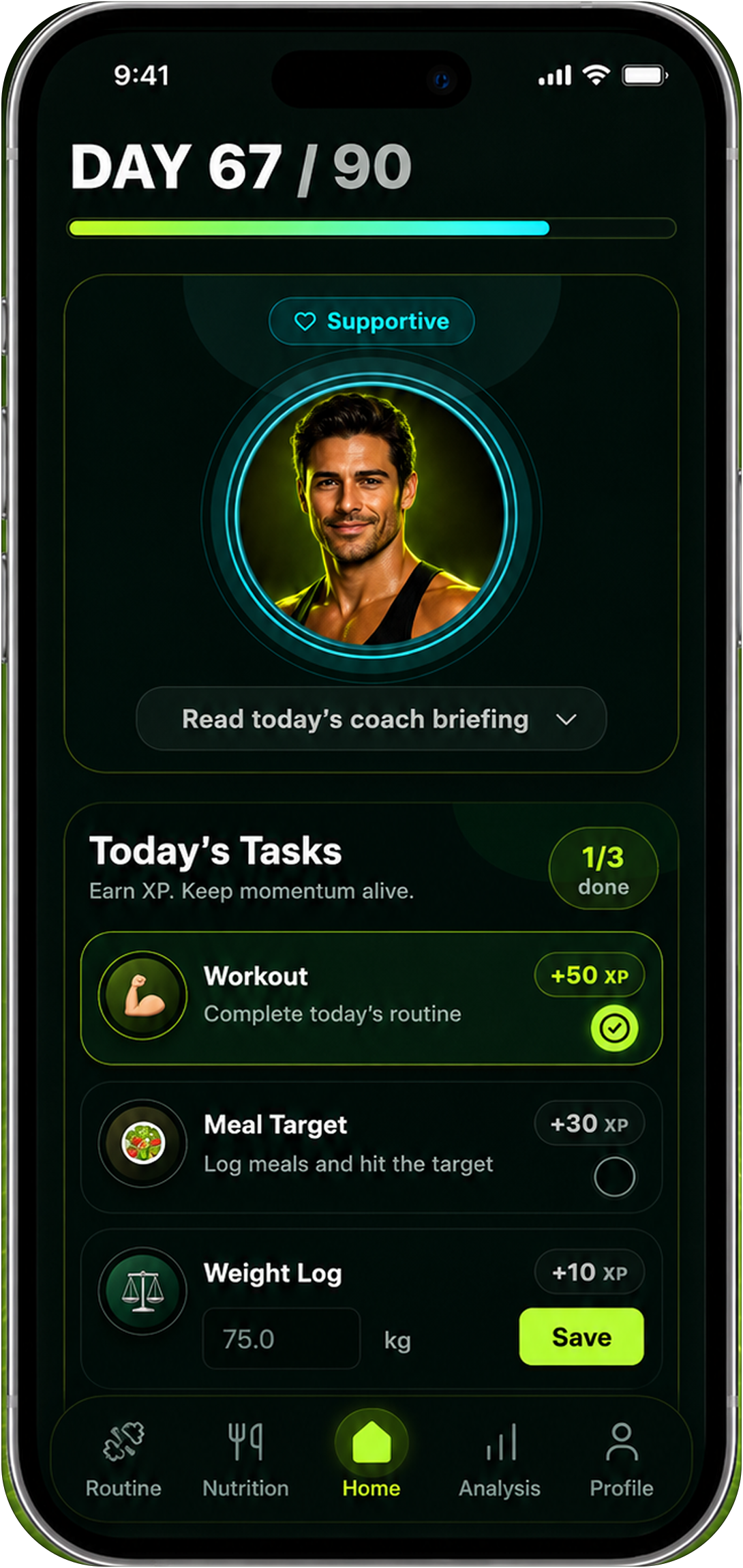
Reset90 can make this setup easier to repeat by keeping workouts, progression, nutrition targets, meal logging, photos, measurements, and check-ins in the same progress loop. The value is not a promise that the App can predict your muscle gain. It is a clearer record for the next decision.
07Run a 30-day calibration instead of chasing perfection
The first month is a calibration phase. Your maintenance estimate may be wrong, your activity may change, and the initial scale movement may include water and glycogen. The goal is to learn your response without making several adjustments at once.
During the first week, keep the plan stable and focus on consistent weigh-ins, reasonable food logging, and training quality. During weeks two and three, watch the weekly average and whether the planned meals are actually happening. In week four, compare the average with the baseline and review waist, photos, performance, appetite, digestion, and recovery.
If the weight trend is flat and adherence is credible, add a small amount of food and repeat the observation period. If the trend is rising rapidly while the waist is also moving faster than you want, reduce the surplus modestly. If performance is improving and the broader picture is acceptable, keep the setting steady. One-variable changes make the result easier to interpret.
08Audit your bulk every four weeks
A four-week audit turns “I think I am getting fat” or “I do not think this is working” into a more useful question: which signal changed, and what action follows?
| Signal | Record | What it can tell you |
|---|---|---|
| Weight trend | Seven-day averages under similar conditions | Whether the plan is broadly flat, slowly rising, or rising too quickly |
| Waist | Same location, posture, and time of day | Whether size is changing around the midsection faster than you accept |
| Photos | Same lighting, distance, clothing, and poses | Whether the visual change agrees with the scale story |
| Performance | Anchor lifts, reps, technique, and effort | Whether the training stimulus is improving or only body weight is rising |
| Adherence | Actual meals, protein consistency, appetite, digestion, and missed sessions | Whether the planned surplus was really the surplus you followed |
Do not expect these signals to move in lockstep. A stronger lift with a stable waist may be a good result even if the scale is slow. A fast scale increase with flat performance and a quickly expanding waist is a reason to review the surplus. Photos can lag, and a single waist measurement can be noisy; look for a pattern.
09What to do when the plan is too flat or too fast
If your weight is not moving
First check whether the average truly stayed flat and whether the planned surplus was eaten consistently. Restaurant portions, missed snacks, appetite changes, and extra activity can erase a small surplus. If the data is consistent and the trend is flat for several weeks, add a small amount of food and hold it long enough to evaluate.
If weight is rising faster than planned
Check whether the jump is recent and accompanied by a change in sodium, carbohydrates, training volume, digestion, or weigh-in timing. A short spike is not proof of fat gain. If the multi-week trend remains fast and waist gain is outpacing performance, reduce the surplus modestly rather than panic-cutting.
If performance is not improving
More calories do not guarantee better training. Review exercise selection, technique, volume, effort, sleep, stress, and recovery. A bulk is not working if the only reliable change is a higher scale reading.
10Food quality matters, but “clean” is not the control system
Most of your meals should make it easier to hit protein, fiber, vitamins, minerals, and training-friendly carbohydrates. That does not mean banning pizza, desserts, or restaurant meals. It means recognizing that highly palatable, calorie-dense foods can make a small surplus easy to overshoot.
Use food quality to support adherence and recovery. Use the trend to regulate the surplus. A homemade meal can still be too many calories, and a flexible meal can fit inside a controlled week. The plan should be nutritionally useful and psychologically sustainable.
11How Reset90 fits into a lean-bulk audit
Lean bulking creates a tracking problem: the answer is rarely contained in one number. You need the training stimulus, nutrition behavior, and body-change signals in the same review.
Reset90 is a practical fit for that loop because you can use the App to keep workouts and progression visible alongside nutrition targets, meal logs, progress photos, measurements, and check-ins. That helps you ask a better question than “Did I gain weight?” You can ask whether your training is progressing, whether your intake is consistent, and whether the physical change matches the goal.
Use the Download Reset90 CTA on this page if you want one place to start that record. Reset90 does not diagnose fat gain, clinically measure body composition, or guarantee a lean-bulk result. It helps organize the signals you need to make a calmer adjustment.
12When should you pause or stop the bulk?
There is no universal number of weeks. Pause or change phases when the surplus no longer matches the goal, the waist is rising faster than you accept, appetite or digestion is consistently poor, training performance is not improving, or you have reached a planned body-weight or composition boundary.
Maintenance is a valid phase. You do not have to choose between bulking and cutting every time your data is unclear. Hold your intake, keep training, and gather better evidence before making a larger change.
If weight changes are rapid and unexplained, or you have swelling, breathing symptoms, severe pain, significant fatigue, or concerns about disordered eating, speak with a qualified healthcare professional. This article is general fitness education, not medical advice.
13Frequently asked questions
Is a 200-calorie surplus enough for a lean bulk?
It can be a reasonable starting point, especially when your maintenance estimate is reliable and you are trying to limit unnecessary fat gain. Whether it is enough depends on your size, activity, training age, and actual response. Use the four-week trend to decide whether the setting needs adjustment.
How much protein should I eat on a lean bulk?
Many lifters use roughly 1.6–2.2 grams per kilogram of body weight per day as a broad starting range. Your needs and medical context may differ. Keep the target consistent and make the overall diet sustainable; adding protein alone will not control the calorie surplus.
Can beginners lean bulk without a surplus?
Some beginners can gain muscle at maintenance or even while losing fat, particularly when training is new and protein intake is adequate. That does not mean a surplus is always unnecessary. It means your training age changes the decision, and a bulk should solve a real need rather than follow a label.
How do I know if I am gaining muscle or fat?
You cannot identify the split from scale weight alone. Review waist, standardized photos, strength and reps, training quality, nutrition adherence, and the multi-week weight trend together. For a broader multi-signal framework, see how to tell whether body recomposition is working.
Should I bulk if I already have a higher body-fat level?
There is no universal cutoff that answers this for everyone. Consider your goal, comfort, training age, health context, and whether maintenance or recomposition would better fit the next phase. A qualified professional can help if body composition, health, or eating behavior makes the decision stressful.
14The practical verdict
To lean bulk without gaining excess fat, keep the surplus modest, make protein and resistance training consistent, and calibrate the plan with real data. Use a 30-day setup, then review every four weeks with weight averages, waist, photos, performance, and adherence. If the trend is too fast, reduce the surplus. If it is flat, make a small change. If it is working, resist the urge to optimize every week.
The best lean bulk is not the one with the cleanest label. It is the one that gives you enough fuel to train, keeps the amount of unnecessary fat manageable, and leaves you with a feedback loop you can actually follow. Download Reset90 from the App Store or Google Play using the buttons on this page to connect that loop across training, nutrition, and progress.
The Reset90 system
Useful ideas for building a body you can keep.
Training notes, product updates, and practical ways to make your next 90 days count.
Start your next 90 days
Get your daily training, nutrition, and check-in priorities in one adaptive system.


Keep reading
Related articles

Ideal Body Measurements for Women
There is no single ideal body measurement set for women. Learn how averages, waist-to-height, body shape and repeatable tracking fit together without chasing a fixed beauty standard.
Read article
Bulk, Cut, or Recomp? A Practical Decision Guide
A practical way to choose a bulk, cut, recomp, or maintenance phase using your goal, training age, recovery, and repeatable progress signals.
Read article
How Often Should You Take Progress Photos?
How often should you take progress photos? Use this goal-based guide to choose weekly, biweekly, or monthly check-ins and make every comparison more consistent.
Read article