
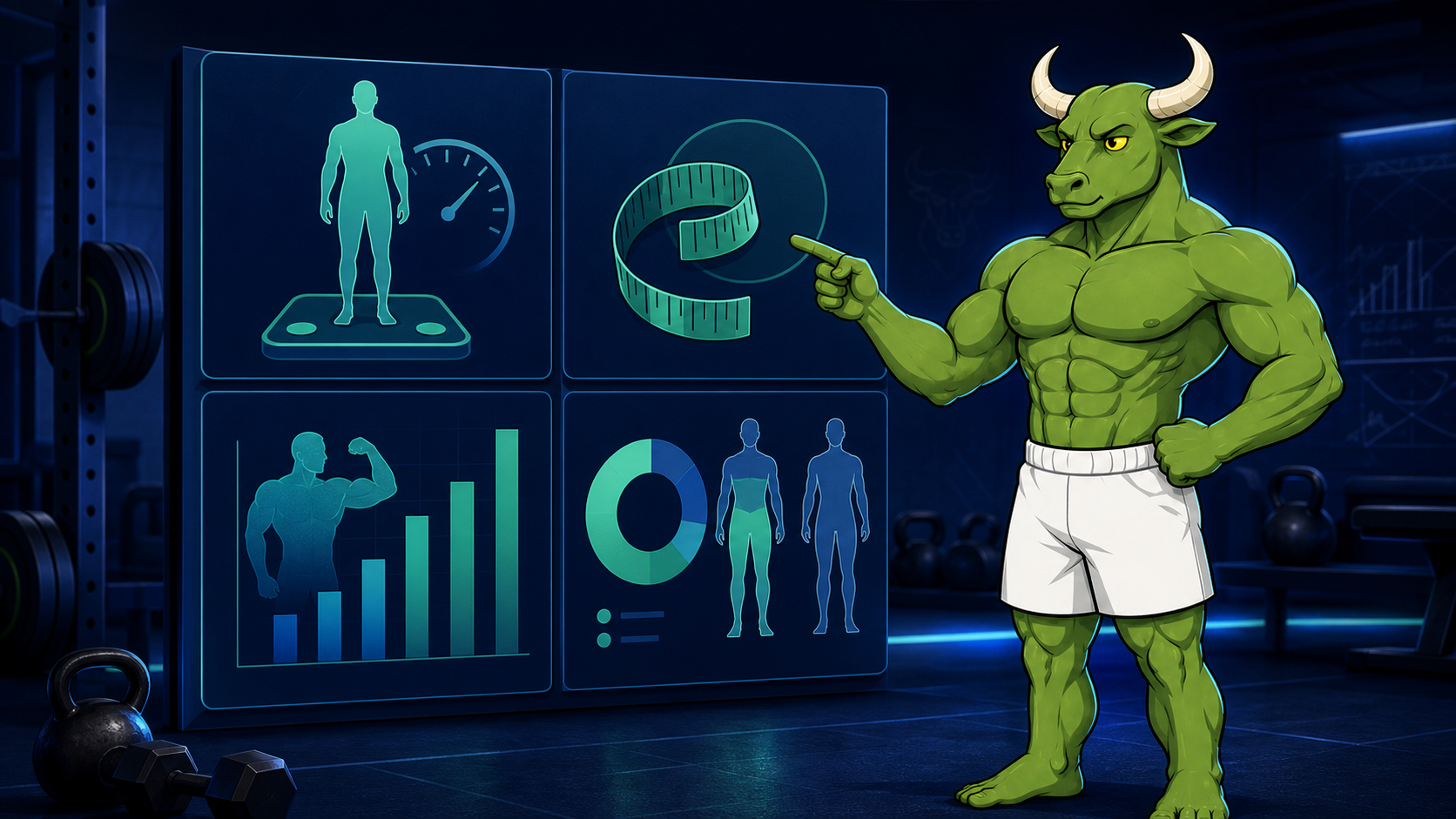
Body Composition for Lifters: BMI, FFMI, Lean Mass, and Body Fat
Learn how lifters should use BMI, body-fat percentage, lean mass, and FFMI together—what each metric measures, where it fails, and how to track progress by goal.
By Reset90 AI Editorial Team
Short answer: Lifters should not ask one number to do four jobs. BMI is a quick weight-to-height screening signal; body-fat percentage estimates the share of weight that is fat; lean mass tracks everything that is not fat; and FFMI puts estimated fat-free mass in the context of height. Use the metric that matches the decision in front of you, then confirm the direction with repeatable measurements, waist, photos, strength, recovery, and a multi-week trend.

If you lift consistently, you have probably seen the same confusing situation: your BMI says “overweight,” your smart scale gives you a body-fat number that changes every few days, and an FFMI calculator seems to promise a definitive answer about muscularity. None of those outputs is useless. The problem is treating them as interchangeable.
Body composition is best understood as a set of related measurements. This guide explains what each metric can tell a lifter, where it breaks down, and how to use the four together during a bulk, cut, maintenance phase, or recomposition.
01The four metrics at a glance
| Metric | What it uses | Best question it answers | Main blind spot |
|---|---|---|---|
| BMI | Weight and height | How does total weight compare with height in a broad screening context? | Cannot separate muscle, fat, bone, water, or organ weight |
| Body-fat percentage | Estimated fat mass and total body weight | Is the estimated fat-to-total-weight ratio moving in the direction I expect? | The result depends on the method, inputs, hydration, and algorithm |
| Lean mass | Everything that is not fat | How much non-fat mass am I carrying over time? | It includes water, bone, organs, and connective tissue—not only muscle |
| FFMI | Estimated fat-free mass and height | How does my estimated lean mass compare after adjusting for height? | It inherits error from the body-fat or lean-mass estimate and is not a natural-limit test |
The useful takeaway is not that one metric wins. It is that each metric has a different owner. BMI is broad context. Body fat is a composition ratio. Lean mass is an absolute non-fat quantity. FFMI is a height-normalized index. A good tracking system keeps those definitions separate.
02BMI: useful context, weak lifter-specific detail
Body mass index is calculated as:
BMI = body weight in kilograms ÷ height in meters²
Because it is quick and inexpensive, BMI can be useful for population comparisons and as one input in a broad health-screening conversation. It does not directly measure body fat, muscle, fitness, or metabolic health. A clinician can interpret it alongside blood pressure, health history, waist circumference, labs, and other information.
For a lifter, BMI becomes less specific as muscle mass rises. Two people at the same height and weight have the same BMI even if one has a much higher body-fat percentage and the other has substantially more lean mass. BMI sees the total; it does not identify the parts.
That does not mean a high BMI should always be dismissed because someone trains. It means the number cannot settle the question by itself. Use it as background context, especially in a medical conversation, and use body-composition and performance signals for training decisions.
For a focused comparison of height-and-weight screening with an estimated fat ratio, see body fat percentage vs. BMI.
03Body-fat percentage: the fat-to-total-weight ratio
Body-fat percentage estimates how much of your total body weight is fat:
Body-fat percentage = estimated fat mass ÷ total body weight × 100
This can be a useful metric when a lifter wants to know whether a cut is reducing estimated fat mass or whether a bulk is adding more fat than intended. It is more directly related to body composition than BMI, but “more direct” does not mean “perfect.” Most people do not measure fat tissue directly at home.
A smart scale uses bioelectrical impedance and an equation. Skinfolds use caliper readings and an equation. A DEXA scan separates tissues through an imaging model. Photos and waist measurements provide different, indirect signals. These methods can disagree while each remains useful for a particular job.
Be careful with precise-looking ranges labelled “athletic,” “ideal,” or “optimal.” A reference group is not a prescription. Sex, age, sport, training phase, health context, measurement method, and personal tolerance all matter. Extremely lean targets can also carry performance, recovery, and health tradeoffs that a chart cannot show.
For most lifters, the practical goal is not to discover a perfect decimal. It is to use the same method under similar conditions and ask whether the estimate moves with the waist, photos, training performance, and goal of the current phase.
04Lean mass: important, but not pure muscle
Lean mass, also called fat-free mass in many contexts, is the part of body weight that is not classified as fat. A simple estimate is:
Lean mass = body weight × (1 − body-fat fraction)
If someone weighs 80 kg and uses a 20% body-fat estimate, their estimated lean mass is 64 kg. That 64 kg includes skeletal muscle, bone, water, organs, connective tissue, and other non-fat components. It is not a direct measurement of contractile muscle.
This distinction matters because lean mass can change quickly when hydration, glycogen, sodium, food volume, or measurement timing changes. A one-day increase in a smart-scale lean-mass field is not proof that new muscle tissue appeared overnight. A one-day decrease is not proof that muscle was lost.
Lean mass is still valuable. During a cut, a stable or slowly changing estimate can add context to weight and waist changes. During a gaining phase, it can help organize a longer-term picture. But interpret it as an estimate of total non-fat mass, not as a pure muscle counter.
05FFMI: a height-normalized lean-mass index
FFMI stands for fat-free mass index. The basic formula is:
FFMI = fat-free mass in kilograms ÷ height in meters²
Because it adjusts estimated fat-free mass for height, FFMI can be more informative than body weight when a lifter wants context for muscular development. It is especially useful for comparing your own results over time when height, body-fat method, and calculation rules stay consistent.
FFMI is not the same as skeletal muscle mass percentage. It is not a body-fat percentage, and it is not a reliable test of whether somebody is natural or enhanced. It also does not directly measure strength. If the body-fat estimate is wrong, the fat-free mass estimate is wrong, and the FFMI inherits that uncertainty.
Calculator outputs can differ because they use different body-fat inputs, unit conversions, height adjustments, rounding, or normalization formulas. If you use FFMI, save the formula and inputs with the date. Compare results from the same calculation method instead of switching calculators and treating every number as one continuous series.
For the formula, chart context, and common interpretation mistakes, read the FFMI vs. BMI guide and the FFMI chart by age and gender.
06How the four metrics work together
Consider two people who are both 5 feet 10 inches tall and weigh 195 pounds. Their BMI is about 28.0. BMI treats them as identical because the inputs are identical.
Now imagine one person has an estimated body-fat percentage of 18% and the other 28%. The first person’s estimated lean mass is about 160 pounds, while the second’s is about 140 pounds. Their estimated FFMI values would also differ, even though their BMI does not. The example does not prove either person’s health, and the body-fat estimates may be imperfect. It shows why a single weight-to-height number cannot answer a body-composition question.
The metrics also have different time scales:
- BMI and body weight: easy to collect frequently, but sensitive to water, food, glycogen, and digestion.
- Body-fat percentage: useful for longer trends, but highly dependent on method and conditions.
- Lean mass: useful for the non-fat total, but vulnerable to hydration and glycogen shifts.
- FFMI: useful for height-normalized context, but only as reliable as the fat-free-mass estimate underneath it.
That is why the question “Which metric is best?” is incomplete. Ask instead: “Which decision am I trying to make, and which signals can check that decision?”
07Which metric should you use in each training phase?
| Phase or goal | Primary signals | What to look for | What not to overreact to |
|---|---|---|---|
| Cut | Weight average, waist, photos, strength, body-fat trend | Fat-loss direction while performance and recovery remain workable | A single low lean-mass or high body-fat reading |
| Bulk | Strength, weight trend, waist, photos, lean-mass context | Performance and body weight rise without an unwanted acceleration in waist change | A week of scale noise or one “optimal” body-fat cutoff |
| Maintenance | Weight average, waist, performance, recovery | Stable body weight and training quality with a consistent routine | Small day-to-day changes in BIA metrics |
| Recomposition | Strength, waist, photos, weight average, body-fat or lean-mass trend | Several signals improve or remain stable in a direction that fits the goal | Assuming a flat scale proves that muscle was gained and fat was lost |
BMI can remain in the background for context, but it rarely deserves to be the main progress signal for a trained lifter. FFMI can add useful height-normalized context, but it should not replace performance or health information. Body-fat and lean-mass estimates are most useful when their method stays consistent.
08A practical tracking stack for lifters
Build a small system that is repeatable enough to show a pattern. You do not need every available metric. You need a few signals that answer different questions:
- Weight: collect readings under similar conditions and compare a weekly average, not only the highest or lowest day.
- Waist and other measurements: use the same landmarks, posture, tape tension, and timing. If you want a full protocol, see how to take body measurements.
- Progress photos: use the same lighting, distance, clothing, pose, and camera angle. A visual record can add context that a scale cannot.
- Training performance: keep the exercises and effort reasonably comparable so load, reps, range of motion, and recovery tell a meaningful story.
- One body-composition method: if you use BIA, keep the device and conditions consistent. If you use DEXA, record the date and remember that it is still an estimate with its own assumptions.
- Review cadence: give the signals enough time to show direction. A 28-day review is often more useful than changing the plan after two readings.
The goal is not to make your spreadsheet more complicated. The goal is to prevent a weak signal from overruling a stronger pattern. If waist and photos are moving favorably, strength is stable, and the weight average fits the phase, a noisy smart-scale output should not automatically trigger a drastic change.
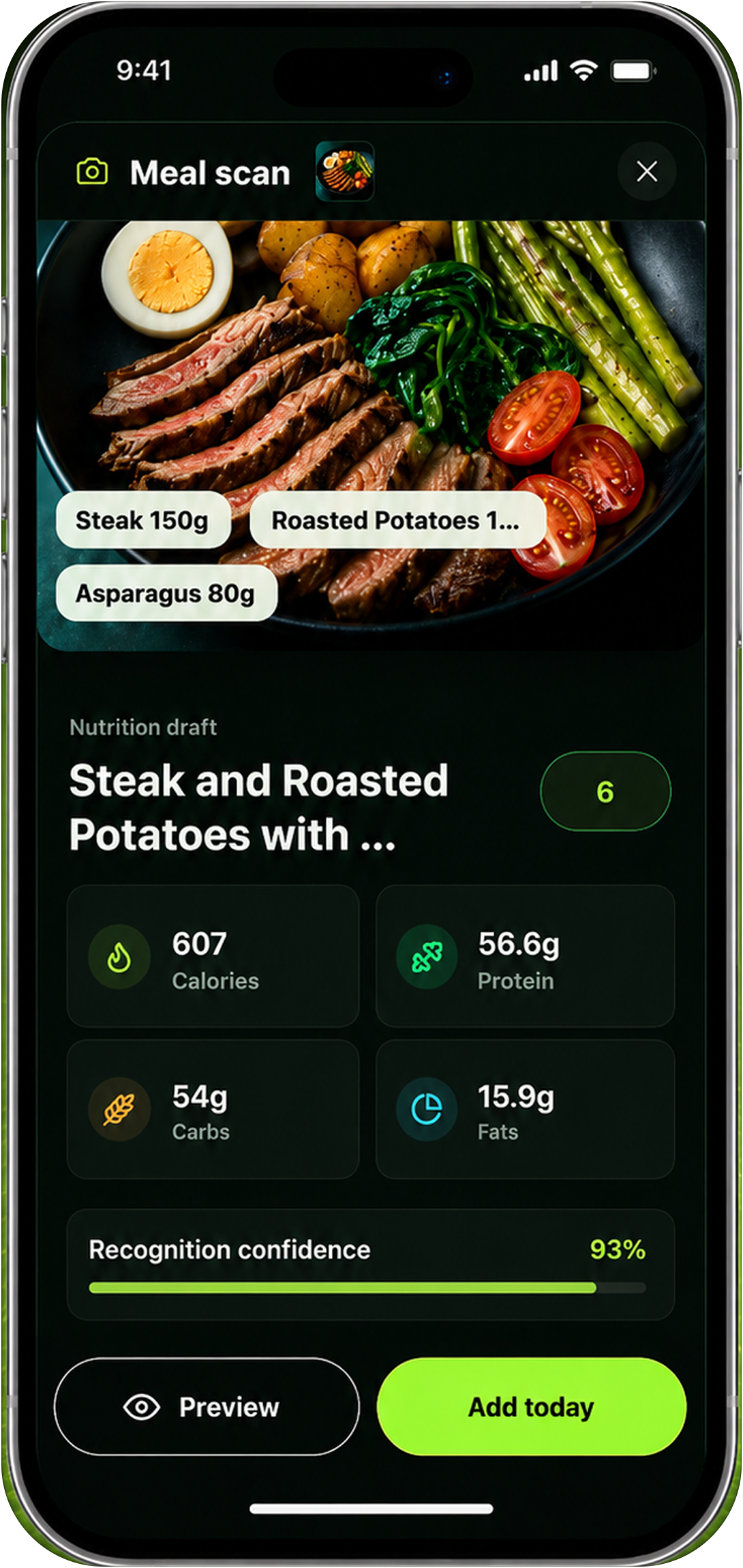
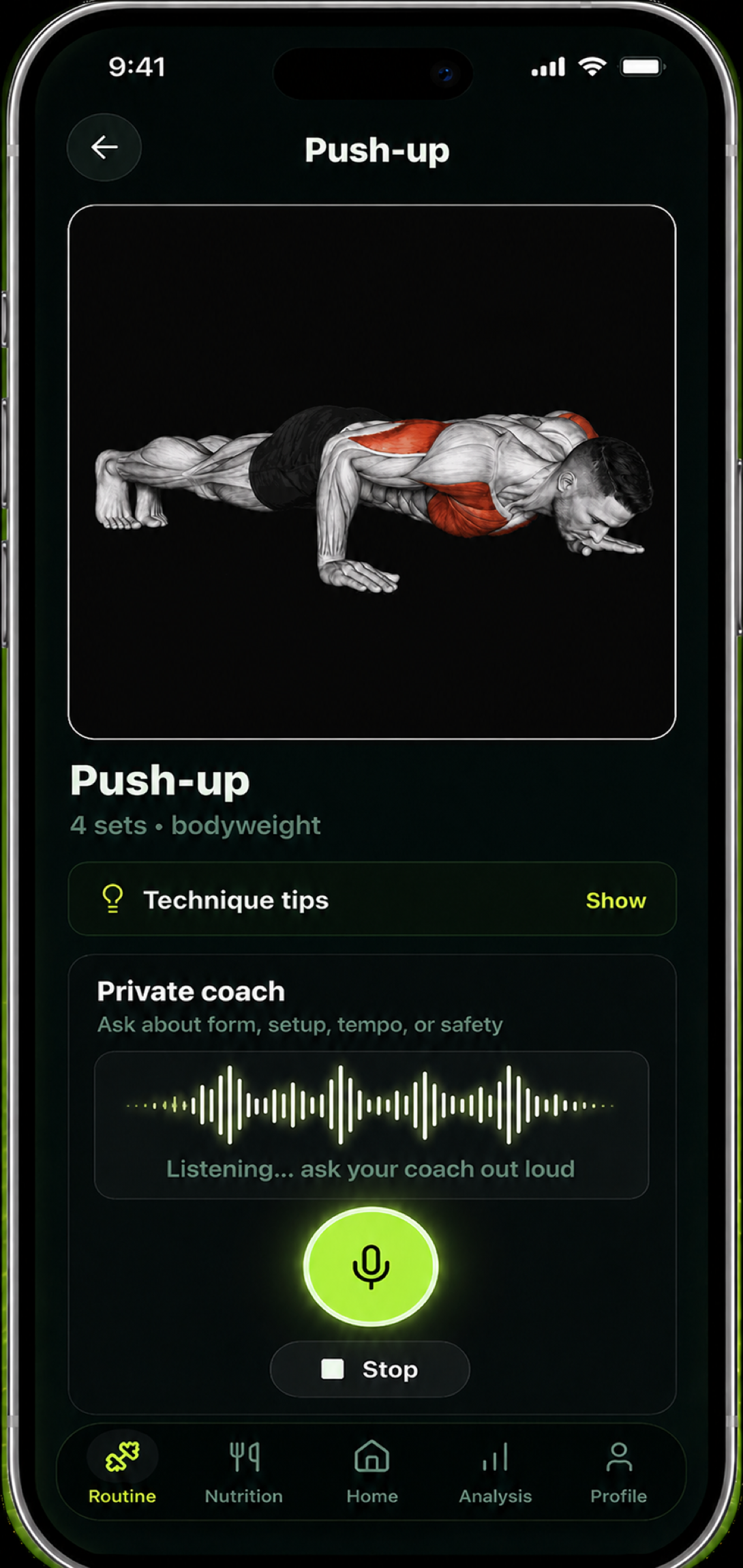
Reset90 can help keep workouts, nutrition targets, weight, measurements, progress photos, and check-ins in one routine. That makes it easier to review the trend and decide what to do next. It does not clinically measure body fat, lean mass, FFMI, or BMI, and it cannot guarantee a specific physique outcome. For a multi-signal review framework, see the body recomposition tracker guide.
09Common mistakes when reading body composition
- Using BMI as a body-fat measurement: BMI uses weight and height only.
- Calling lean mass muscle: water, bone, organs, and connective tissue are part of the estimate.
- Combining unlike methods: a home BIA result, a DEXA result, and an FFMI calculator using a different input should not be treated as one seamless data series.
- Chasing a reference-band midpoint: population tables describe groups; they do not define your best body composition or training decision.
- Using FFMI as a ceiling or identity: FFMI is an index with uncertain inputs, not proof of drug use, talent, health, or future potential.
- Ignoring performance and recovery: a composition number that looks good on paper is not automatically a successful training phase.
10Frequently asked questions
Is BMI useless for lifters?
No. BMI can still provide broad screening context and can be discussed with a healthcare professional. It is simply too limited to describe how much of a trained person’s weight comes from fat, muscle, water, or bone.
Is FFMI better than body-fat percentage?
They answer different questions. Body-fat percentage estimates the fraction of total weight that is fat. FFMI uses estimated fat-free mass and height to create an index. FFMI is more relevant to a height-normalized lean-mass question, while body-fat percentage is more direct for tracking the fat-to-total-weight ratio. Neither is automatically more accurate.
Is lean mass the same as muscle mass?
No. Lean mass includes muscle plus water, bone, organs, connective tissue, and other non-fat components. It can be a useful trend, but a quick change in lean mass is not proof of an equally quick change in muscle tissue.
Which metric matters most during a cut?
Use a combination of weight averages, waist, photos, strength, recovery, and a consistent body-fat method if you have one. The best signal depends on the person and the phase. A single BMI, body-fat, lean-mass, or FFMI reading should not decide whether a cut is working.
Can a high BMI be healthy if I am muscular?
It can be misleading for a muscular individual, but BMI alone cannot prove health or risk. Keep the number in its screening context and consider body composition, waist, performance, health history, and professional guidance together.
How often should lifters calculate FFMI?
Use a cadence that gives the underlying measurements time to change and keeps the conditions consistent. Reviewing every few weeks is generally more informative than recalculating daily, especially when the body-fat estimate comes from a noisy method.
Can body composition metrics prove whether someone is natural?
No. BMI, body-fat percentage, lean mass, and FFMI are not drug tests. Measurement error, genetics, training history, population differences, and calculation methods all affect the numbers.
When should I ask a professional for help?
Seek qualified guidance for unexplained or rapid changes, persistent weakness, symptoms, pregnancy-related questions, medical decisions, or distress around food, weight, or body image. Fitness metrics can show a pattern, but they cannot explain every cause.
11The bottom line
Body composition for lifters is not a contest between BMI, body fat, lean mass, and FFMI. Each metric measures a different slice of the same person. BMI gives broad weight-to-height context. Body-fat percentage estimates the fat ratio. Lean mass captures the non-fat total. FFMI adds height-normalized context to estimated fat-free mass.
Choose the metric that matches the decision, keep the measurement method consistent, and use strength, waist, photos, recovery, and multi-week weight trends to check the story. The best number is not the most flattering or precise-looking one. It is the number you can interpret honestly and use alongside better evidence for your next training decision.
The Reset90 system
Useful ideas for building a body you can keep.
Training notes, product updates, and practical ways to make your next 90 days count.
Start your next 90 days
Get your daily training, nutrition, and check-in priorities in one adaptive system.


Keep reading
Related articles

Ideal Body Measurements for Women
There is no single ideal body measurement set for women. Learn how averages, waist-to-height, body shape and repeatable tracking fit together without chasing a fixed beauty standard.
Read article
Bulk, Cut, or Recomp? A Practical Decision Guide
A practical way to choose a bulk, cut, recomp, or maintenance phase using your goal, training age, recovery, and repeatable progress signals.
Read article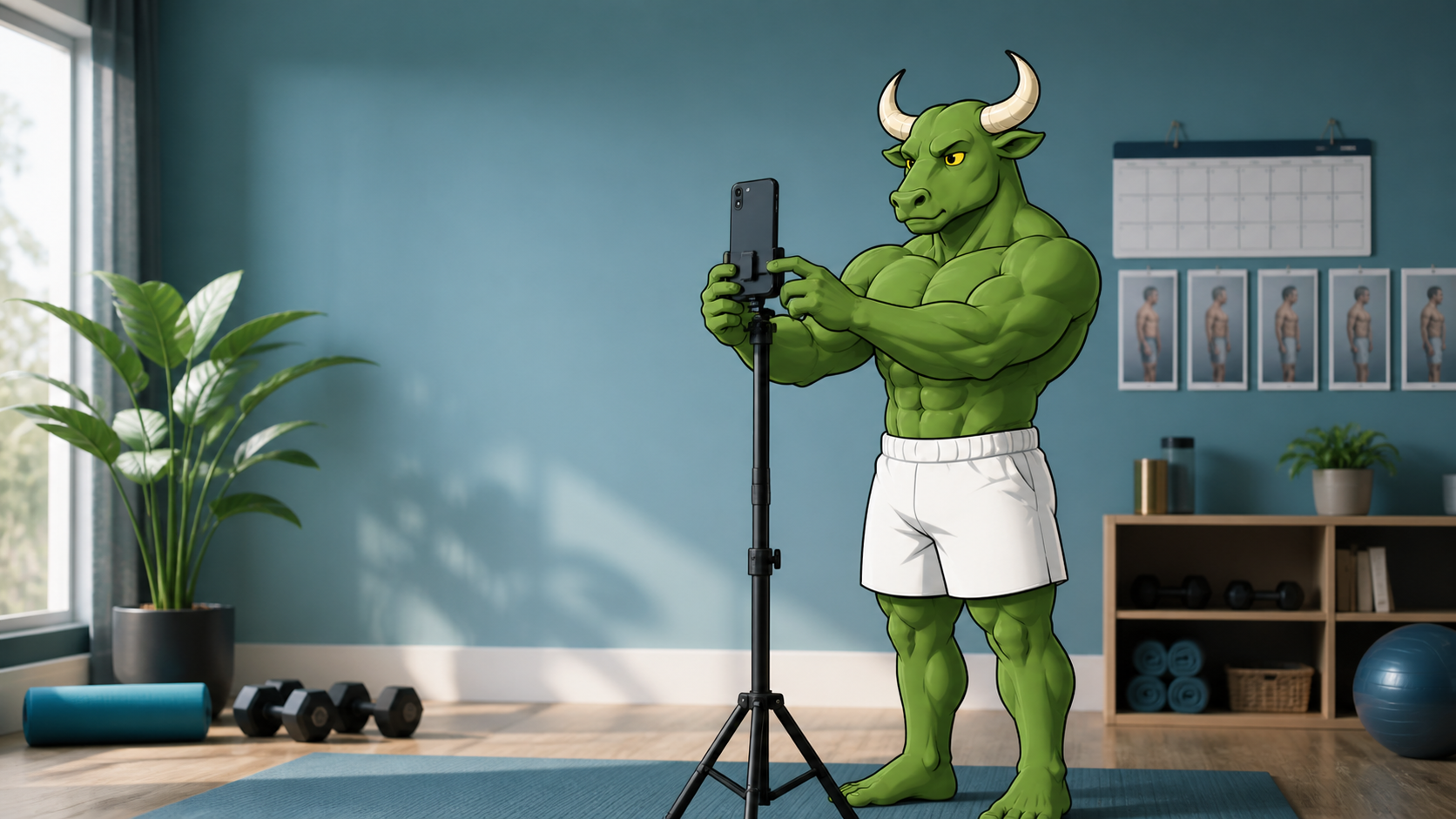
How Often Should You Take Progress Photos?
How often should you take progress photos? Use this goal-based guide to choose weekly, biweekly, or monthly check-ins and make every comparison more consistent.
Read article