
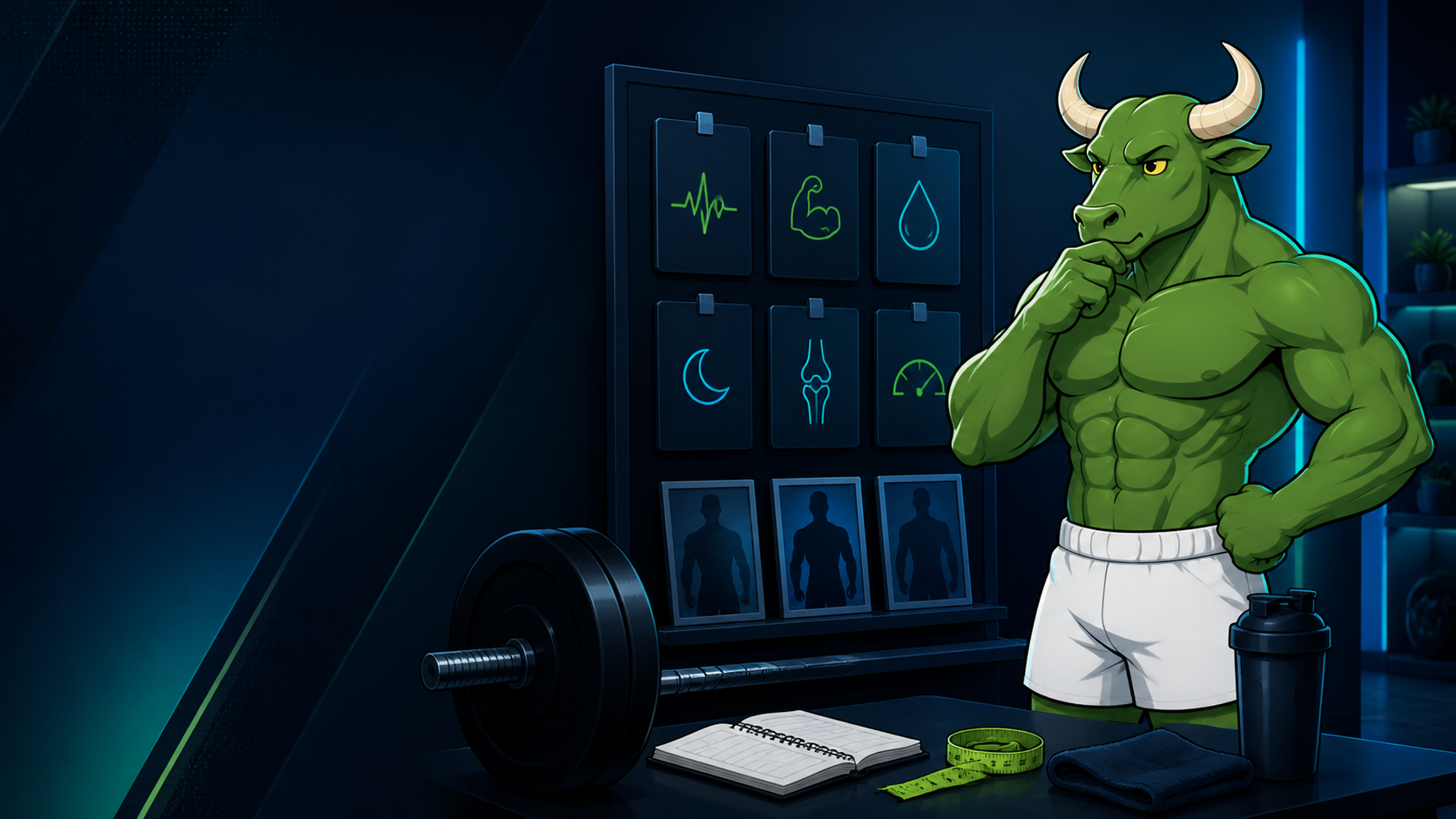
Signs of Muscle Growth: 7 Reliable Signals Before the Mirror Changes
What are the signs of muscle growth? Learn which signals matter before the mirror changes, how to review strength and body-composition trends, and how to avoid mistaking soreness or one good workout for proof.
By Reset90 AI Editorial Team
Short answer: The clearest signs of muscle growth are repeatable strength or rep improvements, better control and work capacity, changes in measurements or clothing fit, comparable progress photos, and a body-weight trend that fits your goal. You may notice performance changes before visible muscle size. Soreness, a temporary pump, or one big personal record can be part of training, but none proves muscle growth by itself. Review several signals over about 28 days before changing your plan.
01Muscle growth often shows up before the mirror
If you are searching for the signs you are building muscle, you are probably waiting for an obvious visual change: fuller shoulders, bigger arms, more definition, or a different outline in the mirror. Those changes matter, but they are often late and noisy signals. Lighting, posture, a training pump, hydration, and body-fat changes can hide or exaggerate them.
The early evidence is usually more practical. You can repeat more quality work. A familiar weight feels easier. Your form is more stable. Clothes fit differently in one area while your waist stays similar. You recover well enough to train again. None of these clues is perfect alone. Together, across several weeks, they can show whether the program is producing a useful adaptation.
Strength training creates several kinds of progress. Early strength can come from coordination and technique, while visible size can be affected by temporary fluid and glycogen. A good tracker keeps those signals separate.
02The most reliable sign: repeatable performance improves
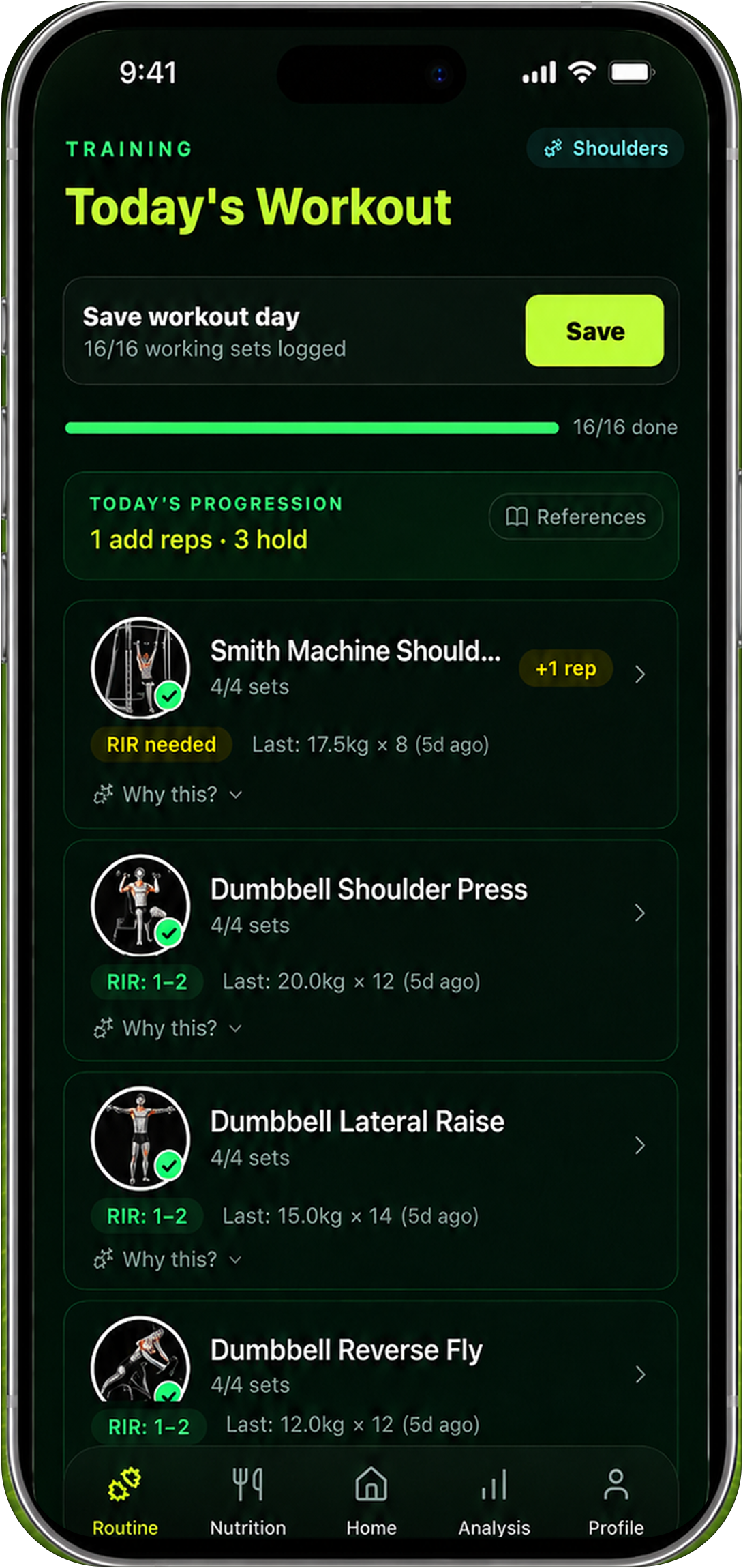
When the same movement becomes stronger over time, that is one of the best accessible signals that your training is working. Progress can look like:
- lifting more weight for a similar number of controlled reps;
- completing more reps with the same weight and similar effort;
- performing the same sets with better range of motion or technique;
- holding a position longer without losing control; or
- doing more high-quality work before your form breaks down.
Use comparable exercises, rest periods, and effort notes when possible. If you switch from a machine to a barbell, change your rep range, or train after very different amounts of sleep, the result may still be useful—but it is not a clean before-and-after comparison.
For a new lifter, some early performance gains are neurological. Your body is learning how to coordinate the movement, brace, and recruit muscle. That is real progress, but it does not let you calculate the exact amount of new muscle tissue. Keep logging the performance trend and give the plan enough repeated sessions for the other signals to catch up.
03Better control is a sign, even when the weight stays the same
Progressive overload is broader than adding plates. A slower eccentric, a cleaner range of motion, a steadier pause, or fewer technique breakdowns can all make a set more productive. If you can use the same load while keeping better control, the exercise may be challenging the target muscles more effectively.
This is especially useful when the scale is not moving or when you are training for body recomposition. A rep record is easy to notice, but the quality of the work is often a better long-term signal than chasing a heavier weight with shortened reps. Record the load, reps, sets, and a simple effort marker such as repetitions in reserve so you can see what actually changed.
04Your workouts and daily tasks may feel easier
As you adapt, a familiar workout may require less concentration and leave you less depleted. Stairs, carrying groceries, lifting a child, or holding a stable posture may also feel easier. These changes can reflect stronger muscles, improved coordination, better conditioning, or improved confidence rather than muscle size alone, so treat them as supporting evidence.
A useful question is not “Did I feel sore?” but “Can I perform the same task with more control or less fatigue than I could several weeks ago?” That gives you a repeatable comparison.
05Clothes and measurements can change before you see obvious size
A shirt may feel tighter around your shoulders or sleeves while the waistband stays the same. Your legs may fit differently. Your waist may slowly decrease while your arms or chest maintain or increase their measurement. These patterns can be informative, but only if you measure consistently.
Use the same tape landmarks, posture, time of day, and amount of tension. Measure weekly or monthly—not repeatedly throughout the day. Digestion and hydration can create more short-term noise than a month of muscle gain.
Our repeatable body-measurement protocol explains how to choose landmarks and reduce avoidable variation. The goal is not to collect the largest possible set of numbers. It is to collect the smallest set you can repeat long enough to see a trend.
06Progress photos reveal slow shape changes
Photos can show changes that the scale misses, especially during recomposition. They are also extremely sensitive to conditions. Take front, side, and back views in similar lighting, clothing, camera distance, and relaxed posture. Avoid comparing a morning baseline with a post-workout photo taken under dramatic lighting.
Look for changes across a sequence, not a single pair. Are your shoulders, arms, back, or legs holding a different shape? Is your waist changing while muscle areas stay full? Does the same relaxed pose look more stable? A monthly timeline usually tells you more than daily mirror checks.
Photos are evidence, not a verdict. Use them at a planned interval and combine them with performance and measurements. Our guide to building a progress-photo timeline covers the capture routine.
07What the scale can—and cannot—tell you
Scale weight is context, not a muscle meter. A slow increase can fit a muscle-gain phase, but it can also include water, glycogen, food volume, and fat. A stable scale can still accompany muscle gain if other signals improve. A falling scale can happen while you maintain or build some muscle, especially when training and nutrition are well managed.
Use a weekly average rather than one weigh-in. Then compare it with waist measurements, photos, and training performance:
| Pattern over several weeks | What it may suggest | What to check next |
|---|---|---|
| Strength up, weight stable, waist stable or down | A favorable body-composition trend is possible. | Keep the plan steady and collect another review block. |
| Strength up, weight slowly up, waist roughly stable | Lean-mass gain may be part of the change, but it is not proven by the scale. | Compare photos, measurements, nutrition consistency, and rate of gain. |
| Weight up quickly, waist up, performance unchanged | The increase may include more fat, water, or food than intended. | Audit intake and context before adding more calories. |
| Weight down quickly, strength falling, recovery worsening | The plan may be too aggressive or under-recovered. | Review energy intake, sleep, training load, and professional support when needed. |
So “the scale is going up” is not automatically a sign of muscle growth. Compare the trend with progress photos and our guide to weight gain after lifting.
08Signs that are not proof of muscle growth
Soreness or DOMS
Delayed soreness can happen after a new movement, a higher training volume, or a long break. It may tell you that the session was unfamiliar or demanding. It does not reliably tell you that a muscle grew. A well-programmed workout can be productive without leaving you unable to sit down the next day.
A temporary pump
A pump is a short-term change in blood flow and fluid in the working muscle. It can make a muscle look fuller for a while, but it is not a measurement of permanent size. Enjoy it if you like it; do not use it as your monthly scorecard.
One personal record
A single PR can be affected by sleep, motivation, technique, leverage, rest time, or the conditions of that workout. It becomes stronger evidence when the performance improvement repeats across several sessions and movements.
09How to tell muscle gain from fat or water gain
No home signal can identify tissue with perfect accuracy. A useful pattern is better performance with stable or favorable measurements, comparable photos, and a weight change that matches your goal. A rising waist alongside rapidly rising weight and no performance improvement deserves a different review than stronger lifts with a stable waist.
Do not label one week as “muscle” or “fat” from a smart scale reading. BIA estimates can move with hydration and other conditions, while photos and tape measurements have their own technique errors. If you need a clinical or highly precise body-composition assessment, speak with an appropriately qualified professional. The app can help organize fitness data; it cannot replace a clinical measurement.
For the broader question of whether a recomp is working, our body-recomposition tracker guide uses strength, waist, photos, and weekly weight averages together. This article is narrower: it focuses on the early signs that training is producing a muscle-building adaptation.
10A simple 28-day muscle-growth review
Instead of asking after every workout whether you are growing, use a four-week review. The purpose is to reduce noise and create a decision you can repeat.
- Set the baseline: record a weekly weight average, selected measurements, standardized photos, and a few anchor exercises with load, reps, and effort.
- Train consistently: keep the exercise selection and progression structure stable enough that comparisons mean something.
- Log context: note sleep, nutrition consistency, unusual stress, illness, soreness, and missed sessions.
- Review at day 28: compare the performance trend first, then measurements, photos, and weight context.
- Change one variable: if the evidence suggests an adjustment, change training volume, calories, protein consistency, or recovery—not everything at once.
Classify the result as “keep going,” “audit the inputs,” or “make one controlled adjustment.” This is more useful than trying to decide whether one mirror check proves the plan is working.
11Make nutrition part of the muscle-growth review
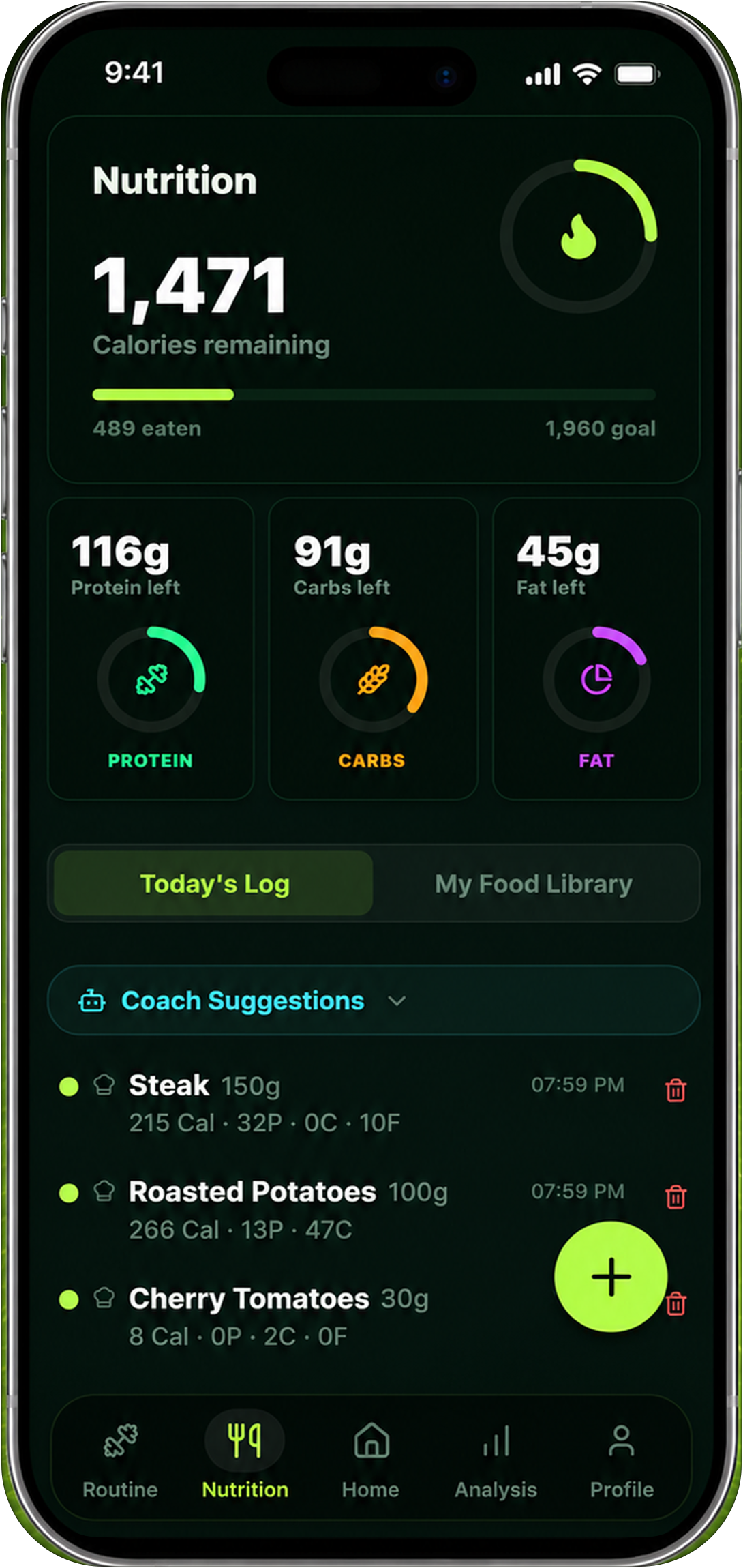
Training provides the stimulus, but nutrition and recovery determine how well you can repeat it. Look at whether you are regularly eating enough total food, getting a consistent protein pattern, and recovering from the work. A perfect daily number is less important than a sustainable weekly pattern.
If your goal is gaining muscle, a modest nutrition target may be appropriate for you. If your goal is recomposition or fat loss, the same training can be paired with a different target. Do not copy a bulk or deficit from someone with a different body, training history, or health context.
Reset90 can keep calorie and macro targets visible alongside workouts, weight trends, and check-ins. That makes the question practical: Did the nutrition pattern support the performance trend I wanted? It does not turn the dashboard into proof of exact muscle gain, and it does not replace guidance from a qualified professional.
For a monthly view of expected rates, read how much muscle you can gain in a month. For a training timeline, see how long it takes to see results from lifting.
12How Reset90 fits into the feedback loop
The hard part is keeping enough consistent records to make the next decision. Reset90 can bring workouts, progression, nutrition targets, weight logging, measurements, photos, and check-ins into one ongoing system.
Use the download buttons on this page to try Reset90, then give the system enough time to collect a meaningful baseline. A tracker becomes more useful as the conditions become more repeatable.
13Frequently asked questions
How quickly do you notice muscle growth?
Strength and coordination can improve within a few weeks. Changes in measurements, clothing, and photos often need several consistent weeks before they are easy to compare. Beginners may notice early changes sooner than experienced lifters, but no timeline is guaranteed.
Are strength gains proof that I am building muscle?
Strength gains are one of the best accessible signals, but they are not proof by themselves. Early gains can come from better technique and nervous-system coordination. Stronger repeated performance combined with favorable measurements, photos, or fit changes gives you a more convincing pattern.
Does being sore mean my muscles are growing?
No. Soreness is a response to training stress and unfamiliar work, not a direct measurement of hypertrophy. You can build strength and muscle without chasing severe soreness, and persistent soreness may interfere with the consistency needed for progress.
Can muscle growth happen if the scale does not move?
Yes. Muscle gain can occur while body weight stays similar, especially when fat loss and lean-mass gain happen together. Use strength, measurements, photos, clothing fit, and weight averages together. A flat scale does not prove progress, but it does not disprove it either.
When should I ask for professional help?
Seek qualified guidance for unexplained rapid weight change, persistent fatigue, significant pain, swelling, symptoms that concern you, pregnancy-related questions, eating-disorder risk, or a medical condition that affects training or nutrition. Fitness tracking is not medical diagnosis.
14The bottom line
The strongest signs of muscle growth are not one dramatic mirror change or one painful workout. They are repeated improvements in performance, better control, useful changes in fit or measurements, comparable photos, and a weight trend that makes sense in context.
Give those signals a 28-day review window. Keep the training and nutrition plan consistent enough to interpret, change one variable at a time, and let the process accumulate. Reset90 can help you keep the evidence connected while you build the next block—but the most trustworthy result still comes from a pattern, not a single number.
The Reset90 system
Useful ideas for building a body you can keep.
Training notes, product updates, and practical ways to make your next 90 days count.
Start your next 90 days
Get your daily training, nutrition, and check-in priorities in one adaptive system.


Keep reading
Related articles

Ideal Body Measurements for Women
There is no single ideal body measurement set for women. Learn how averages, waist-to-height, body shape and repeatable tracking fit together without chasing a fixed beauty standard.
Read article
Bulk, Cut, or Recomp? A Practical Decision Guide
A practical way to choose a bulk, cut, recomp, or maintenance phase using your goal, training age, recovery, and repeatable progress signals.
Read article
How Often Should You Take Progress Photos?
How often should you take progress photos? Use this goal-based guide to choose weekly, biweekly, or monthly check-ins and make every comparison more consistent.
Read article